
Table of Contents
▼
The evolution of digital transformation in Pakistan’s healthcare sector is far-reaching, and it has gone beyond simply keeping patient records and scheduling appointments. An essential aspect to be successfully addressed is regulatory digitization. The adoption of FBR POS in the healthcare sector is now a fundamental aspect of compliance and operational success for hospitals, clinics, pharmacies, and diagnostic centers throughout the country.
Healthcare providers across the country, from a General Hospital in Lahore to a Dental Clinic in Karachi or a specialty clinic in Islamabad, must connect their billing systems to the Federal Board of Revenue for real-time reporting of medical invoices. The following guide provides comprehensive details on how FBR POS integration into the healthcare sector works, who needs it, how invoices are connected and transmitted to FBR, and how partnering with subject-matter experts like Xcentric Services can provide a seamless solution for FBR POS integration.
What is FBR POS Integration for the Healthcare Sector?
Connecting a hospital or clinic billing system to the Federal Board of Revenue’s centralized Point of Sale (POS) system for the automatic and real-time reporting of invoices is referred to as FBR POS integration for the Healthcare Sector.
Many healthcare institutions qualify as Tier-1 Retailers as defined by Pakistan’s tax laws, including:
- Large private hospitals
- Multi-location clinics
- Pharmacy accounts that a hospital owns
- Diagnostic labs with above-average revenue
Once your medical billing software is integrated with the FBR POS, you will receive automatic, real-time reporting of all taxable invoices. Patient invoices are confirmed by the FBR, who then issues an invoice with a unique reference number, which is displayed on the digital receipt the patient receives as proof of their purchase of goods from a registered POS-compliant healthcare provider.
FBR POS integration for healthcare providers allows for all taxable billings to be recorded, verified and stored in real-time.
FBR POS Compliance for Healthcare Pakistan

Meeting the requirements of the FBR POS Regulation is essential for the operation of any compliant healthcare facility in Pakistan. To comply with the regulations, providers must first obtain an NTN Tax Registration through the IRIS website and ensure that their business is correctly registered for the collection and payment of sales taxes.
Compliance Requirements Include:
- Registration for NTN and Sales Taxes
- Approval of the POS System
- Integration with the FBR for API
- Activation of Real-Time Reporting of all transactions
- Monthly Submission of Sales Tax Returns
A Brief Description of the Compliance Requirements:
| Compliance Component | Compliance Description | Insurance |
|---|---|---|
| FBR Registration | Obtaining an NTN/VAT registration | Large retailers/business |
| POS Certification | Tier 1 validated FBR/POS software system | Tier 1 retailers |
| Real-Time Reporting | Daily transmission of the invoice | Hospitals and major clinics |
| Sales Tax Return Filing | Monthly submission of sales data | Registered healthcare providers |
| Digital Receipt Issuance | Monthly required sales tax reports by all registered entities | All compliant facilities |
If you do not meet FBR standards for compliance, you may receive an FBR-POS Related Penalty for Non-Compliance, including fines and possibly the closure of your business.
Proactive implementation will be necessary for any institution in Punjab, Sindh, KPK, or Islamabad seeking to achieve FBR Healthcare Tax Compliance.
FBR E-Invoice for Medical Services
E-invoices for medical services will use the same E-invoice format with the FBR to ensure that all physical invoices are reported electronically.
E-invoicing for medical services will include:
- Unique FBR e-invoice Verification Number
- Tax Category
- Real-time confirmation of reporting
- Automated storage of E-invoice data in the system database
By using E-invoice auto-generation, healthcare facilities will minimize opportunities for human error and eliminate manual tax entries. This will be especially beneficial to facilities with outpatient/inpatient billing, surgical bundle billing, and drug sales.
The increased importance of FBR POS to institutions that bill for both OPD/IPD services, offer surgical packages, or handle pharmacy sales.
FBR POS Receipt Generation Clinic
The shift to FBR POS receipt-generating systems ensures that each printed transaction receives a compliant digital receipt. When a patient enters a clinic, both consultation/treatment receive a bill to be paid. The POS system automatically calculates the sales tax on the service being paid and generates the invoice. At the point of invoice generation, the invoice data is transmitted to the Federal Board of Revenue in `real-time` for validation of billable items, after which they return a unique invoice number. The patient can then receive a printed or electronic copy of the digital receipt.
Below is a comparative analysis of the benefits of using an integrated POS vs. a non-integrated POS to improve billing accuracy:
| Feature | Non-Integrated Clinic | FBR POS Integrated Clinic |
|---|---|---|
| Invoice Validation | Manual | Automated - real-time |
| Audit Trail | Limited | Fully traceable |
| Tax Calculation | Manually entered | Automatically calculated |
| Error Rate | High | Low |
| Compliance Status | At risk | Compliant |
Developments in the Federal Budget Reforms POS require more stringent compliance from the revenue board for medical clinics in Pakistan, as government revenue collection continues to be monitored and increased in volume year to year.
Hospital Billing Software Integrated with FBR
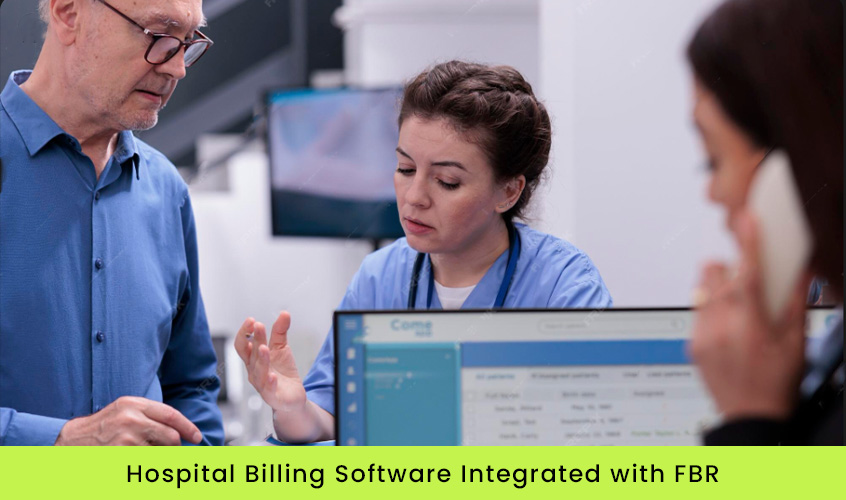
Modern Hospitals require FBR-integrated hospital billing software solutions that support complex workflows across multiple departments.
For example, in a large-scale general hospital, the following departments may have multiple workflows for billing services:
- Outpatient Department Billing (OPD)
- Inpatient Department Ward Billing (IPD)
- Intensive Care Unit Billing (ICU)
- Pharmacy Billing
- Laboratory Services Billing
- Maternity Package
An All-In-One Integrated system must possess the following system attributes:
| System Attributes | Use Cases |
|---|---|
| Multiple Departments Billing | Consolidates pharmacy, laboratory and ward billing |
| Tax Categories | Applies correct tax categories based on the location of service |
| Audit Trail | Tracks invoice changes |
| Multiple User Access | Secure permissions for staff |
| Patient Data Privacy | Protects patient-sensitive medical data |
| Cloud / On-Premise Options | Provides flexibility with hosting solutions |
| Integration Compatibility | Enables integration with existing enterprise resource planning (ERP) systems |
The functionality of the FBR POS system for hospitals provides a significant upgrade to hospital financial management and serves as a compliance tool.
FBR POS for Specialists Clinics
Specialist clinics also need to adopt an FBR POS system for experts, given the multifaceted nature of their billing processes.
Specialist clinics generally merge the following three types of charges:
- Consultation fees
- Procedure fees
- Pharmacy items
- Outpatient diagnostic services
If there is no structured integration of the FBR POS system into the clinic, tax liabilities are at risk of misclassification. Properly implementing the FBR POS system in healthcare organizations will ensure proper categorization of services and the reporting of the appropriate service tax rate on the sales tax return.
How FBR Tracks Healthcare Invoices
Understanding how FBR tracks healthcare invoices will provide insight into managing business risk. FBR tracks healthcare invoices by monitoring:
- Real Time Transaction Flow
- Cancellation Rates
- Tax Rate Discrepancies
- Delinquent Reporting
- Mismatch between the invoice and the sales tax return data
All FBR-transmitted data is stored and identified by the IRIS portal cross-reference system.
| Parameter for Tracking | How the FBR Monitors Invoices |
|---|---|
| Invoice Volume Trends | Sudden drop in revenue |
| Cancellation Rates | Excessive wasted transactions |
| Error in Tax Rate | Incorrect tax rate |
| Reporting Delays | Missing real-time submissions |
The integration of FBR Point of Sale (POS) for the healthcare industry is also crucial to ensure that operations are secure through proper monitoring of systems by the Federal Board of Revenue (FBR).
FBR POS Penalty Healthcare Non-Compliance
The monetary penalty for noncompliance with FBR regulations is no longer viewed as a minor administrative infraction but is considered to have significant adverse effects on the operational and public image of healthcare facilities that do not comply with their required integration processes.
If a hospital or clinic fails to implement the appropriate FBR POS integration for healthcare, the FBR may take various enforcement actions against the facility including, but not limited to, monetary penalties, suspension of their POS System, sending of legal notices to the facility, and/or closing the facility for a temporary period until the facility corrects its FBR POS integration for healthcare. The tiered structure in which many hospitals and clinics in various areas of the country that fall within the Tier-1 Retailer category are subject to well-defined data-driven enforcement processes.
Hospitals and clinics located in major metropolitan cities (Karachi, Lahore, Islamabad, Peshawar, Faisalabad, and Multan) are coming under more scrutiny than in previous periods, particularly for discrepancies in invoice reporting, delays in invoice submission, and errors in sales tax return data. The FBR currently has a real-time monitoring system that cross-checks the billing activity submitted via the IRIS online portal with the monthly filing data submitted by the facilities.
Conversely, implementing FBR POS integration for healthcare will allow facilities to provide current, real-time reporting of all issued invoices, perform structured validations of invoices, and be ready for an audit, thus greatly reducing the risk of FBR enforcement.
FBR POS for Eye Clinics
Eye clinics provide services requiring a high level of precision, and thus, FBR POS for ophthalmology practitioners focuses not only on compliance but also on ensuring the financial aspects of the practice are accurate and complete with regard to the services performed during the visit. Consequently, there are many different aspects of providing service to a patient at an eye clinic that may include: consultation fees, surgical fees, costs associated with use of equipment, costs for lenses implanted into patients, and pharmacy sales, all of which are billed to the patient at the time of a single appointment; if POS is not correctly integrated into the practice’s structure, there is an increased risk that billing errors will occur or an improper tax categorization of an item will occur.
Ophthalmology practices in Pakistan require that a compliant FBR POS for medical clinics provide for:
- Surgical billing modules
- Charges for Use of Equipment and Operating Rooms
- Charges for Medicine sold and Lenses implanted
- Charges for Laser Treatments (Package) sold
Each invoice related to the above will automatically be transmitted to FBR using the Real-Time Invoice Transmission Protocol (or a similar protocol), ensuring that each electronic receipt is validated and securely stored in the clinic’s accounting system, making it available for future auditing.
For growing specialist practices, using structured FBR POS integration systems that incorporate healthcare solutions will protect and preserve the practice’s revenue integrity while maintaining compliance.
FBR POS for Maternity Hospitals or Maternity Units
A maternity hospital or maternity unit also has one of the most complex billing environments in the healthcare ecosystem; from the time a mother sees her physician until she delivers her child and receives care for her newborn, the billing for services provided during that period usually consists of bundled services that often require coordination between many different departments in the hospital.
A maternity facility normally deals with:
- Package billing choices (for adoption planning) for maternity services
- Charges for the patient's room on the inpatient side of the hospital and their associated level of care provided by the outpatient side
- Charges and payments related to the care of newborns are made on either an inpatient or an outpatient basis
- Charges are made for prescriptions filled through the pharmacy
- Charges made for diagnostic lab services
The implementation of multi-department billing within the FBR POS-integrated system for healthcare organizations is key to integrating patient experience and streamlining maternity billing across hospital departments that provide care to women and children.
Once a maternity center is integrated with the FBR, all bundled package prices or items will be recorded accurately by the FBR. This will eliminate any differences between the internal billing records of a maternity center and the sales tax return amounts submitted to the FBR.
If the facility operates in one of the major cities of Pakistan, i.e., Lahore, Karachi or Islamabad, then the FBR POS System will be integrated into the Maternity Module of their respective Hospitals. This will ultimately provide long-term compliance stability.
Connect Clinic Management Software to FBR
To connect clinic management software to FBR, a healthcare provider must follow an organized, technically sound process. The integration of clinic management software to FBR is not just a plug-and-play installation, but rather a regulatory alignment process with system configuration.
This process typically begins with the FBR registration via the IRIS portal. Following the registration process, once their business is determined to be compliant, they are assigned a "Point of Sale" (POS) ID to enable secure API integration within their Medical Billing Software.
When all components of the regulatory process are successfully configured, the clinic can begin sending test invoices to the FBR. Here is a simple overview of the technical process of integration:
| Stage | Process |
|---|---|
| Registration | Enroll in the IRIS portal and receive a POS ID (Used to track transactions) |
| API Set up | Set up your system (Software) to allow secure access to the IRIS system |
| Testing Phase | Send a test invoice to ensure it is properly configured |
| Go Live | Start sending invoices in real time |
Successful integration will allow hospitals to continue their routine day-to-day operations (e.g., OPD/IPD billing) during integration.
Increasing Demand For FBR POS Integration Regionally
The demand for healthcare to implement structured FBR POS integration is rising nationwide, driven by regulatory enforcement and digital monitoring systems, and increasing adoption is being passed along to both private and semi-private healthcare institutions.
FBR POS integration being implemented into healthcare places of business is as follows:
- FBR POS integration for Karachi hospitals
- FBR POS system in Lahore clinics
- FBR POS for Islamabad healthcare
- FBR POS for Peshawar hospitals
- FBR POS for Faisalabad clinics
- FBR POS for hospitals in Multan
- FBR POS for private hospitals in Lahore
As a result of this rapid adoption, there is an increasing demand for dependable, reliable FBR-integrated billing software solutions in Pakistan that can scale with the institution's continued growth.
The healthcare institutions that had manual or partially automated systems in place are now converting to fully integrated systems that provide real-time compliance and automated sales tax return preparation.
Why Xcentric Services Is the Right Integration Partner

Implementing FBR POS integration for healthcare is more than just a technical coding task. Integrating FBR POS Systems into healthcare practice goes beyond just providing technical coding. It is about understanding regulatory requirements, creating secure system architecture, and leveraging in-depth experience and knowledge of healthcare flow processes.
The value provided by the services rendered is:
| Service | Long-Term Relationships with Providers |
|---|---|
| FBR Registration Assistance | Onboarding assistance, documentation fulfillment |
| Custom POS Development | Creation of custom billing systems for clinics and hospitals |
| API Integration | Real-time secure connectivity to FBR |
| Cloud Deployment | Scalability/flexibility of infrastructure |
| Compliance Monitoring | Ongoing reports |
| Data Migration | — |
For healthcare providers seeking trustworthy FBR POS software for physicians or FBR POS systems for large hospitals, Xcentric Services provides a seamless transition to service with long-term compliance.
Conclusion
The regulatory environment relative to healthcare transactions in Pakistan is changing at an unprecedented pace. The integration of FBR with POS in healthcare is no longer merely a legal requirement to be met, but a critical strategic component in the future viability of the healthcare industry.
Whether an FBR POS has been implemented for dental offices or a full-scale POS system for hospitals, FBR POS integration enables healthcare providers to operate with full transparency, automate their processes, and maintain compliance with their business models.
By leveraging the expertise of experienced consultants now, healthcare providers can gain increased operational efficiency, structured financial reports, and reduced risk of compliance fines and penalties. If healthcare providers wait to implement FBR POS integration, they will likely incur penalties for noncompliance and face operational interruptions.
Xcentric Services provides secure, scalable, and compliant FBR-integrated POS solutions for the healthcare sector.
Frequently Asked Questions (FAQs)
Q. Is it mandatory for all hospitals to integrate FBR POS systems?
- All hospitals are not required to integrate; however, hospitals classified as Tier-1 Retailers or that exceed set revenue thresholds must implement FBR POS systems to remain compliant.
Q. Can small clinics implement FBR POS systems for healthcare in Pakistan?
- Yes, there are solutions available that can be scalable to a small or medium-sized clinic. Even a one-physician practice can implement compliant FBR POS systems without incurring excessive infrastructure costs.
Q. How long does integration take?
- On average, the integration period ranges from two to four weeks, depending on factors such as system complexity, the number of outpatient department systems, and the readiness of existing medical billing systems.
Q. Is patient data privacy affected by the integration of systems?
- No. Systems that are properly configured have stringent protocols in place to protect patient privacy by using encryption to send data, enabling controlled access for multiple users, and maintaining a comprehensive audit trail.
Q. What happens if transaction invoices are not reported using real-time reporting?
- If an organization fails to report a transaction in real time, it may receive compliance alerts and will be subject to greater scrutiny, which could lead to fines. Consistent use of FBR POS in the healthcare sector helps eliminate these issues.
Q. Can I upgrade my existing medical billing software to have FBR POS integrated?
- For the vast majority of users, yes, their existing system can be enhanced and modified to provide the healthcare industry with full FBR POS-integrated capabilities, such as automatic invoice generation and real-time invoice validation

Share



Want To Increase Your Ranking On The Search Engines?
Get In Touch With Us!
Trending Blogs
Digital Marketing...
Xcentric Team
6 MONTHS AGO


What To Read Next?

For owners and managers of dental clinics in Lahore, here is a critical fact you...
Xcentric Team
6 MONTHS AGO

The Middle East e-commerce industry is rapidly growing due to increased digital acceptance, mobile-first consumers...
Xcentric Team
7 MONTHS AGO

These days, the e-commerce industry is growing at an exponential rate. With the rise of...
Xcentric Team
7 MONTHS AGO