
Table of Contents
▼
Standard pricing for fleet management software is between $20 and $60 per vehicle per month for many US client deployments. Software-only fleet systems are cheaper, and higher-end telematics systems are more expensive. The total cost is heavily influenced by hardware, installation, connectivity, compliance, integrations, implementation, and support. A better question to ask is, how much does it cost to run fleet management software over the course of five years?
This analysis comes courtesy of a custom software team that built fleet and logistics technology for US operators. The numbers on the build side reflect the cost of development. It is not what a vendor would charge.
When the TCO of SaaS becomes a factor, the fragmentation of modules or limitations of integration are worth considering. After five years, it's time to schedule a software development consultation with Xcentric Services.
How Much Does Fleet Management Software Cost?
Fleet management software cost is determined by how much a fleet is willing to spend to manage what they need and how much the vendor charges. Pricing generally falls into one of the following models: per vehicle, per asset, per user, per flat rate, annual subscription, or enterprise quote.
Telematics systems currently on the market tend to cluster in the $20 to $60 per vehicle per month range. Many Geotab systems fall into the same category as many fleet management systems. A broader survey by Tech.co cites a range of $15 to $50. Pricing for Motive systems hovers in the $35 per vehicle per month range. These pricing references reflect the market. Prices quoted by vendors are likely to change.
Managing a fleet with just software has the potential of being much less expensive. Currently, Fleetio’s plans start with an estimated price of $4 a month for each vehicle when billed yearly. Fleetio’s higher price tiers are estimated to be $7 and $10. Fleetio’s pricing indicates that its software pricing encompasses vehicles and assets, and it demonstrates that asset management software pricing should not be directly compared to complete telematics solution pricing.
For a potential buyer, the critical software pricing distinction is telematics pricing versus complete fleet technology pricing.
Monthly Pricing for Per-Vehicle and Per-Asset
Per-vehicle pricing is straightforward:
Monthly Pricing = Number of Vehicles x Price per Vehicle
For Example:
Fleet Size | $20/vehicle/month | $35/vehicle/month | $60/vehicle/month |
10 | $200 | $350 | $600 |
50 | $1,000 | $1,750 | $3,000 |
100 | $2,000 | $3,500 | $6,000 |
500 | $10,000 | $17,500 | $30,000 |
At the price point of $35/vehicle/month, the cost for a fleet of 10 vehicles would be $350/month. A fleet of 500 vehicles would be charged $17,500/month, prior to volume discounts, telematics hardware, software implementation, and added software modules.
This pricing model clearly indicates the importance of fleet size in pricing for a recurring expense.
Per-asset pricing, on the other hand, is structured differently. Non-powered assets, like trailers and heavy equipment or tools, may be charged separately from powered vehicles. Fleetio, for instance, clearly differentiates between vehicles, equipment, trailers, and tools in its asset management framework.
Flat-rate and Enterprise Pricing For Fleet Management Software Cost
Enterprise fleet management software may have no pricing available at all.
Vendors or resellers will consider:
Fleet size
Asset type
Number of locations
Required modules
Hardware
Integrations
Implementation
Support tier
Contract length
Annual versus monthly billing
Volume discount tiers
Reseller or dealer pricing
Enterprise pricing can be appealing for larger fleets, but buyers should be encouraged to ask for enough information to evaluate competing offerings.
The general type of pricing seen in the U.K. is similar, but costs will be impacted by hardware, taxes, regulations, compliance, reseller arrangements, currency, etc. The costs seen in this article are in USD for alignment.
Software Cost vs Total Fleet Technology Cost
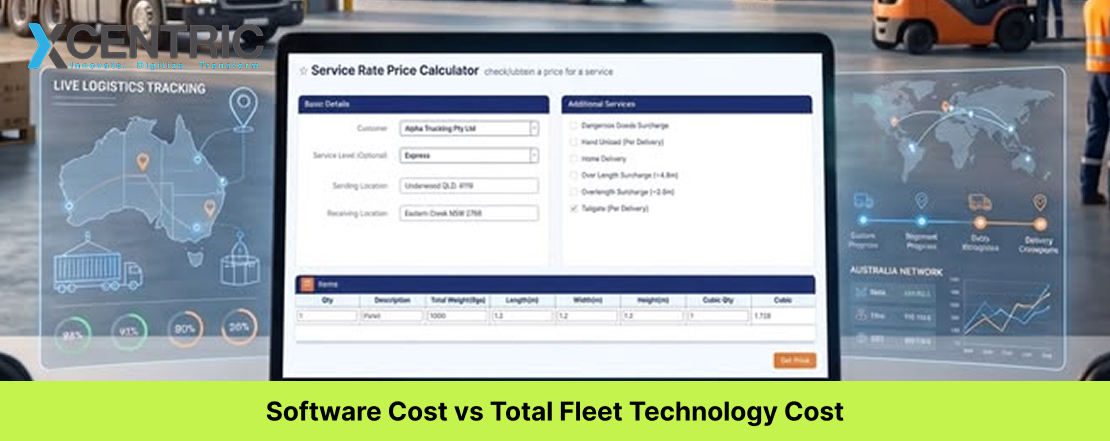
A subscription is just one part of the cost of fleet management software.
Cost Component | Typical Pricing Basis | Potential Impact |
Software | Per vehicle, asset, seat or enterprise | Recurring expenditure |
Hardware | Per device | Initial capital expenditure |
Installation | Per vehicle/project | First-year cost |
Connectivitiy | Per device/month | Recurring expenditure |
Modules | Add-on or higher tier | Recurring expenditure |
Integrations | Included or custom | One-time or recurring |
Implementation | Project fee | Initial cost |
Training | Included or paid | Initial cost |
Data migration | Project scope | Initial cost |
Support | Included or tiered | Recurring cost |
Exit | Termination/migration | Future switching cost |
The equation for the total cost is:
Total fleet software cost = Subscription + Hardware + Installation + Connectivity + Add-on modules + Integrations + Implementation + Support
That is the number procurement teams should evaluate.
What Affects Pricing of Fleet Management Software?
Fleet management software pricing is primarily driven by how operational, technical, and commercial factors intersect. Fleet size impacts subscription pricing. The tier of the software is determined by the functions needed. Features, hardware, and connectivity impact the cost for deployment. Integrations may bring additional development costs and/or professional services costs.
Fleet Size, Vehicle Count, and Subscription Costs
Fleet size is typically one of the most impactful recurring cost variables.
If a subscription costs $35 per vehicle per month, the base subscription for a 10-vehicle fleet is $4,200. In comparison, a 500 vehicle fleet costs $210,000 for the same subscription.
Enterprise pricing likely adjusts to include volume discounts. However, the base relationship remains. When forecasting for five years, always account for the growth of the fleet.
Feature Pricing and Modular Pricing
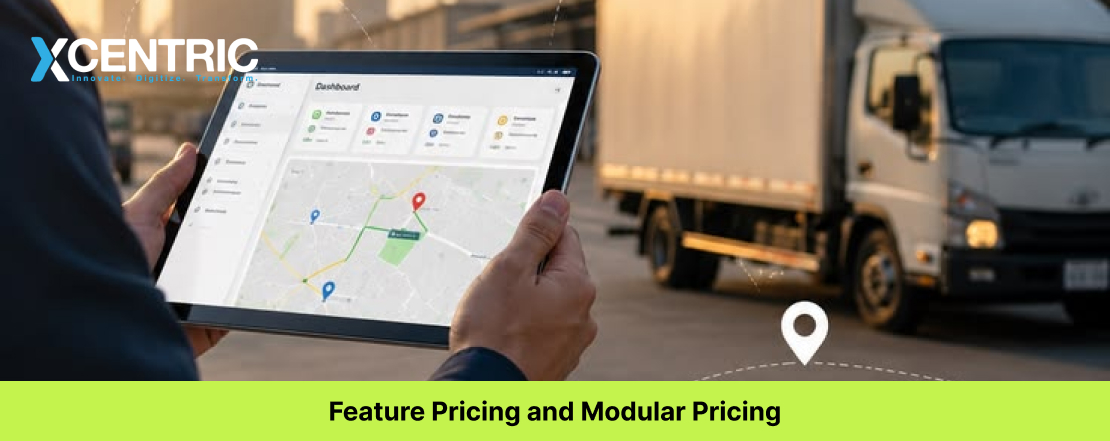
Pricing can be impacted by feature levels. Organizations that need basic GPS tracking may not need the same tracking software as those that need:
Dispatch
Route and schedule optimization
Work order and fuel stops
Driver scoring and delivery proof
Compliance reporting
AI dashcam
Predictive maintenance and advanced analytics
Modularity of features impacts pricing the most. A company may have low initial subscription pricing, but at an expense if most of the needed functionality is delivered through paid add-ons.
Route Optimization Efficiency
When considering the ROI on specialized route optimization modules, the issue of operational drag must be addressed. One important kind of operational drag is the following:
1. Manual Route Planning Drag: Upper's study shows that a manual route-planning process can consume about two to three hours for dispatching purposes on a daily basis.
2. Broken Productivity: If routes are unoptimized, their productivity may be lower by 20-30%, which results in an increase in fuel consumption, excess driver hours, and a decrease in the number of stops performed on a daily basis.
The implementation of dynamic route optimization may help to cover this lost time for operations.
Telematics Hardware and Add-Ons
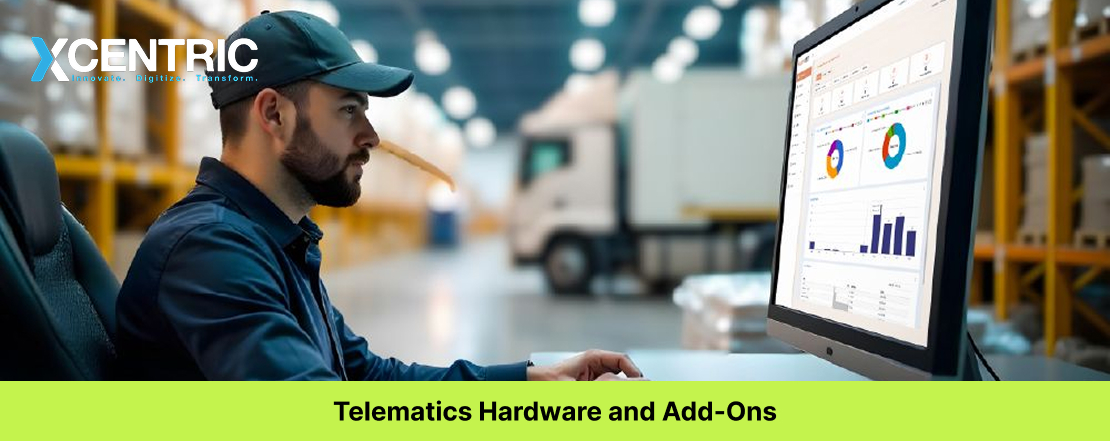
Telematics hardware enables data to be collected from a vehicle and sent to a fleet management platform.
Pricing for telematics hardware may be low for basic GPS or OBD devices. However, the pricing for advanced devices, camera equipment, sensors, and specialized equipment may be higher for the first year. Geotab provides guidance for estimating basic telematics unit costs at ~$100/vehicle with advanced configurations at costs of several hundred dollars depending on the deployment.
Connectivity generates ongoing costs because connected devices create an infrastructure for communication.
Integrations and APIs
Integrations enable fleet management software interoperability with the rest of the business technology stack. often built through custom API integrations.
Integration requirements commonly include:
ERP systems
CRM systems
Transportation Management Systems
Warehouse management systems
Accounting systems
Fuel card systems
Order management systems
Payroll systems
Third-party telematics
Customer portals
APIs enable the two systems to exchange information, and an SDK provides tools to extend the platform.
Geotab provides an SDK and API, but its custom add-ins and integrations provide the benefit of a custom operational interface without the need for a business to construct the telematics infrastructure.
Compliance Requirements
Regulatory compliance is another major cost driver for U.S. trucking operations. The ELD regulations by the Federal Motor Carrier Safety Administration govern the electronic logging of the Hours of Service, the Records of Duty Status, the retention of records, and the associated compliance processes.
In addition, a fleet may need:
ELD
HOS
RODS
DVIR
IFTA
DOT compliance workflows
These requirements typically necessitate an upgrade for the fleet to a higher software tier. Compliance requires data integrity, reporting, workflows for drivers, audit trails, and record retention, driving the increase to higher software levels.
Deployment, Implementation, and Support
Implementation costs typically include:
Configuration
Data migration
User setup
Authentication
Workflow setup
Hardware installation
Testing of the integrations
Training of drivers and administrators
Setup of reporting
Support needs also vary by the size of the fleet. An enterprise operation may need dedicated support and assistance with integrations, while a small fleet may be able to rely on standard support.
The Hidden Costs Vendors Do Not Put on the Pricing Page
When including taxes and fees, ad-quoted subscriptions can be accurate without including all the costs. The costs most customers forget about are hardware, installation, add-on modules, implementation, training, data migration, and costs to cancel the contract.
Hardware, Installation, Upfitting
While a GPS may be $100 and a five-year subscription may be $500, hardware costs can be substantial for hundreds of vehicles.
A fleet should ask for line-item pricing for
Device purchase
Installation
Connectivity
Replacement
Warranty
Removal and installation for disposal
Upfitting
Reinstallation during fleet expansion
As Upfitting can lead to additional costs, vehicles may also need additional equipment such as cameras, sensors, mounts, and temperature monitoring.
Add-On Modules and Module Fragmentation
Fragmentation of modules is most often the hidden cost.
A fleet may purchase:
GPS > maintenance > fuel > dispatch > compliance > cameras > analytics
Each of these modules can also have an increased monthly fee. The purchase strategy should instead be to quote the price for the complete configuration to avoid add-on modules.
Implementation, Training, and Data Migration of Fleet Management Software Cost
For established fleets, the most important cost is implementation. Training and data migration also have internal costs. Each of the fleet's staff and drivers needs to be trained on the system.
Contract, Cancellation, and Exit Costs
The length of the contract can also have an important impact on the cost. Make sure to understand the following before signing any agreement:
These, in addition to the cost implication of servicing a segment, are likely the best starting options for each of the defined segments:
Fleet segment | Primary cost concern | Likely best starting option |
Under 25 vehicles | Avoiding unnecessary software | SaaS |
25 to 200 vehicles | Subscription versus functionality | SaaS or custom layer |
200 to 1,000 vehicles | Recurring TCO and integrations | SaaS or platform + custom |
Enterprise | Ownership, integrations and TCO | SaaS, custom layer, or selective custom |
At $35 per vehicle per month, 10 vehicles cost $350 without the infrastructure and support for the software. $50,000 custom software would take 12 years to equal the cost of the monthly subscriptions for the custom software.
Fleet Management Software for Owner-Operators and Fleets Under 25 Vehicles
Custom development for software means long-haul commitments for small fleets. For this segment, the cost of SaaS is most likely best.
Fleets of 25 to 200 Vehicles
In this case, multiple options may be the best starting options depending on requirements. Deliveries and proof of delivery require different software. Compliance also requires software. Asset management can also require software depending on the type of assets.
Analyzing this particular layer on top of existing telematics technology can be beneficial in several ways.
Enterprise and Multi-Location Fleets
When fleets operate on an enterprise level, the recurring costs from telematics technology can reach hundreds of thousands of dollars each year.
This analysis should include:
Volume discounts
Several locations
Multiple asset classes
API access
Data ownership
Costs of modules
Integrations
Support
Compliance
Exit from contracts
Internal administration
At this stage, a total cost of ownership (TCO) model for five years is more useful than simple, monthly costs.
What Fleet Software Saves: The Other Side of the Equation
A cost-only analysis is incomplete, as fleet management technology has the potential to decrease costs on the operating side as well.
Telematics data can be used to better analyze factors like fuel use, vehicle and driver downtime, use of the vehicle, idling, and maintenance.
Geotab cites fleets using telematics having the potential to save 10% to 15% on fuel and maintenance costs in Year One. This should be treated as a potential scenario, as it is from a vendor.
Fuel Costs and Idling
Savings on fuel costs are highly dependent on the baseline for the fleet.
For example:
Annual fuel spend | 5% saving | 10% saving | 15% saving |
$100,000 | $5,000 | $10,000 | $15,000 |
$250,000 | $12,500 | $25,000 | $37,500 |
$500,000 | $25,000 | $50,000 | $75,000 |
$1,000,000 | $50,000 | $100,000 | $150,000 |
This is an illustration, not a forecast. Actual savings will depend on driving behavior, routes, fuel and fleet costs, and fluctuations in daily operations.
Insurance Premiums and Usage-Based Insurance
Discounts from insurance can potentially cover the costs of the technology, but the range of discounts is very broad.
Numbers published in various sources cite potential discounts of 5% to 15% and, in some cases, discounts of 5% to 30% are reported. Insurance should therefore be modeled using the actual insurer of the fleet and their eligibility requirements.
Insurance that is based on usage can include telematics data to help an insurer assess the risk that a driver and vehicle may impose. Participation and discounts are the terms of the insurer.
Downtime and Maintenance
Predictive maintenance systems can help avoid downtime for a fleet with the use of work orders and tracking of vehicle mileage.
The anticipated financial gain includes:
Avoiding delivery failures
Avoiding costly repairs
Keeping vehicles ready for use
Less downtime
Less administration
Better vehicle repairs
Fewer vehicles used to replace other vehicles
The cost of the downtime that is anticipated should be compared to the actual cost of the downtime. A savings percentage should not be the reference.
Realistic Payback Periods
The equation for what the cost should be is:
Net TCO = Total cost - (Fuel savings + Insurance reduction + Downtime avoided + Admin labor saved)
This is the equation that should be used for all evaluations of whether to use a SaaS product or build a solution.
The Four Ways to Get Fleet Software
There are four realistic ways to obtain fleet software.
Approach | Initial cost | Recurring cost | Technical responsibility | Ownership |
SaaS | Low | Yes | Low | Vendor |
Open source/self-hosted | Low to moderate | No license fee | High | High |
Platform + custom layer | Moderate | Yes | Moderate | Shared |
Fully custom | High | High | No traditional license | Very High |
SaaS Subscription
In most cases, SaaS models are the best financial choice for normal fleet operations.
The vendor bears the cost of:
Development of the application
Creation of the cloud
Security of the system
Upgrades to the system
Development of mobile applications
Management of the database
Integration with other products
Support of the product
The fleet pays for the convenience through a recurring operating cost.
Open Source and Self-Hosted
Open source can decrease licensing costs, but it increases the burden on the operator.
Fleetbase is an example of an open-source logistics platform that is licensed under AGPL-3.0. If you are considering self-hosting, you must review their terms of license, especially if you are planning on making proprietary modifications.
Self-hosting a service means you will have to deal with, among other things, the infrastructure, security, backups, deployment, monitoring, maintenance, and a host of other technical requirements.
Building on Top of an Open Telematics Platform
The more balanced approach is an often overlooked option.
Instead of starting from scratch with a GPS tracking and telematics infrastructure, a telematics platform can be utilized and a custom operational layer built on top of it.
In this layer, the organization can have:
Custom web dashboard
Dispatch workflows
Admin portal
Custom reports
Customer portal
Driver app
ERP
Workflows
Business rules
This provides the organization complete ownership of the workflows, without having to build every single telematics infrastructure capability.
Fully Custom Development
Fully custom development means that every aspect of the application is built around the exact workflows of the organization.
This can include:
Web dashboard
Mobile application
Admin portal
User roles
Authentication
Database design
Real-time vehicle data
Notification systems
Analytics
APIs
SDK integrations
Webhooks
Telematics integration
Cloud infrastructure
The goal is phased development, rather than the daunting goal of feature complete development for a mature SaaS.
What is the Cost of Custom Fleet Management Software?
When looking at third parties and what they estimate, there is a lot of variation. Volpis has stated that custom fleet management software can be in the range of $10,000 to $150,000+, while ScienceSoft takes a more conservative approach, stating that an MVP will take 2 to 3 months while a complete application will take 6 to 8 months.
These are market references and not estimates provided by Xcentric. The actual cost of custom fleet management software boils down to what is being built.
How Much Does Custom Fleet Management Software Cost?
Cost Driver | Effect on Cost |
Discovery | Establishes project specifications and outlines |
UI/UX | Effectively the number and complexity of screens |
Web Application Frontend | Includes design and implementation of the client side |
Mobile Application | Includes the design and implementation of the client side on iOS and Android |
Backend | Defines the complexity of logic |
Database | Includes the design and implementation of storage |
Telematics | Includes the design and implementation of logic for the devices and the data |
APIs | Includes the design and implementation of logic for the third party |
Cloud | Requires infrastructure and DevOps |
QA | Adds testing and release effort |
Maintenance | Includes the effort for ongoing service |
MVP vs. Full Fleet Management Platform
MVPs fill the highest-value gaps. An MVP could be:
Record storage for vehicles and assets
Authentication for users
Web UI
Mobile driver app
Basic telematics with GPS
Dispatch
In-app notifications
Reports
Telemetry
Later versions can add Compliance, Analytics, Fuel Management, Proof of Delivery, and other telematics and service integrations.
This method helps avoid the costly mistake of overbuilding for a feature set that ultimately goes unused.
Integrations, Telematics, and IoT
Making telematics and IoT work in a system can be a challenge.
The system has to deal with:
Real time location and events for vehicles
Miles driven and diagnostics
Driver information
Sensor data
Alerts and the status of devices
The situation can get more complicated when you include more than one telematics vendor. Each vendor can have different data formats, how they authenticate, their APIs, rate limits, and event structures.
Infrastructure, Maintenance, and In-House Staffing
Custom development goes beyond the launch. These are some of the anticipated costs associated with a custom software solution over the next five years:
Cloud hosting
Database management
Monitoring
Security
Quality assurance (QA)
API modifications
Mobile operating system (OS) changes
Bug fixes
New integrations
Feature additions
Engineering support
This is one of the reasons custom software should not be internally marketed as having “no monthly software cost.” While the monthly subscription may eventually go away, there are still ongoing costs for ownership.
SaaS vs Custom: The Five-Year Cost Assessment
For five-year SaaS TCO, the equation used is:
Five-year SaaS TCO = Initial costs + (Monthly subscription costs × 60) + Other costs
For custom software, the equation follows:
Five-year custom TCO = Discovery + Development + Infrastructure + Integrations + Maintenance + Support + In-house staffing
Considering the following example:
Five-year cost | SaaS | Platform + custom layer | Fully custom |
Initial setup | $10,000 | $35,000 | $75,000 |
Software/platform | $210,000 | $120,000 | $0 |
Hardware/connectivity | $40,000 | $40,000 | $40,000 |
Integrations | $15,000 | $50,000 | $75,000 |
Infrastructure | Included | $20,000 | $45,000 |
Maintenance/support | $25,000 | $65,000 | $100,000 |
Five-year TCO | $300,000 | $330,000 | $335,000 |
These are illustrative examples and not quotes from Xcentric or other vendors. The objective was to show the cost of a custom solution, not what the SaaS solution would cost.
However, it is worth noting that conventional TCO estimates change when scaling up the solution. Stfalcon research suggests that moving from the SaaS solution to a custom software solution can reduce total software costs by 40-60% over 5 years of implementation, as the compound per-user/per-vehicle subscription can be avoided.
When a fleet has unique business requirements, the platform+custom layer solution becomes favorable to avoid building the telematics infrastructure from scratch. Fully custom development is justifiable when the fleet software is critical to the business and the custom development will provide the business with a competitive advantage.
The consideration when developing fleet software should focus on the cost of developing software versus the potential costs incurred from ownership, not the UI frustrations with your current vendor.
When Subscription Costs Exceed Expectations
A fleet of 500 vehicles at $35 per vehicle per month incurs a cost of $210,000 annually ($1.05 million over five years) before normal subscription costs are calculated.
At that scale, alternatives are certainly worth exploring. However, the comparison must take into consideration the development cost and maintenance, the cost of infrastructure and equipment, the integrations, the staff, and the opportunity cost.
When to Use Custom Workflows? When are Custom Workflows Warranted?
Custom development is most cost-effective when the process is truly unique to a business. These can be special rules for dispatch, unique logistics workflows, intricate customer processes or a platform that will be a commercial software product.
The more the business differentiates itself from its competitors, the more worth is in owning it.
SaaS should be recommended when:
Requirements are standard
The fleet is small
Deployment must be speedy.
The following are existing integrations for the requirements:
It is difficult to find skilled human resources in the area to carry out the work
The organization does not have to be the owner of the application
Subscription pricing is not too high to qualify for operating savings
The "fence it" approach to building software is not always enough.
How to Choose Between Buying and Building
A well-designed and organized decision-making process can minimize the chances of relying on emotion in the decision-making process.
Question | If "yes" | Likely direction |
Are requirements standard? | Existing platforms cover them | SaaS |
Is the fleet small? | Limited subscription exposure | SaaS |
Are workflows proprietary? | Differentiation is important | Custom layer/custom |
Are integrations unusual? | Existing products struggle | Custom layer |
Is telematics infrastructure already available? | APIs/SDKs available | Custom layer |
Is software itself a product? | Software creates | Custom |
The first thing to do is not "build everything" when considering a custom platform.
It helps to ensure that the initial scope of development is defined by measurable business needs.
Conclusion
The final cost of fleet management software is a TCO (Total Cost of Ownership) decision. Subscription is just the start. This figure is the sum of hardware, connectivity, installation, modules, integrations, implementation, training, support, compliance and contract terms.
There are four choices of paths:
SaaS subscription
A software that is open-source or self-hosted.
Open telematics platform used to create a custom layer.
Fully custom development
For most small fleets and businesses that have traditional workflows, SaaS will continue to be the logical choice.
If your company has a substantial subscription budget and a unique workflow, it may be worth considering the platform-plus-custom combination. In some businesses, it's the software that provides the competitive value; therefore, it could be economically viable to invest in full custom development.
Xcentric Services can help with that discovery-to-development journey in custom full-stack development, Web dashboards, mobile apps,, APIs and third-party integrations, backend architecture, and cloud infrastructure. The goal is to define the system based on usage requirements first, and only if it is not a viable MVP or custom layer, consider whether it is cost-effective to use a larger platform.
Frequently Asked Questions
Q. Is fleet management software transactional based on per vehicle or per user?
There are two types of pricing models, but per-vehicle or per-asset pricing is more common in fleet pricing, given that connected vehicles produce the data that's being managed. There may be different per-user fees, or enterprise platforms may use custom pricing. Purchasing agents should make sure whether drivers, administrators, dispatchers and managers are billed separately or not.
What goes into fleet management software pricing?
That is dependent on the vendor and plan. GPS tracking, Asset management, Maintenance, Reporting, User access, Support and selected Integrations can be part of the pricing. Additional can include hardware, installation, connectivity, advanced modules, implementation, training, data migration, and premium support. Before comparing proposals, ask for a breakdown of the total cost of ownership (TCO) for the first year and over the five years of the contract
Does the subscription come with GPS tracking and hardware?
Sometimes. Some vendors include hardware in the subscription, while others are offering hardware to purchase or lease separately. Cameras, sensors, OBD devices or other equipment may be necessary for advanced telematics deployments. Include installation and replacement in the budget as hardware can add up in a large fleet.
Do you have to sign a long term contract with fleet management software?
Not always. Some vendors offer monthly plans or trials, and enterprise telematics deployments can be done on an annual or multi-year contract basis. Before signing, check minimum term requirements, early termination fees, ownership of hardware, renewal costs, data exporting and migration requirements.
Any free or open source fleet management software?
Yes. Fleetbase and Traccar are examples of open-source fleet or tracking technology. But open source does not mean that ownership costs are dispensed with. However, other resources are needed for hosting, security, customization, maintenance, integration, monitoring, backups, and technical support. The modified software should also be reviewed for AGPL licensing
How much does it cost to build custom fleet management software?
There are many differing published estimates. Volpis has claimed any custom fleet management software costs around $10,000 to $150,000 or more. A more targeted MVP will be significantly less expensive than the entire platform that includes telematics integrations, mobile apps, dispatch, maintenance, compliance, analytics, and enterprise integrations. The actual development cost will vary according to scope
Is custom fleet management software less expensive than SaaS?
Not automatically. When the requirements are standard, SaaS is often the better option since it shares the costs of developing and maintaining the software with all customers. Custom software becomes even more appealing when there is enough value to be gained in the long run, so much so that it makes sense to invest in its development and maintenance, such as when there is a cost of ownership of subscriptions or module fragmentation, integrations, or proprietary workflows.
What is the timeframe for creating a customized fleet management solution?
An MVP can be built in a couple of months, a larger scale platform can take significantly longer. ScienceSoft has set around 2-3 months for MVP and 6-8 months for a full application. The exact timeline will vary due to integrations, mobile applications, compliance, telematics, analytics, QA and scope.
Does custom fleet software fit in with the current telematics equipment?
Yes, when the telematics provider makes the appropriate APIs, SDKs, data feeds or webhooks available. It can help cut down on development scope since vehicle connectivity and device infrastructure do not need to be re-created with a custom layer on top of an existing telematics platform. Some of the factors that need to be considered for integration planning include authentication, data structures, rate limits, historical data, device identification, and API availability.
What's the payback on fleet management software?
Payback is based on measurable savings. The complete technology investment should be compared against fuel cost, idle time, maintenance and downtime cost, administrative labor, insurance and compliance cost. A fleet must have its own financial base line and not rely on a vendor quote of a savings percentage. Payback period may vary significantly from one fleet to another.
Share



Want To Increase Your Ranking On The Search Engines?
Get In Touch With Us!
Trending Blogs
Digital Marketing...
Xcentric Team
7 MONTHS AGO

What To Read Next?

For owners and managers of dental clinics in Lahore, here is a critical fact you...
Xcentric Team
7 MONTHS AGO

The Middle East e-commerce industry is rapidly growing due to increased digital acceptance, mobile-first consumers...
Xcentric Team
8 MONTHS AGO

These days, the e-commerce industry is growing at an exponential rate. With the rise of...
Xcentric Team
8 MONTHS AGO