Table of Contents
▼
Today, mobile app development comes with the repetitive challenge of choosing between Flutter and React Native. The answer to that question isn't as easy as some developer comparison articles make it out to be. Both React Native and Flutter can create production mobile apps. The real challenges happen when planning a strategy on timelines, budgets, hiring, and the future of your product.
When looking at Flutter vs React Native, the conversation has shifted dramatically over the last 5 years. By 2026, this conversation will include both of these frameworks as fully capable of the same modern mobile features, and able to build mobile apps with the same level of speed and cost efficiency.
When making the decision to go with one of these frameworks, your main concern should be the impact on your business. We will examine all of the consequences, business and otherwise, associated with the use of one of these frameworks and why Xcentric Services is the ideal business partner for Flutter or React Native frameworks.
Why This Decision Matters More Than Most Businesses Realize
A framework of choice is a decision most founders consider a technical choice. In reality, it has a far-reaching impact on a number of factors, including product delivery and hiring, and the cost of maintenance and growth.
The choice you make regarding frameworks today may affect how quickly you get your MVP to market, how conveniently you can recruit developers in the future, the financial burden the app will place on your business over time, and the level of frustration this will all create for you. While Flutter and React Native are both highly regarded and correct app-building tools, they create unique operational challenges for your business.
We have witnessed clients select a framework based entirely on the framework that they saw endorsed on some website, and then realize later how difficult and costly it would be to bring on developers for that framework, scale the product, or manage the app.
That is why selecting a technology should be a part of the overall strategy for building a product.
Framework selection is one of the first strategies we talk about with our clients at Xcentric Services. We do not recommend a tech stack until we understand in detail the business and user expectations, and the areas of flexibility in the budget and the timeline. The intent is not to push clients toward one framework over another, but to help clients invest in a framework that gives the best long-term ROI.
What is Cross-Platform App Development?

Advancements in cross-platform mobile app development allow for a single mobile app to be deployed on both iOS and Android from a single code base. It was traditionally a requirement to have both a mobile and a web development team to be able to develop for both Google and Apple Services. This adds to the costs, time to development, and the burden of ongoing support.
Cross-platform frameworks let developers write code once and deploy it to multiple platforms. It results in reusable code and less development effort and services. Estimates tend to indicate that 30% - 60% savings are achievable vs maintaining separate development projects for each platform. Actual savings are likely to be more or less based on project size and requirements.
Native vs Cross-Platform Development
Factor | Native Development | Cross-Platform Development |
Codebase | Separate for iOS and Android | Single codebase |
Development Cost | Higher | Lower |
Maintenance Cost | Higher | Lower |
Launch Speed | Slower | Faster |
Team Size | Larger | Smaller |
Code Reuse | Limited | High |
Taking all of these factors into account, it is no wonder that many SMEs and Startups prefer cross-platform development.
Flutter and React Native: What They Are
Flutter
Flutter is a help from Google for developers in making applications for multiple platforms. It is an open-source UI framework developed by Google for building applications that are mobile and web-based.
Flutter uses Dart. Each UI element is painted directly on the Canvas. For businesses with strict branding requirements, Flutter allows for visually consistent designs. Statista's cross-platform framework survey indicates that Flutter has around a 46% market share.
React Native
Meta supports the use of a cross-platform development framework known as React Native. It incorporates JavaScript, typically in conjunction with TypeScript, and utilizes native system components to generate user interface layouts. JavaScript is among the most popular programming languages globally, and, as a result, React Native has a large community with a significant number of developers.
Based on Statista, React Native holds an estimated 35% of the cross-platform framework market, positioning it as one of the most developed mobile solutions in the market.
Comparing Flutter and React Native: Main Distinctions
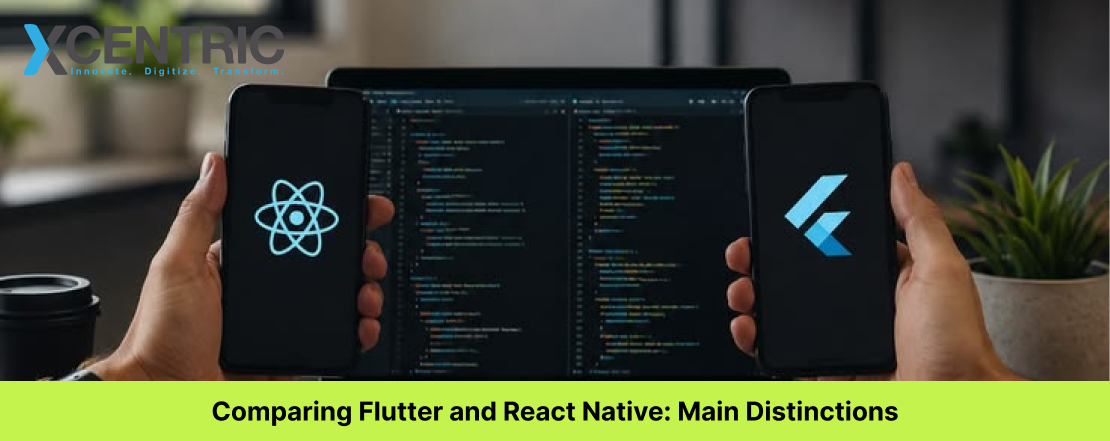
The major differences between Flutter and React Native Differences Between Flutter and React Native are as the following:
Programming Language | Dart | JavaScript / TypeScript |
Rendering of UIs | Own rendering engine | Uses Components |
Code Reuse | 95-100% | 80-95% |
Ease of Learning | Moderate | Easier for JS teams |
Developer Pool | Smaller talent pool | Larger talent pool |
From a business standpoint, prioritizing costs, maintenance, and the scalability and flexibility of different frameworks and the available workforce is more beneficial than assessing the minor technical distinctions.
Flutter and React Native Performance
Historically, performance has been one of the main advantages of Flutter. With the introduction of Impeller, a modern rendering engine offered by Google, the drawbacks of stuttering and lagging animations have been largely overcome. With the previous rendering approach of Flutter and Skia, there were more of these limitations.
This makes Flutter a great option for applications that need custom UIs, detailed graphics, and rich animations.
With the introduction of React Native's New Architecture (which consists of Fabric, JSI (JavaScript Interface), and TurboModules), this framework has eliminated most of the communication bottlenecks that exist between the realm of JavaScript and native code of the mobile platform.
The gap in performance has been mostly mitigated.
Performance Comparison
Factor | Flutter | React Native |
Animation Performance | Excellent | Very Good |
Startup Speed | Excellent | Very Good |
UI Consistency | Excellent | Good |
Native Platform | Good | Excellent |
Graphics-Heavy Apps | Strong | Good |
Business Apps | Excellent | Excellent |
When it comes to fintech solutions, media services, near-gaming apps, and custom user-centric apps, Flutter is usually slightly better.
For apps like marketplaces, booking and scheduling systems, SaaS, client portals, and content-based apps, there really is no meaningful difference.
In the end, there won't be any significant app performance difference (most app users aren't even able to notice) between a well-built app using Flutter and a well-built app using React Native.
Cost Comparison: Flutter vs React Native
The difference in frameworks comes down to costs for most companies. When comparing costs for Flutter and React Native vs Native, there are cost savings since only one app needs to be built and maintained.
The difference in cost for Flutter and React Native tends to come down to short-term costs for app development vs long-term costs for app maintenance.
Flutter App Development Cost
In the short-term, Flutter app development costs can be more expensive since it can be harder to find Dart developers compared to JavaScript developers.
In the long-term, Flutter's approach to unified rendering often means there are fewer platform-specific issues that require testing and that lead to app maintenance.
Savings can be significant for organizations that are focusing on long-term costs.
React Native App Development Cost
In the short-term, it can be more cost-effective to pursue a React Native app since there are a greater number of developers in the React Native ecosystem.
By utilizing a wider array of JavaScript talent, recruitment will become easier, and hourly development costs may decrease.
For companies using React in their web apps, development may be faster due to their team already being on board.
Estimated Mobile App Development Costs

The following estimations are meant to provide a rough idea of costs and are based on pricing by US agencies.
Project Type | Cost Range |
Basic MVP | $25,000 - $75,000 |
Advanced MVP | $75,000 - $150,000 |
Consumer App | $100,000 - $500,000 + |
Enterprise Platform | $250,000 - $1,000,000 + |
Costs will vary based on required features and integrations, compliance, backend development, and the expected user base.
Total Cost of Ownership Matters More Than Initial Cost
It is natural to focus on the cost to launch the application, especially for startups with a limited budget. However, the costs of application development do not stop with the launch. Mobile apps need ongoing development for maintenance and features, OS updates, security, testing, and optimization. The cost of support must also be considered.
TCO, or Total Cost of Ownership, becomes an important business metric in this case. What may appear to be a cheaper, long-term solution may actually be a more expensive initial investment.
The actual cost of a digital product must also consider the support costs, and we encourage our clients to consider both development and support costs when making their framework decision.
Developer Availability: A Real Business Risk
One of the biggest blind spots in framework analysis is hiring. The product's lifecycle enters a new phase after the mobile app is launched. You will have added costs for hiring and app maintenance, as well as paths for future scaling.
React Native provides advantages in many of these situations. According to the available developer ecosystems, React Native is based on JavaScript and TypeScript, giving it a wider development community. Dart is the language that Flutter is based on. Dart is more specialized.
Development costs and the availability of a programming workforce for Flutter will be a greater concern for the long-term maintenance and scaling of a Flutter app, compared to a React Native app.
Hiring Considerations
Factor | Flutter | React Native |
Language Used | Dart | Javascript |
Talent Pool Size | Small | Large |
Hiring Speed | Same Day | Faster |
Maintenance Staffing | More Challenging | Easier |
Existing React Team Reuse | No | Yes |
Limited workforce availability can be a major risk for startups and small-to-medium enterprises (SMEs) that rely on existing frameworks to build their solutions.
The Hidden Cost of Choosing the Wrong Framework

There is a hidden cost for choosing an inappropriately fitting framework. The misconception that an app's framework can be easily changed deters from seeing the real danger in changing frameworks, which is the cost. Framework changes will set businesses back by an estimated $50,000 to $250,000 or even more.
Adding costs will include extensive quality assessment (QA) testing, interface rebuilding, integration rewriting, and training employees.
Migration Risks
Challenge | Business Impact |
UI Rebuilds | Expenses increase |
Integration Rework | Launch is postponed |
Additional Testing | QA budgets increase |
Team Retraining | Loss of productivity |
Feature Freeze | Decrease in product updates |
Framework selection should be treated as a strategic business decision rather than a technical decision made to benefit a single project.
Investing a few weeks to assess appropriate technology has the potential to save a lot of money and avoid many months of wasted effort.
Which Framework Will Best Fit Your Business?
The answer to this question will depend on your business objectives. When visual consistency and high-quality UI animations are a priority, or when the organization is looking to support web and desktop in addition to mobile, Flutter is often the better solution. Organizations in industries such as digital banking and healthcare are often able to leverage Flutter to be more competitive due to its highly flexible UI and code.
When animating a high-fidelity interface is not as critical, and especially when time to market is more important, React Native is often the better solution. Organizations are often able to develop and staff React Native applications faster, and the initial development costs are typically lower. This is especially the case for startups that are focused on developing MVPs and web apps with less complex consumer-facing applications.
If you are still confronted with the question ‘Flutter or React Native?’, here are some propositions to consider:
Will you need to develop for other platforms besides mobile in the future?
Will Frequent developer hires be required after launch?
Is long-term maintenance more important than rapid delivery?
Do you already have expertise in React or JavaScript?
Does the visual consistency of the product offer a competitive advantage?
The answers to the above propositions will often guide you to the correct decision.
For businesses unsure of the decision framework, consulting a development partner before the decision may be beneficial in avoiding costly errors. At Xcentric Services, we assist clients in determining framework selections before development, ensuring the technical decisions during development align with the business goals.
Which Framework Is Right for Your Business?
An additional reason businesses may comfortably select either framework is the scalability of each.
Major organizations, including Google Pay, BMW, and Alibaba, run Flutter-based applications. Facebook, Instagram, and Shopify are based on React Native. Millions of users across the globe access the services provided by each of these organizations.
The success of each of these frameworks proves there is no reliability concern with either framework for large-scale, commercial applications.
While more recent frameworks, for example, Kotlin Multiplatform, have been developed, the most popular frameworks remain React Native and Flutter.
Why Businesses Partner With Xcentric Services Before Making a Framework Decision
The selection of a framework is one of the decisions businesses treat as a technical decision. Whichever framework is selected will affect the cost and ease of hiring, scalability and maintenance, the timelines of product delivery, and the return on the investment.
At Xcentric Services, we assess the impact of the decision on the business before the product development commences. We only recommend a framework after understanding the goals of your business and your target customers, as well as growth and compliance within your budget.
This consulting helps make useful investments that are less risky and unnecessary, and that can also help avoid complexity. When developing a startup MVP or a cross-platform solution for large enterprises, the framework selection for MVPs, for example, can have a substantial impact on the time and resources saved.
Conclusion
Having experienced guidance makes selecting the right mobile framework easier. At Xcentric Services, we prepare startups, SMEs, and growing enterprises for technology decisions by providing a detailed evaluation of their product vision, business goals, and growth potential while considering compliance and budget constraints.
As a Flutter app development company, we create customized digital solutions, while our react native app development services target faster time to market. We offer development frameworks that address your mobile app priorities.
Our extensive Flutter app development services and react native development services encompass every phase of your product from idea to support. We prepare startups to understand development factors, including costs and timelines, while clarifying risks and opportunities for growth, thus enabling consideration of less funding to start.
Do you need help building a mobile app? Get in touch with Xcentric Services so we can discuss options, design suggestions and a build framework, all customized to complement your business targets.
Frequently Asked Questions (FAQs) About Flutter vs React Native
How do Flutter and react native compare?
Flutter features the Dart programming language and has its own rendering engine, while React Native is a JavaScript framework that uses the platform's native components. For consistency of appearance, Flutter wins. For a bigger developer community and easy recruitment, React Native wins.
Is Flutter or React Native more cost-effective?
React Native has the edge in initial cost due to the abundance of JavaScript developers. On the other hand, the architecture of Flutter results in fewer platform alignment issues, which drives the long-term maintenance cost to be lower. The more cost-effective framework is determined by the time and ownership parameters.
What are the advantages of Flutter compared to React Native?
The control of the user interface and consistency of appearance are better in Flutter, while the speed of development and control of the developer pool are favored by React Native. This is more of a business need comparison.
What is the estimated lead time for a mobile app developed in Flutter or React Native?
Despite other factors, the MVP development time for both frameworks is typically 2 to 4 months, and 6 to 12 months for production apps.
Is it true that apps developed in Flutter and React Native are cross-platform?
Correct. Both frameworks enable the creation of a single codebase that is compatible with both the App Store and Google Play.
What companies use Flutter and React Native?
Flutter is used by Google Pay, BMW, and Alibaba. Companies that use React Native are Facebook, Instagram, and Shopify.
What is React Native's new architecture?
React Native’s New Architecture involves Fabric, JSI, and TurboModules. It enhances the framework's performance and responsiveness and addresses many shortcomings of previous versions.
Should a startup choose Flutter or React Native?
Startups often go with React Native because of the availability of developers who can build the app quickly. If extensive control over the UI and animations is required or if there are plans to expand to other platforms, consider using Flutter.
Share



Want To Increase Your Ranking On The Search Engines?
Get In Touch With Us!
Trending Blogs
Digital Marketing...
Xcentric Team
6 MONTHS AGO


What To Read Next?

For owners and managers of dental clinics in Lahore, here is a critical fact you...
Xcentric Team
6 MONTHS AGO

The Middle East e-commerce industry is rapidly growing due to increased digital acceptance, mobile-first consumers...
Xcentric Team
7 MONTHS AGO

These days, the e-commerce industry is growing at an exponential rate. With the rise of...
Xcentric Team
7 MONTHS AGO