
Table of Contents
▼Custom Healthcare Software Development for Secure, HIPAA-Compliant Patient Platforms
- May 15, 2026

It is a legal and financial liability to create patient platforms without meeting HIPAA compliance. This guide delves into the concept of custom healthcare software development, the associated expenses, and what you can expect from a compliant US development partner.
The healthcare industry in the USA is under pressure to modernize patient care and comply with federal privacy laws. Whether it's hospitals, clinics, health systems or digital health startups, they are making quick investments in secure patient platforms, telemedicine systems, interoperability infrastructure, workflow automation tools and more that can safely process Protected Health Information (PHI). Healthcare organizations are investing heavily in digital transformation because many generic platforms lack the operational and compliance characteristics required in the healthcare sector.
This is the main reason for the increasing traction of custom healthcare software development for US healthcare organizations. Rather than fitting their clinical workflows into a third-party system, providers can, with development partners like Xcentric Services, establish secure healthcare platforms designed from the ground up to fit their clinical workflows, meet interoperability requirements, and comply with HIPAA security measures in advance.
What are Custom Healthcare Software Development Services, and Why are they Important?
Custom healthcare software development involves creating and developing a digital healthcare system tailored to specific healthcare uses such as clinical operations, patient engagement, medical workflows, billing systems, medical interoperability, and regulatory compliance.
Healthcare software is unlike typical enterprise software because it is required to securely process PHI and conform to HIPAA, HITECH, and healthcare data exchange protocols like HL7 and FHIR. A healthcare platform is more than just another business application. It runs within a highly regulated environment where security architecture, auditability and interoperability is crucial.
Healthcare systems need to securely integrate with EHR or EMR software such as Epic, Cerner, Allscripts, and athenahealth. These integrations can give providers access to patient information, laboratory results, prescriptions, imaging and treatment history, all in real time, without losing valuable information as it moves from system to system.
The right healthcare platform with the right development company, such as Xcentric, also has technical features like those like AES-256 encryption of data at rest, TLS 1.3 encryption of data in transit, Multi-Factor Authentication (MFA), Role-Based Access Control (RBAC), secure API infrastructure, and thorough Audit Logs that record all access and changes to PHI.
The security and interoperability that this requires are what differentiate healthcare software from regular SaaS apps.
Custom Healthcare Software vs Off-the-Shelf Solutions
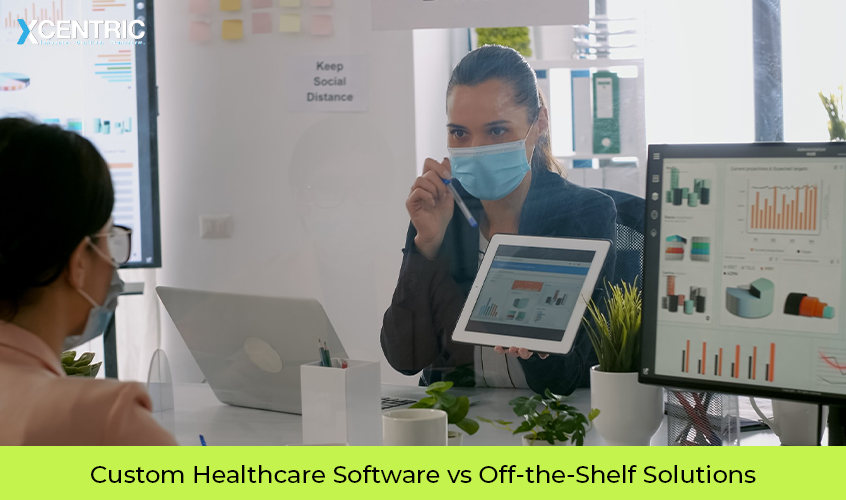
Initially, the use of off-the-shelf software seems quicker and cheaper, so many healthcare providers start off that way. But generic platforms often impose limitations on operations after organizations start to scale patient services, adopt EHRs, or deal with more patients with greater amounts of PHI.
Off-the-Shelf Healthcare Software
Healthcare workflows are seldom accounted for in off-the-shelf software. Expensive workarounds or third-party integrations are often needed to manage patient appointments, billing, onboarding, physician documentation, care coordination, and interoperability. Security is also a significant issue.
For healthcare environments, generic software may not have HIPAA-compliant infrastructure controls, RBAC policies, MFA enforcement, or audit trail capabilities. Post-deployment compliance retrofits can be more costly than building a secure architecture.
Custom Healthcare Platforms
The Custom Healthcare Platforms offer a comprehensive solution for healthcare organizations seeking to standardize their workflows and reduce complexity. They provide a complete suite of healthcare-specific workflows, EHR integration, and healthcare-grade security controls, making them perfect for organizations looking to streamline their workflows and minimize complexity.
For healthcare organizations that are interested in the long-term digital transformation, they receive significant advantages from healthcare software solutions created with specific operational and compliance requirements.
Types of Custom Healthcare Software Applications
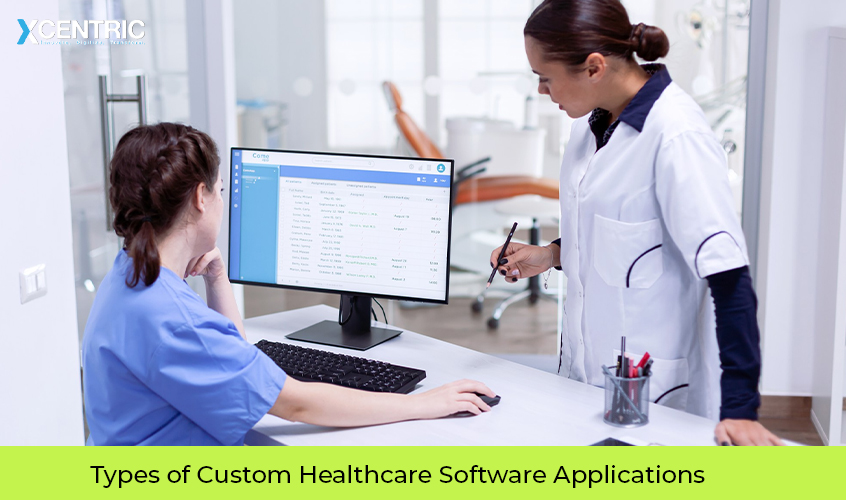
Proprietary systems that have limited API access or customization, scalability, or interoperability also pose a vendor lock-in challenge for healthcare organizations.
Below is a comparison of the differences between the operations:
EHR and EMR Systems
Electronic Medical Record (EMR) systems are designed for managing patient information within a specific medical practice, while Electronic Health Record (EHR) systems are aimed at facilitating interoperability between different health care providers and organizations. These platforms collect patient information, prescriptions, treatment plans, diagnostics, and physicians' documentation, and facilitate secure data sharing using the HL7 and FHIR standards.
Patient Portals
Patient portals enable patients to book appointments, view records, check on lab results, request prescription refills, and securely interact with providers. These platforms should also have robust authentication features, encrypted communication systems, and secure handling of PHI data to ensure HIPAA compliance.
Telemedicine Platforms
Telemedicine systems facilitate virtual visits, remote service provision, secure messaging, e-prescribing, and provider-to-patient video. Telehealth infrastructure is a growing component of an organization's healthcare operations to enhance access and streamline workflow.
Remote Patient Monitoring Platforms
Remote Patient Monitoring (RPM) apps are designed to interface with IoMT devices used to gather patient health metrics from outside of a clinical setting. Such systems also carry valuable data such as glucose levels, blood pressure, oxygen saturation, and cardiac activity, requiring secure transmission and encryption.
Healthcare CRM Systems
Healthcare CRM systems enable healthcare providers to handle patient communication, care coordination, appointment reminders, outreach initiatives, and retention efforts. Healthcare CRMs need to handle PHI in a secure way with tight privacy as a top priority, unlike conventional CRM solutions.
Practice Management Software
Practice management software automates administrative tasks like patient registration, insurance verification, scheduling, billing and reporting. These systems can also minimize inefficiencies in operations and enhance front office coordination.
Medical Billing and Revenue Cycle Management.
Revenue Cycle Management (RCM) systems manage payer communication, ICD-10 coding, claims processing, reimbursement, denial management and payment tracking. Billing platforms have to handle financial information and PHI, so they must have a broad degree of security and audit safeguards.
Clinical Decision Support Systems
Clinical Decision Support (CDS) tools support clinical treatment, diagnostics and clinical risk decisions. AI-powered workflows are becoming a fundamental part of advanced systems for delivering efficient care and enhancing patient outcomes. There may be some diagnostic applications classified as FDA SaMD (Software as a Medical Device).
Care Coordination Platforms
Physician-specialist, physician-nurse, and physician-administrative collaboration is facilitated by care coordination software, as is collaboration among physicians, specialists, nurses, administrators, and referral networks. These systems enhance communication, patient transfers, and collaborative treatment decisions within healthcare settings.
Health Information Exchange Platforms
Health Information Exchange (HIE) systems allow the sharing of patient information between providers, insurers, pharmacies, labs, and healthcare networks in a secure way. FHIR and HL7 interoperability standards are crucial for HIE infrastructure to ensure accurate and compliant data exchange.
Custom Healthcare Software Development: HIPAA Compliance
Healthcare software engineering involves a number of factors, among the most important of which is compliance with HIPAA. HIPAA applies to any platform that generates, stores, sends or receives PHI within the U.S.
The HIPAA Security Rule mandates that all HIPAA-compliant healthcare software have administrative, technical, and physical safeguards in place to protect sensitive patient information. This implies that compliance must be built into the application architecture, as opposed to being applied on top of the application upon deployment.
Technical safeguards involve secure authentication mechanisms, encryption, access controls, access logs, session monitoring, intrusion detection systems, and secure API management. Two new security measures have become commonplace for the protection of PHI at rest and in transit:
AES-256 Encryption
TLS 1.3
They have now been established as standard security requirements for the protection of PHI at rest and in transit. Patient information is accessed and disclosed under the HIPAA Privacy Rule. Healthcare platforms need to have a very stringent permission control system based on RBAC, where employees can access only the minimum data they need to perform their duties.
HIPAA Security Expectations in Software Architecture
HIPAA Requirement | Technical Implementation |
Access Control | RBAC and MFA |
Data Encryption | AES-256 and TLS 1.3 |
Auditability | Audit trails and activity logging |
Data Integrity | Secure backups and version controls |
Transmission Security | Encrypted APIs and secure sessions |
Risk Management | Continuous security assessments |
The HITECH Act significantly broadened the scope of enforcement powers and put more money into the pockets of HHS.HITECH Act extended HIPAA enforcement and fining power to Covered Entities and Business Associates. Any software vendor or software partner that processes PHI is a Business Associate, according to the federal law.
A Business Associate Agreement (BAA) is signed prior to any healthcare software development company undertaking a job involving PHI. Any development partner that refuses to sign a BAA should be of immediate concern to healthcare organizations.
HIPAA Violation Penalties

The stakes are big. The US Department of Health and Human Services Office for Civil Rights (HHS OCR) imposes fines of $145 to $2,190,294 per violation, depending on severity and whether corrective action is taken. In addition to financial fines, data breaches can cause disruption, erode patient trust and pose legal and reputational risks to organizations.
The table below summarizes the tiers of violation for 2025 for HIPAA.
HIPAA Violation Tier | Penalty Range |
Tier 1: Unknowing Violations | $145 per violation, starting at this tier |
Tier 2: Reasonable Cause | More severity of the penalties that escalate |
Tier 3: Willful Neglect Corrected | Large exposure to loss of money |
Willful Neglect Uncorrected | Up to $2,190,294 annually |
When looking for a healthcare custom software development company HIPAA-compliant partner, it's crucial to examine their true operational security practices, not just their marketing hype.
Compliance isn't just a paperwork exercise. It impacts infrastructure architecture, deployment pipelines, access policies, cloud configurations, logging frameworks, monitoring systems, and long-term maintenance practices. Once the process is completed, adding HIPAA compliance is costly, disruptive and frequently incomplete.
The Custom Healthcare Software Development Process
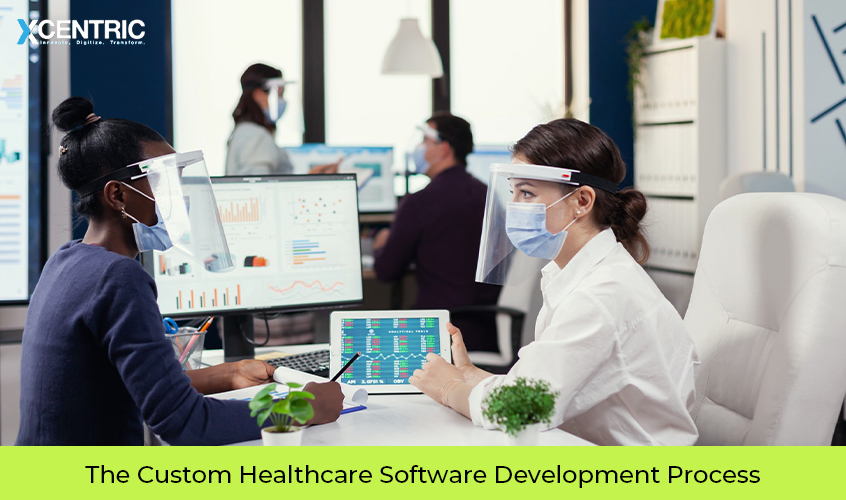
Healthcare software development is unique compared to the development lifecycle of regular enterprise software, as compliance and security play a part in each phase of the project.
Discovery | Workflow and compliance analysis |
Architecture Planning | Security-first system design |
UX/UI Design | Provider and patient usability |
Development | Feature implementation |
Security Testing | HIPAA safeguard validation |
Deployment | Infrastructure hardening |
Monitoring and optimization |
1) Discovery and compliance assessment are the first steps in the process. In this step, the development team analyzes workflows, exposure points for PHI, interoperability needs, operational bottlenecks, and infrastructure needs.
2) During the design and user experience (UX) planning stage, there is a significant emphasis on usability and compliance. Healthcare providers must be able to access patient data quickly while maintaining confidentiality and security.
3) Developing the process is usually done via a DevSecOps approach security reviews, code analysis, vulnerability testing, and compliance verification are done throughout the development process, and not at the end after coding.
4) Test phases include interoperability validation, penetration testing, compliance testing, role and permission testing, and infrastructure stress testing, using realistic healthcare workloads.
5) Deployment planning includes secure hosting environments, disaster recovery, access control enforcement, audit logging configuration and backup management.
6) It's even more critical to have long-term support, as healthcare systems need continuous patch management, regulatory updates, monitoring of infrastructure, SLA-based maintenance and cybersecurity response planning.
How to Choose the Right Development Partner

A good custom healthcare software development firm should not only make generic security claims, but it should also have proven experience in implementing HIPAA in real life. It is important for providers to inquire about previous healthcare projects, infrastructure controls, penetration testing processes, and PHI management practices.
An agreement, called a Business Associate Agreement, must be signed before any work is done. Healthcare organizations should also ask if the partner has experience in integration with Epic, Cerner, Allscripts, athenahealth, HL7 interfaces and FHIR APIs.
Healthcare-specific portfolios are important because the workflows are very different from that of an enterprise application. An agency that develops software for a variety of industries but occasionally creates healthcare software may not have as much knowledge about provider operations, patient workflows, reimbursement requirements, or compliance regulations.
Another significant consideration factor is security maturity. DevSecOps teams make security a part of the engineering lifecycle, rather than a checklist for compliance at the end.
Support for post-launch is crucial, too. Healthcare systems need to be continuously maintained, monitored, supported by SLA, patched, and made compliant.
The following assessment model can be used to help healthcare organizations evaluate vendors.
Evaluation Criteria: Why it matters?
Why It Matters | Evaluation Criteria |
HIPAA Compliance Track Record | Minimizes regulatory risk |
BAA Readiness | Confirms accountability |
EHR Integration Experience | Interoperability is supported |
Healthcare Portfolio | Indicates domain knowledge |
DevSecOps Approach | Improves software security |
SLA Support Model | Ensures operational continuity |
Healthcare providers should also seek out references or case studies from similar U.S. healthcare settings prior to entering into development agreements.
Cost of Custom Healthcare Software Development
The costs of healthcare software can differ greatly based on the complexity of the platform, integrations, compliance standards, and scalability needs.
Estimated Healthcare Software Cost Ranges
Project Type | Estimated Cost Range |
Basic Patient Portal | $25,000 - $65,000 |
Telemedicine App | $80,000 - $250,000 |
RPM Platform | $120,000 - $400,000 |
Enterprise Healthcare Platform | $250,000 - $1,000,000+ |
The overall development cost depends on a number of factors, such as compliance architecture, integrations with third parties, cloud infrastructure, analytics capability, mobile support, AI capabilities, and long-term maintenance.
The short-term focus on developing a system at a lower initial cost can lead to unexpected problems when trying to scale the system or ensure it meets compliance requirements later on.
Why Choose Xcentric for the Development of Your Custom Healthcare Software
Healthcare companies require more than a typical developer. They require a technology partner who grasps healthcare operational realities, interoperability, and compliance, as well as patient workflows.
Xcentric Services supports hospitals, clinics, physician groups and digital health startups in creating secure patient platforms, telemedicine solutions, EHR integrations and healthcare workflow applications specifically designed for the U.S. healthcare market. We are a trusted custom healthcare software development company in the USA. We provide scalable healthcare software solutions designed for patient engagement, interoperability standards, and HIPAA requirements, and we support long-term healthcare software operations.
From the initial patient portal concepts to the final design, development, and post-launch support, Xcentimatic Services offers an end-to-end solution to meet healthcare compliance expectations in any patient portal initiative, regardless of whether you are launching a new platform or upgrading an existing system, such as Epic or Cerner, or creating a secure telemedicine platform.
Frequently Asked Questions
What is meant by custom healthcare software development?
It's about creating apps for clinical, operational and patient workflows in healthcare. The systems are designed with HIPAA compliance from the ground up, along with EHR integration, integration with other systems, and security of PHI.
What is the price of custom Healthcare Software Development?
The cost of simple healthcare apps can range anywhere from about $25,000 to $65,000, whereas enterprise HIPAA-compliant applications can easily go from $250,000 to $1,000,000+. The actual price varies based on integrations, security needs, infrastructure and scope of features.
What's the time required for healthcare software development?
Applications with fewer use cases can be ready in 3 to 6 months, with enterprise systems, such as those that integrate EHRs and review compliance, ready in 9 to 18 months and beyond, depending on the use case's complexity.
What does it mean to be HIPAA compliant when building software?
HIPAA-compliant software utilizes the following features to safeguard PHI: encryption, audit logs, access control, secure authentication, and monitored infrastructure. Compliance needs to be built into the platform as part of the design.
What is the difference between EHR and EMR?
An EMR is typically used within a single provider or practice, and an EHR allows for interoperability and data sharing across healthcare systems, laboratories and providers.
What are some things to consider when selecting a Healthcare Software Partner?
Seek out HIPAA experience, BAA readiness, case study knowledge of the healthcare industry, DevSecOps practices, clear pricing, and support capabilities.
Which is more effective, a custom-made software or healthcare tools that are off the shelf?
Tailored healthcare platforms often offer more flexibility, scalability, and operational integration for organizations with complex workflows, interoperability requirements, or stringent compliance standards.

Share



Want To Increase Your Ranking On The Search Engines?
Get In Touch With Us!
Trending Blogs
Digital Marketing...
Xcentric Team
7 MONTHS AGO


What To Read Next?

For owners and managers of dental clinics in Lahore, here is a critical fact you...
Xcentric Team
7 MONTHS AGO

The Middle East e-commerce industry is rapidly growing due to increased digital acceptance, mobile-first consumers...
Xcentric Team
8 MONTHS AGO

These days, the e-commerce industry is growing at an exponential rate. With the rise of...
Xcentric Team
8 MONTHS AGO