
Table of Contents
▼Social Media Branding: How to Build a Consistent Brand Across Every Platform
- Nov 16, 2026
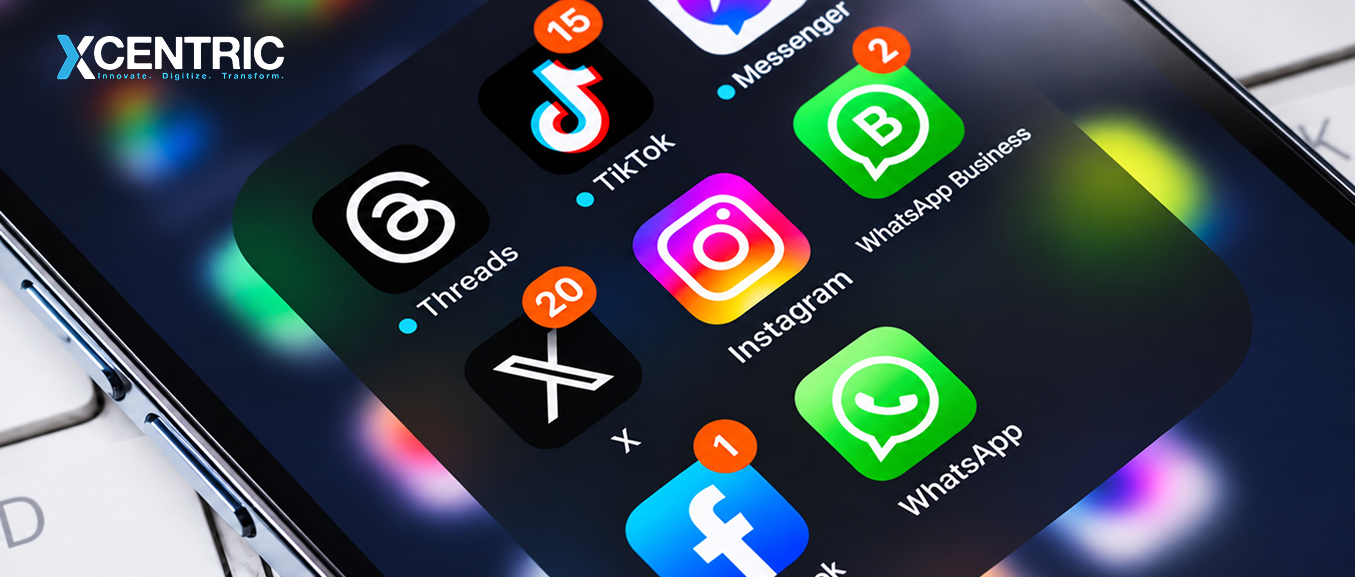
Your customers find your business in different ways. They may see your posts on Facebook, watch your videos on YouTube, read your posts on LinkedIn or Instagram, and eventually end up on your site. Each touchpoint impacts how they build a relationship and recall your business.
Now imagine you post different things across your channels, with different personalities and messages, and different visuals. How recognizable do you think your business is?
Social Media Branding provides a consistent identity across channels for your target audience. It brings cohesion and consistency to your visuals, message, brand voice, and interactions.
At Xcentric Services, we take branding beyond the logo. It encompasses how a business looks, communicates, and presents itself across digital channels. Our branding services assist clients in building their visual and strategic foundations, while our Social Media Management services help with execution.
What Is Social Media Branding?
Social media branding is the consistent representation of a business identity across social platforms, through use of recognizable visuals, messages, personality, and interactions. The goal is to help customers recognize your business and build trust and familiarity with your content.
Visual identity: Consists of your logo, colors, typeface, photographs, graphics, and brand design.
Brand voice: It’s the language, character, tone and communication style of your captions and communications.
Messaging: means your value proposition, main messages, positioning, and offer description of your services.
Content identity: the subjects, themes, formats, and educational materials central to your business.
Community experience: how your business interacts with customers, including its response to questions, comments, feedback, complaints, and concerns.
Branding and consistently publishing content are not the same thing. A business can post content daily and still have a brand identity issue if the content is inconsistent or lacks a clear strategy.
Social Media Branding vs. Social Media Marketing

Branding defines how audiences recognize and understand a business. Marketing defines how a business uses promotions, advertising, and other activities on social platforms to reach a target audience and drive them to take a desired action.
Area | Social Media Branding | Social Media Marketing |
Main purpose | Generate awareness and engagement | Generate action (clicks, leads, sales) |
Main focus | Visibility, positioning, content, and distribution consistency | Ads and promotions |
Time frame | Ongoing | Campaigns, cycles and repeating |
Examples | Logo, tone, color palette, messaging | Paid ads, promotions, lead campaigns |
Measurement | Recognition, mentions, branded searches | Clicks, leads, conversions, campaign performance |
Both work together. The purpose of marketing is to introduce potential customers to your business. Branding helps potential customers understand what your business is all about.
The Five Parts of a Social Media Brand System
The brand system consists of five elements: Identity, Visual Style, Voice, Content Pillars, Proof and Community.
1. Essentials
This is your business name, preferred social media handle, profile name, bio, website, and short description of your offerings. Be precise, but consistent.
2. Visual Style
Your visual style goes beyond your logo to encompass other visual elements that help make your content identifiable. Styles may include:
Color and usage
Type and layout
Image and graphics
Design and treatments
Stock and custom
Media and video
Consistent styles help match brand identity with design.
3. Social Media Brand Voice
Your brand voice defines your social media communication style and helps distinguish your voice from that of competitors. Identify three characteristics. Indicate the type of language your business should use or avoid.
Example: A financial consultancy would use language that is professional, informative and reassuring. A lifestyle retailer would use language that is friendly and conversational, perhaps even a little playful.
4. Content Pillars
These cover the most published topics on your social media and help create a consistent structure to your content. Pillars may include:
Educational content
Service content
Behind-the-scenes content
User-generated content (UGC)
Community content
These cover a broad range of content without structuring posts in an identical manner.
5. Proof and Community
Your brand should give value and provide proof through interaction, case studies, or demonstrations, and engage with the community.
These help showcase your brand’s purpose and elements, strengthen trust and confidence, and provide evidence to back claims.
What to Keep Constant and What to Adapt within Social Media Brand Guidelines

The best social media brand guidelines distinguish between elements that must be consistent and elements that must be adaptable. Your business identity should be recognizable, but the way you present yourself, the type of content you post, and the way you communicate should be in line with the social media platform.
The framework below is Xcentric Services' practical way of looking at how social media branding is approached across multiple platforms.
Platform | Keep Constant | Adapt | Format Note |
Business name, logo, positioning, voice | Expertise, insights, updates | Company presence, descriptions, visuals | |
Visual identity, logo, colors | Product and service content | Prioritize visuals, creatives, templates | |
Service descriptions, positioning, voice | Community and user engagement | Page descriptions, contact info, creative | |
YouTube | Channel identity, messages | Tutorials and long-form content | Recognizable channel artwork |
TikTok | Brand personality, message | Informative and educational content | Video-first approach |
X (formerly Twitter) | Positioning, voice, name, logo | Commentary and discussion | Recognizable profile info and images |
Here’s how to tailor your profiles on different social media platforms.
Check our guides to editing LinkedIn profiles, customizing YouTube channels, and profiles on TikTok and X. For Facebook and Instagram, go to the Meta Help Center.
What Should Stay the Same Across Platforms?
Your business name, essential value proposition, logo, approved color palette, brand personality, and key messaging should be the same on all platforms.
What Should Change?
Your content format, caption length, level of detail, and story and presentation style, as well as calls to action, should be adapted to the social media platform and audience.
For example, a software company could write a long post on LinkedIn explaining an industry trend, post a condensed version of the post as a carousel on Instagram, and create a short video on TikTok demonstrating how the software performs a specific task. The topic stays the same, but the explanation differs.
How to Build a Social Media Branding Strategy With a One-Page Brand Sheet
One way to build a social media branding strategy is to use our One-Page Brand Sheet template. This template can help document the foundation of your brand before your team starts creating and posting content. Xcentric Services has adapted the brand consistency framework to create the following template.
Your Fill-In Brand Sheet
Brand Element | Information to Document |
Business Name | Official name of your business |
Preferred Handle | Username on your preferred social platform |
Brand Description | Brief description of business |
Target Audience | Audience type, business, industry, location |
Value Proposition | What makes the business interesting |
Primary Colors | Hex codes |
Typography | Font family |
Logo | Logo variations, usage |
Brand Voice | Personality traits |
Words to Use | Preferred phrases |
Words to Avoid | Unpreferred phrases |
Content Pillars | Consistent topics |
Visual Direction | Illustrative style |
Call to Action | What do you want audiences to do? |
Proof | Examples of the business in action |
An established brand sheet helps with onboarding designers, copywriters, and social media managers. For assistance with these foundational elements of your brand, consider Xcentric Services branding solutions.
Social Media Profile Optimization: A 10-Point Brand Consistency Audit
Optimizing social media profiles refers to making sure that the information, photos, messages, and activities posted on all profiles reflect the business consistently and correctly. The Xcentric Services audit checklist will help you evaluate your social media profiles.
Fill out the checklist for each platform your business uses.
No. | Audit Point | What to Check |
1 | Handle match | Do usernames on your accounts align, or are they easily recognizable? |
2 | Bio wording | Do your descriptions provide an overview of your business? |
3 | Website link | Do your profiles contain a working link to your business website? |
4 | Profile image | Is the correct business logo/image being used? |
5 | Banner | Is the image being used for banner cover/header artwork aligned with your business? |
6 | Pinned content | Does the content introduce your business? |
7 | Brand voice | Are posts/comments in a consistent style/tone that aligns with your business? |
8 | Tags | Are branded hashtags/account tags used appropriately? |
9 | Disclosure | Are endorsements/gifted posts disclosed? |
10 | Last post date | When was the last time content was posted to reflect your business? |
How to use the audit: Verify that every profile has the information it needs and document inconsistencies. Assign someone to make changes to your accounts. Prioritize outdated info, broken links, inconsistent branding and missing disclosures.
If you are a business operating on several different channels, the audit is a great way to identify profiles that can be consolidated or retired.
Looking for brand identity and social profiles review? Xcentric Services offers professional review of your social media and other brand identity assets as part of their social media management services.
Brand Consistency on Social Media: Handles, Disclosures, and Trademarks
Brand consistency on social media also means protecting your business identity, using accurate account info, and making commercial relationships clear.
Get Same Handles
Try to secure the same business handles on your priority platforms. If the exact username is not available, try to come up with alternatives that are easily recognizable and do not create confusion with another business.
Keep records of proof of ownership, access to administrator accounts, the email addresses tied to the accounts, and how the accounts are secured.
Follow FTC Disclosure Guidelines
According to the FTC's Disclosures 101 for Social Media Influencers (November 2019), Creators must disclose any financial, employment, personal or family relationships they may have with a brand.
If a Creator receives something for free (i.e. product, service, discount, etc.) from a brand, and then endorses that brand, the Creator has a material relationship with that brand and must disclose it.
The FTC suggests that the disclosures must:
Be clear and conspicuous
Be placed next to the endorsement
Use language such as "I was gifted", "This is a sponsored post", or "I endorsed this because I received X"
Be placed in video content if the endorsement is made in video format
Do not rely on profile biographies, built-in disclosures on the platform, or other means to make disclosures
For additional information, check out the FTC Endorsement Guides Q&A and FTC Disclosures 101.
Do a Trademark Check Before Finalizing a Name
Do a search in the USPTO Trademark Database to see if there are similar marks to the one you want to use before finalizing your business name, logo, and social media branding.
The USPTO states trademark clearance involves a search for similar marks used on related goods and services. Similar social media handles have no bearing on trademark availability.
Use the USPTO’s federal trademark searching guide for assistance, prior to investing a great deal of time or money into a particular name.
How to Measure Social Media Brand Identity and Tell If It Is Working

You can measure brand identity on social media using a variety of signs, including a decrease in recognition, an increase in familiarity and purchases. Some signs will not be immediately visible and may require additional research. Small and medium enterprises can review branded searches, social media profile visits, mentions, and direct visits to their website to determine if their brand identity is becoming more recognizable.
These signs are measured through various means, including:
Recognition Signal | What It Tells You | How It's Measured |
Branded searches | Are people searching for you by name? | Google Search Console |
Profile visits | Are people visiting your social pages? | Platform analytics |
Brand mentions | Is your business being tagged? | Social listening |
Direct website visits | Are people going directly to your site? | Website analytics |
Branded engagement | Are people engaging with your content? | Platform analytics |
Compare similar reporting periods and consider other variables such as campaign activity, seasonality and other marketing channels.
Social Media brand identity often aids in a customer's decision to purchase, but rarely results in a clear direct sale. A customer can become aware of your business through social content, visit your site, and make a purchase through another channel.
Branding should not be presented as a guaranteed sale to customers, but rather as an aid in the customer's journey.
Common Social Media Branding Mistakes and How to Fix Them

Many companies undermine their social media branding efforts by creating each social media account with a separate identity instead of developing a unified brand system. The following errors are avoidable with sufficient planning and regular reviews.
Using multiple logos: Customers may be confused about your business identity
Using multiple types of messaging: Messaging may feel disjointed
Posting the same content on all platforms: May be inappropriate for the format of the platform
Leaving out details on social profiles: Potential customers may not understand your business
Posting content that is not on brand: May cause loss of business focus
Not responding to comments and messages: Creates a disjointed customer experience
A consistent social media branding strategy allows for variation in content. The goal is for all content to be aligned with the same business.
Establish Your Social Media Presence with Xcentric Services
There is a misconception that social media branding is about occasionally changing your logo. In reality, social media branding is about developing a cohesive brand identity that spans across different social media platforms and aligns with your overall business identity. For small and mid-sized businesses, the starting point is clear: document the brand, establish consistent profile information, adapt content to the platform, and keep an eye on the competition.
Xcentric Services understands the needs of small and mid-sized businesses. Our multi-disciplinary team has the skills required to elevate a business's digital presence through branding and marketing. Contact us to learn more about our branding, social media and digital marketing services.
Frequently Asked Questions
How often should you audit your social media profiles?
Small to mid-sized businesses should evaluate their social media profiles quarterly. Additionally, an evaluation is warranted after any major changes to a business, such as adjustments to a company's branding, business details, or services. A review is also warranted after a social media platform modifies profile features.
Does social media branding lead to sales?
Yes, Social media branding can assist the customer journey in multiple ways. It helps customers recognize the business. Social media branding helps communicate the business’s value propositions. Social media branding helps customers be familiar with the business.
What goes into a social media brand guide?
A social media brand guide will outline your business identity, how to use your logo, your business colors and fonts, your brand voice, the messaging you want to communicate, content pillars, visual direction for images, hashtags and disclosures, and presentation rules for each social platform. It will outline the elements of the brand that must remain constant and elements that can be adjusted.
What is the difference between brand identity and brand image?
A business’s brand identity is the way the business presents itself to the world with intent. Brand image is how the world ultimately receives the business. With consistency in its efforts, a business can mold its brand identity to its desired brand image.
Can a small business build a strong social media brand without an agency?
Yes, a small business can build its own social media brand by defining its identity, creating a brand sheet, crafting consistent profiles, and being intentional about all the content it posts. An agency becomes an asset when the business needs a designer, a copywriter, or ongoing account management.
In which areas should a business concentrate with social media?
When determining the social media channels to prioritize, you must take into account the communication objectives, available resources, and the nature of the content. A B2B consultancy is likely to focus on LinkedIn and YouTube, while a visually driven retail business is likely to focus on TikTok and Instagram. It is better to have a few well-run accounts than a number of accounts that are poorly run.

Share



Want To Increase Your Ranking On The Search Engines?
Get In Touch With Us!
Trending Blogs
Digital Marketing...
Xcentric Team
8 MONTHS AGO



What To Read Next?

For owners and managers of dental clinics in Lahore, here is a critical fact you...
Xcentric Team
8 MONTHS AGO

The Middle East e-commerce industry is rapidly growing due to increased digital acceptance, mobile-first consumers...
Xcentric Team
9 MONTHS AGO

These days, the e-commerce industry is growing at an exponential rate. With the rise of...
Xcentric Team
9 MONTHS AGO