
Table of Contents
▼PostgreSQL vs MySQL for SaaS: Which Database Should Your Multi-Tenant Product Run On?
- Sep 14, 2026
Choosing a database for a full stack development service is more complicated than finding the best SQL engine for your needs. The database affects architectural choices around tenant isolation, reporting, and data replication. It can also impact the cost of hosting and ease of migrating your SaaS application.
When a SaaS application uses shared tables to represent data for a tenant, PostgreSQL can provide a more complete solution out-of-the-box with the recent release of PostgreSQL 18, which provides row-level security policies. MySQL 8.4 provides similar functionality using views and application-level filtering, but native row-level security policies are still missing, making PostgreSQL the better option for new SaaS applications. MySQL can still be a good option for SaaS applications in specific scenarios where the application is integrated with other MySQL applications.
SaaS Database Criteria | PostgreSQL 18.6 | MySQL 8.4 LTS | Practical Edge |
Shared-schema tenancy | Native Row-Level Security | Application filtering | PostgreSQL |
Schema-per-tenant | Supported | Supported | Depends on operations |
Database-per-tenant | Supported | Supported | Depends on operations |
Flexible JSON data | JSONB with GIN and expression indexes | JSON with generated columns and indexes | PostgreSQL |
OLTP performance | Strong, workload-dependent | Strong, workload-dependent | No universal winner |
Read scaling | Streaming and logical replication | Replication and read replicas | Both |
Managed hosting | RDS, Cloud SQL, Neon, Supabase and others | RDS, Cloud SQL, PlanetScale, others | Both |
Licensing | PostgreSQL License | GPLv2 Community Edition plus commercial licensing | PostgreSQL for licensing simplicity |
PostgreSQL vs MySQL for SaaS, Postgres or MySQL for Startup, Which Database for SaaS?
PostgreSQL 18 offers Row-Level Security (RLS) to implement such rules. MySQL 8.4 doesn't offer RLS yet. However, it provides views and other mechanisms that help with access control. Still, MySQL assumes that the application handles tenant filtering.
PostgreSQL vs MySQL comparisons for SaaS applications are useful, as the principles that differentiate both platforms for one application may not apply for another.
Multi-Tenant Data Isolation: Row Level Security Postgres Multi Tenant vs MySQL Multi Tenant
PostgreSQL 18 introduces native Row-Level Security (RLS) for shared-scheme SaaS applications, where each role is restricted to work with only a subset of the data. MySQL 8.4 relies on application logic for tenant filtering, although it provides mechanisms for views and access control, which can be used for implementing tenant filtering.
In a shared projects table, some rows may be restricted to a particular tenant:
tenant_id | project_id | project_name |
101 | 1001 | Marketing Portal |
101 | 1002 | Customer Dashboard |
205 | 2001 | Sales Workspace |
205 | 2002 | Support Portal |
…
In PostgreSQL 18, RLS allows restriction of rows based on the context of the tenant. Such policies can deny (or allow) access to rows based on the policies defined.
Constraints on access to shared data based on tenants are best implemented using PostgreSQL RLS. MySQL 8.4 introduced SQL SECURITY modes and the ability to create views with the check option. These can be used to implement a form of tenant isolation; however, they do not provide the same level of functionality as PostgreSQL’s row-level security policies.
The main differences in tenant isolation models are in the arrangement of data. The models are:
Shared schema: All tenants’ data is stored in the same set of tables, but is differentiated by a tenant identifier.
Schema-per-tenant: Each tenant is provided a schema.
Database-per-tenant: Each tenant is provided a separate set of databases.
In all of the above models, PostgreSQL does not ensure tenant isolation. Row-level security policies must be designed and implemented by a system administrator. It should be noted that policies can be circumvented by system administrators. PostgreSQL 18 ensures table owners are restricted by row-level security policies with the command FORCE ROW LEVEL SECURITY.
PostgreSQL provides a means to ensure tenant isolation at the database level.
PostgreSQL JSONB vs MySQL JSON
JSON support in PostgreSQL (via the JSONB type) and MySQL has differing levels of maturity. Both can model and support configurable SaaS data models; however, JSONB tends to be more productive when incorporating JSON in a relational application data model.
Suppose a SaaS application provides a core accounts data model, which allows customers to control other settings and configurations.
PostgreSQL 18 supports GIN indexes for the JSONB type and expression indexes for JSONB fields. PostgreSQL’s JSONB type provides a number of features that can simplify development for a SaaS application.
MySQL 8.4 offers JSON functions to perform pattern matching and other operations on JSON data. Per MySQL’s documentation, scalar JSON data is represented by a special type and therefore is not indexed. However, MySQL and InnoDB support multi-valued and other types of indexes on JSON data.
Judging by the above analysis, MySQL is more suited for SaaS applications which do not heavily use JSON data. PostgreSQL is a better option for applications where modeling and supporting configurable data is an important feature.
Performance: What Benchmarks Really Say About PostgreSQL vs MySQL
PostgreSQL 18.6 and MySQL 8.4 LTS performance comparisons for SaaS workloads haven’t determined a clear winner. Several other factors, such as query design and schema, can impact the results.
A benchmark by ReadySet shows that databases performance comparisons usually lack important details. In 2026, ReadySet’s performance test team published a benchmark between PostgreSQL 16 and Percona’s MySQL 8.4 and found that PostgreSQL 16 supports a higher throughput, 2,181,981, than Percona’s MySQL 8.4, 1,573,565. To make the test more realistic, the team at ReadySet added their caching layer to PostgreSQL 16 and found that it was able to sustain over 5,600,000 queries per second (QPS), and Percona’s MySQL 8.4 supported approximately 4,800,000 QPS. The test at ReadySet focused on the team’s ability to serve hundreds of thousands of concurrent requests per second and, as such, should not be used to predict the overall performance of a SaaS application.
Ultimately, research between PostgreSQL and MySQL Performance is often based on reference implementations and focused on the design of the workload being tested.
For a fair comparison, test case scenarios should include a range of workload mixes (ie., OLTP, BI, analytical) and concurrency levels, including read/write workloads, authn/authz, and ad hoc queries. PostgreSQL 18 adds features to improve query performance and observability, such as buffer accesses and index lookups. As such, PostgreSQL 18 should improve the performance of application workloads compared to PostgreSQL 17.
Comparison of PostgreSQL and MySQL Scalability
PostgreSQL 18.6 and MySQL 8.4 offer robust replication systems and support read scaling. While their differences in architecture may not be apparent at first glance, they do vary in their replication system ecosystems.
Physical streaming replication is included in PostgreSQL 18. Also included is logical replication, which uses a publish-subscribe system to replicate data. PostgreSQL 18 improved logical replication to allow for the parallel processing of streamed transactions.
MySQL 8.4 provides replication where a single source replica is used to propagate data to one or more replicas. MySQL's documentation describes a read scale-out architecture.
PostgreSQL 18.6
MySQL 8.4 LTS
Read Replicas
Physical Replication
Logical Replication
Selected Table Replication
Read-only SaaS
Horizontal Scaling
PostgreSQL's ecosystem and surrounding architecture provide for Horizontal Scaling. Vitess is an open-source project, developed by Google and other contributors, that provides Horizontal Scaling for MySQL. Other projects provide Horizontal Scaling for both MySQL and PostgreSQL.
Xcentric Services builds backend systems and SaaS products. Sometimes, architectural limitations impact both the backend and the SaaS product. An optimization of the backend may help improve the SaaS product. Adding resources to the system, query tuning, or improving indexes may provide the improvement needed.
This is a real-world comparison of PostgreSQL and MySQL. The database systems themselves vary, but the architecture surrounding the systems is equally important.
Managed Postgres vs. Managed MySQL Pricing & Options
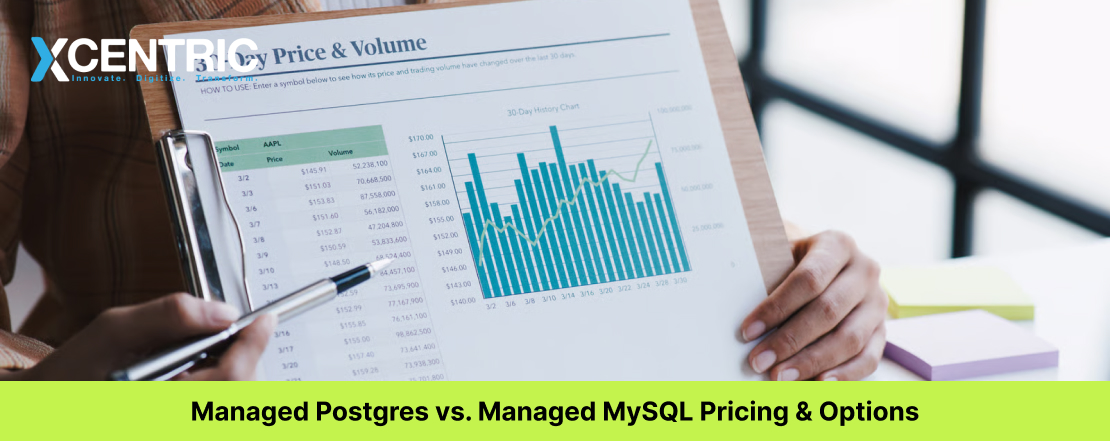
PostgreSQL and MySQL managed solutions are similar in concept and pricing. There are several factors beyond the database engine that affect the total cost. These may include the virtual machine’s compute and memory resources, storage and backup configurations, and network and I/O throughput. Availability and replication may also impact the overall cost.
One of the managed solutions for MySQL and PostgreSQL includes Amazon RDS, Google Cloud SQL, Supabase, Neon, and more recently Railway and PlanetScale. Not all solutions provide both MySQL and PostgreSQL managed options.
Vendor | MySQL | PostgreSQL | Current Model |
Amazon | Yes | Yes | Instance storage I/O, and other usage; on-demand and reserved |
Google Cloud SQL | Yes | Yes | MySQL and PostgreSQL Enterprise and Enterprise Plus |
Railway | Yes | Yes | Subscription and usage |
Neon | Yes | No | PostgreSQL usage-based |
Supabase | Yes | No | PostgreSQL, compute, and other usage |
PlanetScale | No | Yes | Resource-based |
Railway has a $5 Hobby plan and a $20 Pro plan for MySQL and PostgreSQL. The first $5 or $20 of the month is applied toward resource usage. Neon moved to fully usage-based PostgreSQL in 2025, eliminating the monthly minimum. In 2026, it increased the data transfer limit to 500 GB.
Always check the total cost of ownership for a database system, as headline prices don't always reflect real-world usage.
PostgreSQL and MySQL Licensing and Governance
PostgreSQL 18.6 employs the PostgreSQL License, which is a permissive open source license, similar to both the BSD and MIT licenses. MySQL Community Edition is licensed under the General Public License (GPL), and MySQL’s commercial licenses are sold by Oracle.
When a SaaS company employs a database server as aserver only component of its service, the license of the database server is of little to no concern. The license of the database server becomes of greater concern when the server is embedded in or combined with other server products.
The PostgreSQL server license gives operators of the server greater freedom, in comparison to servers licensed under the GPL. MySQL Community Edition is licensed under the GPL. MySQL is also licensed commercially by Oracle.
Licensing of MySQL becomes of greater concern when a SaaS product employs MySQL as its backend database. The product of the SaaS company is a service, which employs MySQL, and the MySQL backend service is integrated with other server components of the SaaS product. The integration of the MySQL component is of greater legal concern, as compared to the integration of the PostgreSQL component.
Ecosystem and Tooling: PostgreSQL vs MySQL for Modern SaaS Stacks
In regard to tooling and ecosystems, MySQL and PostgreSQL are comparable for developing backends of SaaS products.
PostgreSQL is the most commonly used and the most widely desired database environment as per the 2025 Stack Overflow Developer Survey. PostgreSQL has occupied the top spot for the last three years. The survey's database question received a total of 26,083 responses.
Although PostgreSQL is the top database environment, that does not mean other environments, like MySQL, do not have a place. MySQL is very common in web application development. Also, a number of supporting services are available for MySQL, including a number of LTS (long-term support) versions.
When evaluating ecosystem fit for a SaaS Engineering Team, other factors in the stack must also be taken into account.
Factor in the stack | PostgreSQL | MySQL |
Node.js | Support for ORMs and drivers | Support for ORMs and drivers |
Python | Support for Django and SQLAlchemy | Support for Django and SQLAlchemy |
PHP | Support for Laravel and Symfony | Support for Laravel and Symfony |
TypeScript | Support for Prisma and Drizzle | Support for Prisma and Drizzle |
It must also be considered if the database fits the skills of the software development team.
PostgreSQL and MongoDB are two of the more popular options and are discussed in Xcentric's Backend Content. Xcentric's other content covers building a SaaS product with a focus on multi-tenancy. Xcentric recognizes the importance of designing a scalable product with a flexible and robust backend.
Migrating from MySQL to PostgreSQL
While MySQL and PostgreSQL are very similar and migrating from MySQL to PostgreSQL is not overly complicated, there are differences. A migration project typically has four layers:
Layer | Change |
Schema | Data Definition Language |
SQL | Application-level SQL |
Application | Application infrastructure level changes |
Operations | Database Operations level changes |
The highest level of difficulty is encountered with application layer changes. Most SaaS applications use an object-orientated architecture and have programming logic to support reporting, integrations, and other background processes. Such SaaS applications further use stored procedures and other styles of programming to embed SQL.
A staged migration approach poses less risk and provides a window to remove vendor lock-in. A migration team can first identify key features, remove vendor lock-in, design and implement PostgreSQL-compatible features, and perform end-to-end tests before a business cuts over the application.
Which Should You Choose? A Decision Guide by SaaS Type
Prior to the existence of the SaaS application, the best practice recommendation was to choose PostgreSQL to gain the advantage of the query optimization and planner features of the database, and to avoid architectural lock-in. It is less disruptive to the business to adopt PostgreSQL in the absence of production data.
PostgreSQL 18.6 is a better choice than MySQL 8.4 LTS to support advanced features for JSON and relational data. MySQL 8.4 LTS should be considered by businesses who have prior experience with MySQL and MySQL-based infrastructure.
SaaS situation | Database to evaluate | Main reason |
New multi-tenant B2B SaaS | Postgres 18.6 | Native RLS (row-level security) allows us to horizontally partition data at the database layer |
Configurable workflow | Postgres 18.6 | Postgres can model configurable entities using relational and/or JSON data |
Existing large MySQL SaaS | MySQL 8.4 LTS | Risk of breaking things outweighs potential benefits of PostgreSQL |
PHP application with mature MySQL stack | MySQL 8.4 LTS or PostgreSQL 18.6 | Postgres or MySQL can be integrated with existing PHP App |
Analytics SaaS Solution | PostgreSQL 18.6 | Postgres provides better relational databases and logical replication |
SaaS requiring distributed MySQL architecture | MySQL 8.4 or PostgreSQL 18.6 | MySQL 8.4 LTS with appropriate scaling layer |
New product with no legacy constraints | PostgreSQL 18.6 | PostgreSQL provides a rich ecosystem |
When evaluating SaaS solutions, a number of factors must be considered together, for instance, multi-tenancy architecture, API and auth integrations, billing and subscription systems, deployment strategies, and monitoring and logging tools. Xcentric Services has extensive experience implementing these types of systems and maintains that, in the real world, the various layers of a system's architecture typically need to integrate with one another. Xcentric maintains that in the design and implementation of multi-tenant SaaS solutions, tenancy architectures and scalable APIs are first-order considerations.
When considering tenancy architecture, APIs, auth integrations, and other factors that shape the user experience, talk to Xcentric Services first. We can assist in defining the data model, tenant isolation strategy, and back-end architecture to ensure your SaaS is built on the right foundation.
Frequently Asked Questions
What is the difference between PostgreSQL and MySQL?
PostgreSQL is more mature than MySQL and offers capabilities such as better queries, concurrency, and transaction control. Both support pluggable storage and report reasonable performance with SSDs. PostgreSQL supports Asynchronous COW (Copy on Write) and MySQL does not support any COW at all. MySQL’s default is to create a copy on write, while PostgreSQL’s default is not to create a copy on write. PostgreSQL is slightly faster than MySQL on operations relating to InnoDB. In addition, PostgreSQL is more complicated than MySQL, thus MySQL is easier to scale horizontally than PostgreSQL.
How do PostgreSQL and MySQL divide multi-tenant data?
In PostgreSQL 18.6, you can use Row Level Security (RLS) to restrict rows based on tenant or user. Other features in MySQL 8.4 enable the use of views and application level row filtering. MySQL does not have native RLS like PostgreSQL.
Which handles flexible schemas and JSON better?
PostgreSQL 18.6 adds JSONB with GIN and expression indexes. MySQL 8.4 adds the JSON data type and functions. MySQL also adds generated column and multi-column indexes. If your application uses JSON heavily, PostgreSQL can be a better choice.
Which is more time efficient, PostgreSQL or MySQL?
Neither is ideal for all situations for a SaaS workload. PostgreSQL can be faster with OLTP style workloads while MySQL can be faster with workloads involving complex joins. To accurately compare the two, you would need to test your application's actual tenant workloads.
What is the attraction to PostgreSQL?
PostgreSQL has become increasingly popular with software developers. In 2022, the 2025 edition of the Stack Overflow developer survey reported PostgreSQL as the database environment of first choice for development and use, a trend that has continued since 2023.
Is PostgreSQL better than MySQL for startups?
When considering the development of a large-scale, multi-tenant SaaS application, PostgreSQL 18.6 potentially meets a greater number of default application requirements compared to MySQL and may warrant consideration. From a business perspective, for a startup that has already standardized on MySQL, the cost of migrating to PostgreSQL may not be warranted.
How difficult is it to migrate to PostgreSQL?
The MySQL to PostgreSQL migration depends on the level of application and business logic that has been integrated into the application. As a general rule, ORM framework-based applications may be easier to migrate, while complex, business-logic-layer integrated applications may be more difficult to migrate.

Share



Want To Increase Your Ranking On The Search Engines?
Get In Touch With Us!
Trending Blogs
Digital Marketing...
Xcentric Team
7 MONTHS AGO

What To Read Next?

For owners and managers of dental clinics in Lahore, here is a critical fact you...
Xcentric Team
7 MONTHS AGO

The Middle East e-commerce industry is rapidly growing due to increased digital acceptance, mobile-first consumers...
Xcentric Team
8 MONTHS AGO

These days, the e-commerce industry is growing at an exponential rate. With the rise of...
Xcentric Team
8 MONTHS AGO