
Table of Contents
▼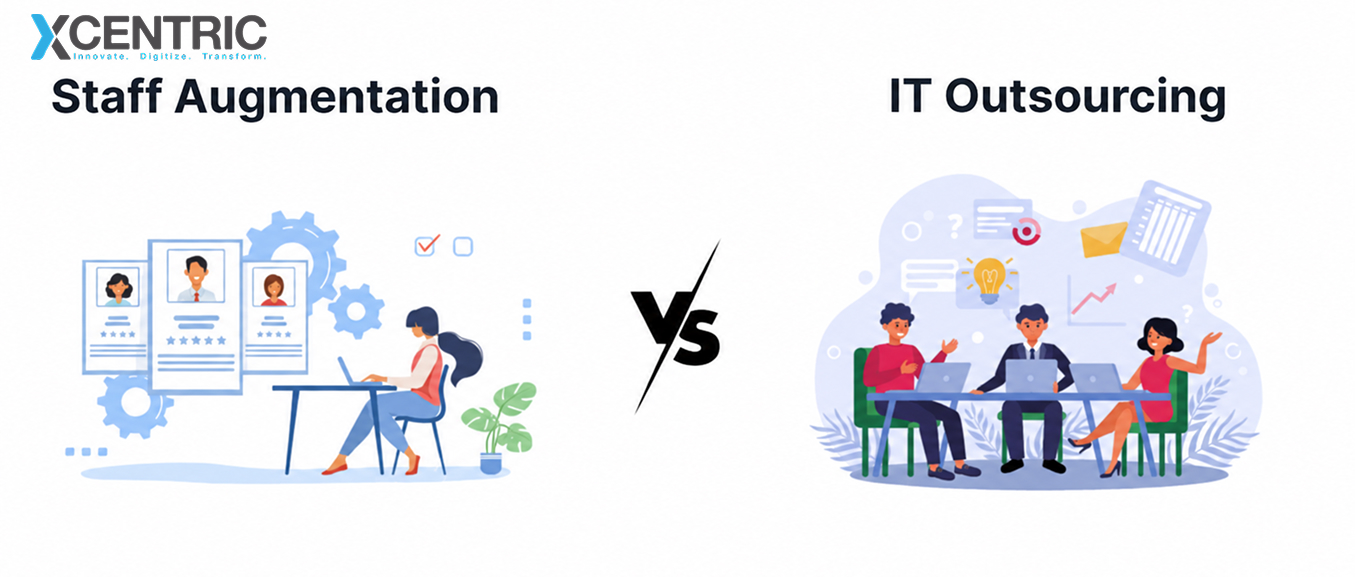
Staff augmentation and outsourcing are both means of introducing external technology resources into your business but have one main distinction: the role of the manager and the ownership of delivery risk. Staff augmentation involves hiring external experts or developers to work alongside your current team, keeping your company in control of priorities, processes and workflows. Outsourcing involves delegating a specific project or process to another party who is responsible for the people, process and delivery. The right one is for someone who needs more talent under their command or for someone who wants to delegate an entire outcome.
Staff Augmentation vs Outsourcing at a Glance
The easiest way to grasp the concept of staff augmentation versus outsourcing is to start with two questions: Who is responsible for the work? and Who owns the risk of delivery? The two options are: Staff augmentation remains with the client, and project-based outsourcing is handed over to the vendor.
Factor | Staff Augmentation |
Who manages the work? | Client |
Who owns delivery risk? | Client |
Team integration | External professionals are brought into the client's team |
Most suitable for | Skills or gaps in skills |
Flexibility | High; resources can scale with demand |
Process control | Client retains day-to-day control |
IP/process control | Typically remains closely controlled by client contract |
Accountability | Client manages individual contributors and output |
This is important because the primary difference between staff augmentation and outsourcing isn't the number of people hired or where they are located. That's the question of responsibility.
A company can utilise offshore staff augmentation with the management of the developers. It can also task a local vendor to carry out a project. Location and engagement model aren't connected.
What Is Staff Augmentation?
An IT resourcing model where a vendor provides skilled staff that augment the client's existing team to work as an extension of the client team on the client's direction.
A business doesn't need to hire a permanent developer, designer, QA engineer or cloud specialist, but can hire a temporary or temporary skill set through an outside source. The augmented professional "fits into" tools, meetings, workflows and communications.
The client usually defines priorities, sets tasks, checks the work and carries out the day-to-day development. The vendor's job is to acquire, select, take on and maintain the talent needed. Staff augmentation can be very beneficial when an existing engineering team is familiar with the product but is understaffed or lacks a specific engineering skill.
In the case of a SaaS company that has eight developers but requires two more to support a significant release of a new product, they might need two more React developers. The time to hire permanent employees can be several months, and the complete outsourcing of the product could result in the loss of the control that the company desires. Staff augmentation is in the middle.
Xcentric Services centers its staff augmentation service on this kind of team expansion and offers vetted professionals in various fields, such as Python, PHP, Laravel, Node.js, JavaScript, WordPress, mobile application development, and database development. It entails talent discovery, technical screening, team structuring, onboarding, delivery support, and scaling/transition support.
What is Outsourcing?
An outsourcing agreement where a company outsources a project, deliverable, or function to an external party who is responsible for people and processes. Instead of hiring three developers from a vendor who report to you, you could hire a vendor to build an ecommerce platform, develop a mobile app or manage a specific business function.
The organisation of the team and delivery of the work within the agreed scope, timeline, quality requirements and contract is at the discretion of the vendor. But that's significant in staff augmentation vs software outsourcing.
In software outsourcing, the client is responsible for outlining the business requirements and the expected results, and then a vendor assumes more responsibility for fulfilling client requirements and producing a completed product or deliverable. The client still has much more to do as far as execution is concerned with the staff augmentation.
Example requirement | Better Aligned Model |
Internal development team is small and requires two senior developers | Staff Augmentation |
More capacity is needed in the QA department to support three product releases | Staff Augmentation |
Create, design and launch our new customer portal | Outsourcing |
Mobile app needs to be developed and released by an outside party | Outsourcing |
Product leadership exists but doesn’t have specialised AI skills | Staff Augementation |
Don’t have an internal development team but have ideas | Outsourcing |
The Core Difference: Who Mnages the Work?

With the staff augmentation engagement, your company is still responsible for managing the staff augmentation professionals. You can pick what to build, which sprint is more important, what changes in priorities you think will be necessary, and how this will fit into your current development workflow.
Outsourcing means that greater responsibility will be placed on the vendor for delivery. You outline what you need, but the provider handles the team, process and activities that are necessary to deliver that outcome.
This also shifts the delivery risk.
Responsibility | Staff Augmentation | Outsourcing |
Selecting individual tasks | Client | Vendor |
Daily management | Client | Vendor |
Sprint priorities | Client | Vendor |
Team organisation | Client-led | Vendor-led |
Delivery responsibility | Shared, client has significant responsibility | Mainly vendor based on agreed deliverables |
Product Direction | Client | Client |
Execution management | Client | Vendor |
That's why staff augmentation vs IT outsourcing cannot be simplified to “temporary workers versus an agency”. Offshore engineers are available through staff augmentation programs from one vendor and a fully outsourced project from another vendor, both in the same country. The structure of the engagement dictates control of execution.
Staff Augmentation vs Outsourcing: What Should You Choose?
Staff augmentation is the best solution for staff who have the skills to do the work but lack capacity, and outsourcing is for when the project has a well-defined scope and the external service provider will be responsible for delivery.
One of the most crucial variables is your internal management ability.
Consider staff augmentation when:
You have a CTO, engineering manager, product manager or technical lead to whom you can point external contributors. Maybe you're looking for a DevOps Engineer, Senior Laravel Developer, React Native Expert or AI/ML specialist, but you don't need to hire them permanently.
It can also be applied in situations where the number of team members must change rapidly. A company can hire developers for a big release and then reduce the number of developers provided by the external company once the demand is reduced.
Choose outsourcing when:
Your project is fairly well defined with requirements and the product you're looking for, but you don't have the resources or knowledge in-house for the project.
Sometimes, outsourcing is also a viable option because of management overheads. If your leadership team is not interested in recruiting, onboarding, managing and coordinating an outside engineering team, then it may be more appropriate to contract out delivery to a vendor.
When you consider the following, the decision becomes more apparent
Staff Augmentation | Outsourcing | Decision Factor |
Existing technical leadership | Strong fit | Less essential |
Need to fill a skills gap | Strong fit | Possible |
Need for direct control | Strong fit | Lower |
Defined project/deliverable | Possible | Strong fit |
Need to transfer delivery management | Poorer fit | Strong fit |
Low frequency scope changes | Excellent fit | Needs change management |
Need for rapid capacity scaling | Strong fit | Possible |
The key is, staff augmentation is not a procurement decision, but a business decision. It is not necessarily the case that the cheaper hourly rate or bigger vendor team is the best value.
Staff Augmentation vs IT Outsourcing for Software Development
There are differences between Staff Augmentation and IT Outsourcing for software development. Staff Augmentation vs. IT Outsourcing for Software Development.
Businesses with product leadership and who require more software-development capability often find staff augmentation more suitable, whereas software outsourcing is more appropriate for those that want to outsource a product with a defined development end result.
It may be more practical to use full project outsourcing since the company may not have the engineering framework needed to support a greater number of people working on a development team. The real meaning of staff augmentation vs. outsourcing software development is who is able to handle the software development process.
Xcentric has the ability to augment a current technology team with developers in Web, mobile, cloud, AI and other technology fields. In its current form, the model of staff augmentation it has is onboarding, tracking delivery, QA and scaling support.
Staff Augmentation vs Traditional Outsourcing: Control, Flexibility and Risk
Staff augmentation offers more client control, while outsourcing places more responsibility on the vendor side. This difference has implications from project management to IP to communications. Staff Augmentation means that the external developer will be part of your Git workflow, project-management system, sprint ceremonies and communication channels. The developer essentially fills in the roles of your current team.
In traditional outsourcing, the vendor can form its own delivery team, set up its own project management team, determine the work execution within the agreed requirements and carry out QA for the project.
That doesn't mean that the client is taken out of the picture! There is still a need for clients to be involved in product requirements, approvals, business decisions and acceptance criteria. The difference with the vendor is that he/she assumes more responsibility for execution. An important difference to note for organisations considering staff outsourcing vs staff augmentation is that the external person is not necessarily 'outsourced staff' - it's the person who is actually in control of the work.
Nearshore IT Outsourcing vs Staff Augmentation: Where Does Location Fit?

The terms ‘nearshore' and ‘offshore' refer to the geographic location of the external team, while ‘staff augmentation' and ‘outsourcing' is the ways they are brought on board and managed by the client. They are independent variables and can be used in various combinations.
For instance, a U.S. company might employ:
Staff Augmentation in a nearshore country, with developers in a nearby time zone
Staff augmentation offshore to developers from another region
Outsourcing nearshore projects with the responsibility for delivery on the vendor
Outsourcing offshore software with a single vendor to take care of an entire project
The actual time zone difference, communication, cultural understanding, talent availability and cost can be practical differences.
Location Model | Typical Advantage | Potential Consideration |
Onshore | High overlap in work and culture | Higher labour costs are often experienced onshore |
Nearshore | More time zone overlap due to geographical location | Talent pool can be more limited for specialized skills |
Offshore | Access to wider global talent pool, possibly reduced delivery costs | Time-zone coordination is time-consuming and needs planning |
Comparing nearshore staff augmentation to offshore outsourcing, then, is important not to be compared on a single scale since they are not the same.
In fact, a company may have to answer two different questions:
Question #1: Do we need staff augmentation or outsourcing?
Question #2: Should the delivery team be onshore, nearshore or offshore?
Time-zone management is especially crucial for companies in the United States that are collaborating with an offshore provider like Xcentric Services. The Xcentric team augmentation service is built on the concept of international partnership around time zones and client team and processes integration.
The right offshore engagement should, therefore, have clear communication windows, reporting expectations, collaboration tools and escalation procedures. Operating model clarity makes geographic distance a lot easier to manage.
What about Managed Services, Dedicated Teams and Other Models?

There are several models of external technology engagement, and the decision comes down to the amount of management/deliverability that you wish to keep when selecting between them.
Managed services typically pass on the day-to-day responsibilities of the service to the service provider with a defined service expectation or service level agreement. This is not staff augmentation or project outsourcing. If you'd like to learn more about the differences, read our IT managed services vs staff augmentation article.
It's a separate army standing between pure staff augmentation and full project outsourcing. The management method can be varied, with a vendor forming a team of people who work exclusively for one of their clients, and usually over a longer period of time. An independent contractor is a person who is contracted directly and not supplied by a staff augmentation company. It's a bit like a freelancer, where the relationship is, for the most part, not a set-up with a vendor to manage the talent.
Business process outsourcing (BPO) typically means a transfer of an existing business process, like customer support, call handling or back-office operations, to an external service provider, instead of outsourcing software development services. Xcentric provides BPO services such as inbound call-center services, outbound call-center services and order processing separately. The differences are important because, although the contractual and operational model can vary significantly, sometimes “outsourcing” is used as a blanket term for all work conducted outside the business.
How Xcentric Services Can Help You Choose the Right Model
You have to be clear about what you want to have under your control in the business, and what you're willing to outsource. Xcentric Services collaborates with businesses that require more technical manpower and also businesses that are in search of more extensive digital and software development skills. Currently, it supports staff augmentation by connecting relevant experts to a project, ensuring they fit into the in-house team, and assisting in the delivery of that project while enabling businesses to add or remove resources as needed.
Xcentric's extensive offering also includes web development, mobile apps, digital marketing services, SEO, branding, BPO, and business solutions, enabling businesses to leverage technical resourcing and leverage broader digital needs as needed.
For those already running an engineering company who require additional manpower, Xcentric's IT staff augmentation service is the obvious choice. For a defined product or software need, if you are considering whether augmentation, project outsourcing or a different delivery model is more appropriate, Xcentric can scope the need with you prior to suggesting an engagement structure.
Final Takeaway: Staff Augmentation or Outsourcing?
Consider staff augmentation if you have the leadership to manage external experts and require extra capacity, expertise or quick team expansion. Outsource a function or project with a clear scope of work and a provider who assumes more responsibility for the project and its team. Don't forget that you make a separate choice about where the documents are located. Just like outsourcing, staff augmentation can be done in-house or abroad: onshore and nearshore are two options to consider.
Xcentric Services can offer vetted technical staff that plug into existing teams and can be scaled for additional development capacity without relinquishing control of your engineering workflow. The same initial assessment process can be used to identify if project outsourcing, staff augmentation, or another business model is appropriate.
When you are considering outsourcing vs. staff augmentation for an upcoming software or digital project, speak with Xcentric Services about your needs, team setup, technology being used, and the objectives you are looking for to be met. Then you can choose the right engagement model based on the work you need done, not an out-of-the-box engagement package.
Frequently Asked Questions
What's the difference between staff augmentation and outsourcing?
Staff augmentation involves bringing on additional resources to your current team – you remain in charge of day-to-day management and delivery. Outsourcing involves outsourcing responsibility for a defined project or function to the vendor who runs its own team and completes its own project or function.
What is the economic difference between staff augmentation and outsourcing?
Not necessarily. Staff augmentation may be a cost-effective solution since you already have an in-house management to handle the day-to-day operations, and merely require the skills or extra workforce to bridge the gap. Outsourcing can offer a superior value for the money if the project could be managed in-house would take a great deal of time, management and coordination. Don't focus solely on hourly rates—also consider total delivery cost.
Is staff augmentation a type of outsourcing?
Staff augmentation can be viewed as a method of providing external resources or outsourcing services in the widest sense of the word, but it is also different from project outsourcing. The critical difference is that the client will still manage the enhanced professionals instead of handing control of delivery over to the vendor.
What are the differences between staff augmentation and a dedicated team?
Staff augmentation generally involves bringing extra professionals on to an in-house client's staff, whereas a dedicated team is often a vendor-created team that provides services for a longer-term contract to a single client. This responsibility may be split differently depending on each contract.
What is the difference between Independent Contractor and Staff Augmentation?
Staff Augmentation is where the vendor brings in a professional to support the client, who brings him into their team. An independent contractor is usually hired by the client and will work under the terms of a direct contract with the client.
Nearshore vs offshore: which is better for staff augmentation?
There is no universally best solution. Time zone and communication alignment can be more achievable through nearshore delivery and access to a wider talent pool or possibly alternative pricing models through offshore staff augmentation. It is dependent on the skills required, working hours to overlap, communication requirements, and the complexity of the project.
Nearshore vs offshore: which is better for staff augmentation?
The best way to determine whether to use staff augmentation or outsourcing is to determine who is responsible for delivering the work and who will be responsible for the execution.

Share



Want To Increase Your Ranking On The Search Engines?
Get In Touch With Us!
Trending Blogs
Digital Marketing...
Xcentric Team
6 MONTHS AGO


What To Read Next?

For owners and managers of dental clinics in Lahore, here is a critical fact you...
Xcentric Team
6 MONTHS AGO

The Middle East e-commerce industry is rapidly growing due to increased digital acceptance, mobile-first consumers...
Xcentric Team
7 MONTHS AGO

These days, the e-commerce industry is growing at an exponential rate. With the rise of...
Xcentric Team
7 MONTHS AGO