
Table of Contents
▼
Many entrepreneurs mistake PR and marketing for the same thing. Some think PR only means writing press releases or newspaper features. The truth is that the connection is much wider. Knowing what PR is in marketing is important because while marketing creates a business’s awareness and sales, public relations helps a business build its credibility. The best businesses build a balance of both.
If you have been asking what PR marketing actually means and how it varies from advertising, or if PR can enhance your SEO, then you will find this guide useful. We will look at the modern world of PR and its importance to all businesses, and we will see how companies such as Xcentric Services utilize an intelligent approach to public relations in order to augment brand credibility, improve PR, and facilitate the ongoing growth of the business.
What Is PR in Marketing?
A popular question is what PR mean in marketing. PR is the abbreviation for Public Relations. The Public Relations Society of America (PRSA) defines public relations as:
"Public relations is a strategic communication process that builds relationships that are beneficial to the public relations between an organization and the public."
This definition is an indication of the industry’s progression. Many decades ago, favorable press coverage was what achieved PR. Nowadays, the focus is creating trust, covering reputation, and relationships of the many that impact the success of the organization. An essential part of PRSA's definition is the word "publics." PR encompasses far more than just customers, unlike marketing, which is solely focused on customers. PR involves employees, investors, regulators, journalists, community groups, partners, and government entities.
Focused on Marketing | Focused on PR |
Customers | Public |
Growth in Sales | Trust and Reputation |
Promotion of Products | Managing Relationships |
Paid Advertisements | Earned Trust |
What is essential for marketing is the understanding that the reputation of the business is an asset. The stronger the reputation a business has, the stronger the ability to attract customers, further investors, and employees, and finally get the press and media on board.
Modern Day Public Relations: Understanding PR Marketing
Modern-day public relations helps to satisfy the understanding of what PR marketing is. Following a Pennsylvania Railroad incident, Ivy Lee is believed to have created the first modern press release in 1906. Instead of concealing the truth, he promoted transparency and created the Declaration of Principles, where he said that organizations could gain the public's trust only by being honest and forthright.
Bernays introduced the first strategic communications framework and the use of psychology to Public Relations. His book Crystallizing Public Opinion, published in 1923, is one of the first real public relations textbooks. He also introduced the first public relations course at NYU.
Although history is undecided on whether Ivy Lee or Edward Bernays should be more credited for establishing today's public relations profession, there is no doubt that both of them changed the way organizations communicate. Public Relations Society of America was created in 1947 and is one of the first and still operates as one of the most important organizations for public relations.
What Is PR and Marketing? Where They Overlap, and Where They Differ?
When people are looking to find what PR and marketing mean, they are usually looking to find if they are the same: they are not.
Marketing's purpose is to develop a customer base to bring in sales. PR is about developing relationships based on trust and credibility that ultimately improve marketing's success. A helpful way to examine the difference is to consider the following example:
A trustworthy business Google ad is an example of marketing.
A trustworthy business article in the news is an example of PR.
The second example is more trustworthy since it is a third-party endorsement.
The PESO Model created by Gini Dietrich in Spin Sucks (2014) shows how the combination of marketing and PR is the focus of today's communications.
PESO Element | Description | Primary Owner |
Paid Media | Advertising, sponsored content, PPC | Marketing |
Earned Media | News coverage, interviews, media mentions | PR |
Shared Media | Social media conversations | Both |
Owned Media | Website, blog, email, newsletters | Both |
Today's businesses almost always integrate marketing and communications. Marketing teams need PR to build trust and credibility, and PR teams build digital marketing assets. Therefore, many of the large organizations need to have dedicated PR departments, while the rest of the company usually considers PR to be a part of the marketing function.
When PR is considered in Marketing?
To see what PR means to marketing now, it is important not to look only to the media.
Current Elements of PR
Today’s PR consists of many new elements, including:
Reputation management
Digital PR
Crisis communication
Media relations
Influencer partnerships
Modern businesses connect with their customers at many different touch points, such as news sites, podcasts, LinkedIn, and blogs. PR can help ensure these valuable conversations won’t hurt a company’s reputation.
In the digital world, marketing is easy, but PR is one of the most effective tools for building a brand and fostering customer relations.
What Does a PR Strategy Entail?
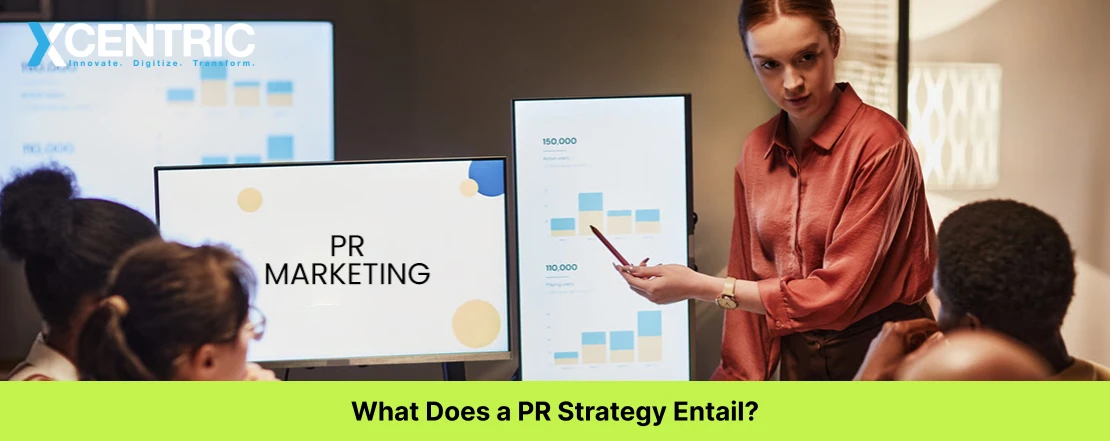
Most people think of PR as being all about the news, but it is so much more. Modern PR is the strategic use of many ways of communicating to facilitate a positive perception of a business.
PR Service | Business Purpose |
Media Relations | Build relationships with journalists to earn media coverage |
Strategic Press Release Writing | Announcing company news professionally |
Crisis Communication Response | Reputation Protection |
Digital PR Services | Online mentions and backlinks |
Executive Branding | Positioning CEO’s and Founders as industry experts |
Online Reputation Management | Brand Sentiment Control |
Event & Influencer PR | Partnership Outreach |
A good example of this is a Pakistani technology startup that is trying to get coverage in publications such as Dawn, The Express Tribune or Business Recorder to announce their new technology. They may also be running Digital PR campaigns to get backlinks in industry publications.
Rather than solely relying on paid advertisements, businesses create a validation system that strengthens customers’ trust and belief.
Where does Xcentric Services fit in within this holistic model? Xcentric uses an integrated process. Rather than viewing PR as a single tactic, Xcentric merges media relations, content marketing, SEO, branding, and a digital strategy into an integrated communication framework.
How is PR Evaluated?
One misunderstanding that people have regarding PR is that the results are impossible to evaluate. Today, public relations is more data-driven than ever.
In the past, many agencies used to depend on Advertising Value Equivalency (AVE), which was a method to estimate the cost of buying an advertisement for what would have been media coverage. Presently, AVEs are disdained.
The International Association for the Measurement and Evaluation of Communication (AMEC) formally distanced itself from AVEs in the Barcelona Principles, which were introduced in 2010 and have been revised to Barcelona Principles 4.0 in 2025. Today, organizations focus on the assessment of important business results.
Modern PR Metrics and What It Measures

This framework describes PR in terms of seven steps or stages. This framework describes PR in terms of measurable business performance rather than the focus of PR on a set of vanity metrics.
Share of Voice (SOV) | The percentage of industry conversation that consists of your brand |
Media Reach | The audience impacted by your coverage |
Media Impressions | The number of opportunities people can see your |
Sentiment Analysis | Assessment of positive, neutral, or negative sentiment |
Website Traffic | Coverage that results in visits to a website |
Backlinks | Coverage that results in high-quality SEO |
AMEC introduced the Integrated Evaluation Framework. For agencies like Xcentric Services, this framework provides an added value of aligning their focus with achieving clearly defined business outcomes versus counting the number of media coverage.
Can PR Improve SEO?
Investing in Public Relations (PR) offers businesses many advantages. One of the most important is the enhancement of a business's search engine optimization (SEO).
When reputable online newspapers and magazines write about businesses, they often add links to the businesses' websites.
For Google, these backlinks are a significant authority signal. Digital PR is located where PR and SEO meet. PR offers a variety of ways to enhance search visibility. The table below summarizes the ways.
PR Activity | SEO Benefit |
Media coverage | High-authority backlinks |
Executive interviews | Increased expertise signals |
Industry publications | Stronger authority |
Brand mentions | Greater online trust |
Thought leadership | Improved topical relevance |
PR also enhances Google's E-E-A-T principles:
Experience
Expertise
Authoritativeness
Trust
Search engines evaluate a business's trustworthiness. Independent media coverage is an excellent trust signal, especially when a reputable media outlet reflects a voluntary interest in the business.
For businesses that ask what is marketing PR, a modern response would include gaining reputable digital coverage that enhances a business's reputation and improves the business's SEO.
Why Local Media Landscape Shapes PR Strategy

PR principles are the same across the globe. However, the local media ecosystems force the use of different tactics.
Businesses in Pakistan, as an example, work in a landscape that includes the Dawn Media Group, Jang Group, The Express Tribune, and Business Recorder.
Television and radio media are regulated by the Pakistan Electronic Media Regulatory Authority (PEMRA), and the Associated Press of Pakistan (APP) distributes news to a majority of the country's publications.
PR requires an understanding of these systems and their interrelations. A campaign created for Pakistan will have little in common with a campaign created for the USA or Europe - even if both campaigns are created to meet the same business objectives.
When companies take on an international presence, Xcentric Services, amongst others, alters their PR Strategies to align with the local media, rather than apply the same generic communication plan across all markets.
Why Every Business in the Growth Phase Needs Both PR and Marketing
A common question among businesses is whether advertising should come first, or public relations should come first. This is entirely dependent on the goal. Because PR and marketing are so interrelated, companies are often confused about whether PR is part of the marketing function.
PR is part of the marketing function.
Marketing creates demand for a product or service, while PR builds credibility.
These functions are most effective when performed in conjunction.
Let’s say, for example, that you are launching a software platform. In this case, marketing is immediately generating traffic through paid ads. At this time, PR is securing reviews, interviews, and other valued media placements for the business.
You are highly likely to gain customers through this integrated approach, as opposed to other means that simply rely on advertising. This is the primary reason why businesses have started to integrate content marketing, digital PR, reputation management and other forms of marketing into a cohesive strategy. PR without marketing may generate awareness but not enough sales opportunities. The best firms draw from both disciplines because they reinforce and complement one another.
The Importance of PR in Digital Marketing

In Digital Marketing, this technique emphasizes the main keyword and offers advantageous semantic SEO. Public Relations is quickly adapting to the creation of new search engines, online reviews, podcasts, social media, and AI search generation.
Public relations is no longer limited to general newspapers.
Businesses build their authority in:
Industry Publications
Podcasts
Interviews
Digital Magazines
High Authority Backlinks
Digital PR is one of the fastest-growing segments in modern-day marketing and for good reason. The signals to online reputation and leadership are quickly becoming the most important factors in establishing trust with your customers and your place on the Search Engines.
For companies like Xcentric Services, digital PR ties the media relations within the framework of SEO, content strategy, and reputation management together to deliver real business advantages.
Why You Should Choose Xcentric Services for PR Marketing

Knowing what PR is in marketing is only a small part of the picture. The real challenge lies in building a strategy that focuses on media coverage and public relations in a way that positively impacts the business.
At Xcentric Services, PR is part of the digital marketing process, not a standalone service. Be it national media coverage, Digital PR and the search process, managing the public relations of executives, dealing with a reputation or crisis PR, product launches, etc., the focus is on visibility that positively impacts the business.
While many firms focus on short-term benefits, Xcentric Services focuses on building trust and authority. This helps companies improve their long-term relationships with customers while positively impacting lead generation and search engine visibility.
If you don't know how to assess the current state of your communication strategy, a PR consultant can help you to identify areas for further developing your visibility and trust.
Conclusion
Knowing what PR means in marketing means that you will see that PR is much more than simply being known. There is a substantial element of strategy that develops trust, maintains reputation, and carries media credibility, all of which positively influences SEO. While marketing generates interest, PR ensures that clients will decide to work with you instead of a competitor.
For higher levels of scale and sustainability, the best and most reliable outcome comes from the combination of the two. Xcentric Services combines Digital PR, media relations, branding, content strategy, and SEO into interlocking activities that focus on maximizing visibility and authority, while also facilitating real, impactful growth for your business.
Frequently Asked Questions About PR (Public Relations)
What does PR stand for in marketing?
PR in marketing stands for Public Relations. This describes the management of relations with all the different sectors of the public, including customers, employees, investors, media, and the community
Is PR marketing?
Although most of the functions of PR and those of marketing are not the same, they complement one another. While marketing develops and creates interest in a product or service, PR provides the assurance that the marketing will work
How is PR different from advertising?
The biggest difference between PR and advertising is that advertising is a controlled, paid-for communication, while PR is earned media, and the value of the story will determine if independent journalists, publishers, or industry experts decide to cover your organization
Can PR improve SEO?
Yes, PR strengthens the E-E-A-T signals and online authority; thus, it can positively support your SEO efforts
How much are PR services?
Expect PR investment to stretch based on the campaign, the target audience, the media requirements, and the agency’s experience. A well-known agency will price a national campaign higher than a local campaign, and most agencies will offer a price for a project as well as a monthly retainer
Do startups need PR?
Yes, startups need to build their credibility, and the fastest way for a new business to build trust is through media coverage, executive digital branding, and digital PR. This is much faster than the traditional route of paid advertising
How quickly do you see results from PR?
PR is a long-term investment. Some campaigns will receive media coverage in a matter of weeks, but the reputation, brand recognition and trust and authority of the business will take several months to be noticed and improve
What is the value of PR to marketing?
PR is a valuable component of marketing because it builds trust before a purchase is made. Positive coverage, a strong brand and reputation, and media coverage will strengthen the confidence of the customer and build brand awareness for a successful marketing campaign
Does PR fall under digital marketing?
PR and digital marketing are two separate areas, but they have begun to work in conjunction with one another. Digital PR enhances a brand and builds reputation with media coverage, online content, and SEO, while also gaining valuable backlinks
What’s the difference between branding and PR?
Branding is the messaging and visual identity of a business and how they want to be perceived. PR builds on that perception, and through media coverage and public engagement, builds a reputation for that business. Branding creates the promise and PR and reputation builds peoples’ belief in that promise
What distinguishes PR from content marketing?
Unlike content marketing, which emphasizes documenting particular company events on available communication infrastructure, traditional PR uses third-party communication infrastructure to advertise company events by garnering news coverage. They work best when combined, as they ensure a larger audience for the same event
Which industries gain the most from the use of PR?
Using PR has a major positive impact on most of the available industries. These include industries that are mostly transactional, such as commerce, technology, healthcare, education, manufacturing, finance, real estate, hospitality, and other professional services. Practically any business that thrives on trust and public perception can use PR positively
Are PR services important for small businesses?
Unlike a common misconception that PR is big business only, small businesses can focus their market for a Digital PR campaign or Local Press coverage while building an audience for the company using Local Media Outreach and Executive Branding. The focus of the business determines the scale of budgeting, meaning small businesses have access to PR

Share



Want To Increase Your Ranking On The Search Engines?
Get In Touch With Us!
Trending Blogs
Digital Marketing...
Xcentric Team
6 MONTHS AGO


What To Read Next?

For owners and managers of dental clinics in Lahore, here is a critical fact you...
Xcentric Team
6 MONTHS AGO

The Middle East e-commerce industry is rapidly growing due to increased digital acceptance, mobile-first consumers...
Xcentric Team
7 MONTHS AGO

These days, the e-commerce industry is growing at an exponential rate. With the rise of...
Xcentric Team
7 MONTHS AGO