Table of Contents
▼Cafeteria Management System for Corporate Offices: Features, Integrations, and What to Expect
- Jul 15, 2026
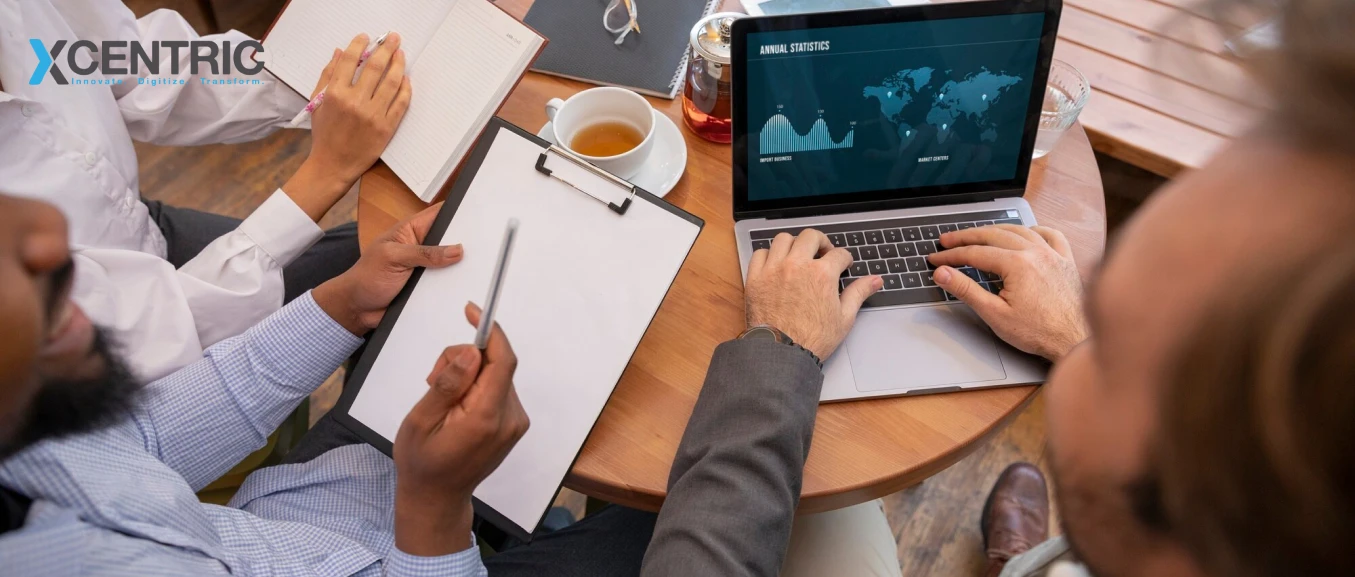
A food management system for corporate offices is a unified digital solution that streamlines and automates all aspects of the food experience in the workplace, including meal ordering and eligibility criteria, billing, coordinating vendors, reporting, and integration with HR systems.
Cafeteria services at most workplaces are more than just a place where food is served. Users are in different categories, several subsidy rules and vendor counters, shift meal timing, and finance teams require proper cost allocation. The manual management of all this can result in mistakes, misuse and lack of transparency.
These disjointed operations are replaced by a digital system in a modern corporate cafeteria management system. It tracks every meal, classifies every user properly and matches each transaction with company policy.
At Xcentric Services, these systems are used within an overall employee canteen management strategy, which enables organisations to integrate the use of the cafeteria with HR systems, payroll processes and multiple location reporting dashboards. The result is a fully traceable operation unit in the cafeteria, which has replaced the traditional and labor-intensive cost center.
Core Features for Corporate Environments
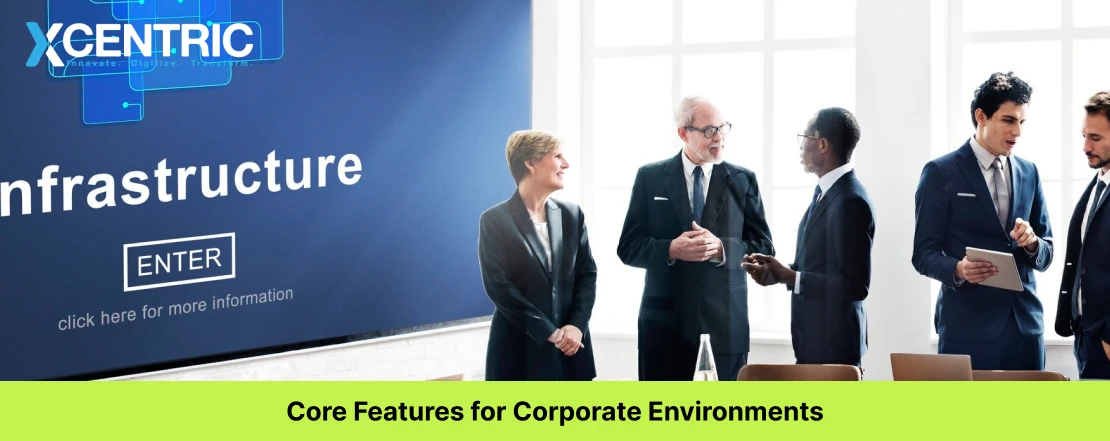
A modern enterprise cafeteria platform is designed to deal with complexity, particularly in organizations with thousands of staff, contractors and guests eating daily.
Payroll Linked Meal Deduction and Subsidy Rules
Automated payroll linkage is one of the most essential elements in a corporate canteen management software ecosystem, where the utilisation of meals is captured in the payroll or subsidy records.
Through integrations like SpaceBasic and Savvy HRMS, structured financial management of the use of the cafeteria can be done:
Automatic payroll deduction based on the number of meals consumed by an employee
Employer-created subsidies for designation, department or role
Cafeteria usage reports (which are consolidated monthly by employee)
Integrated with HR Attendance data for eligibility validation
Minimized manual work in finance reconciliation
This not only helps to keep tabs on the cost of the cafeteria, but the costs are also accurately allocated throughout the payroll cycle.
Xcentric Services allows payroll rules to be set based on internal HR policies so that all meals are recorded correctly, and there are no discrepancies between HR, finance and the cafeteria system.
Multi-Vendor Food Court Management
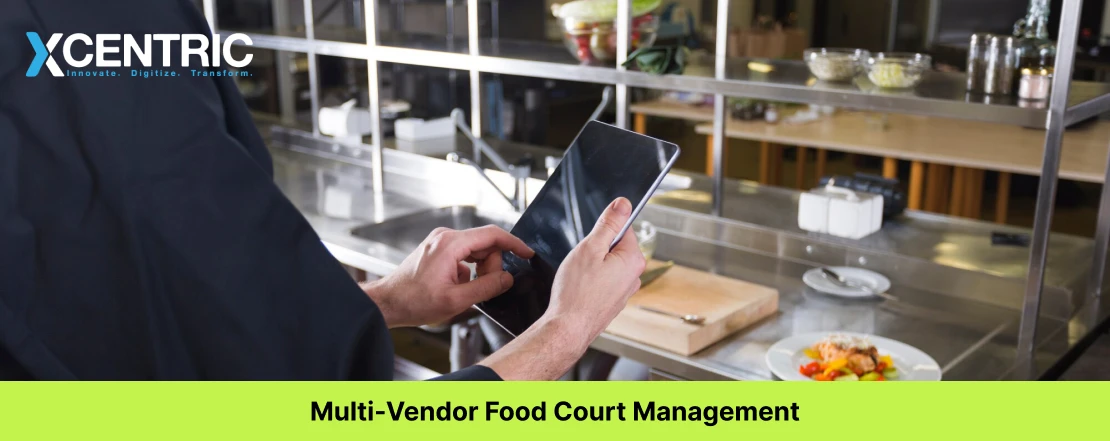
The modern corporate campus is often a multi-vendor setup, where several food vendors work on the same campus without sharing the same kitchen, which requires the ability of multi vendor food court management system.
Structured control can be achieved through multiple vendors and in the same premises with platforms such as eFACiLiTY and Matrix.
Key capabilities include:
Control of several autonomous food vendors in a single location
A comprehensive ordering and billing system that is unified throughout all counters
Customize menu and pricing rules for vendors
Performance monitoring in real-time for each vendor
The finance and administration team is a single team reporting
This enables workers to have a diverse range of choices, while keeping the cost, quality and compliance under the central control of the organisation.
A corporate cafeteria management system can ensure that, even if multiple vendors are involved, all the transactions are done in a single operational system.
Managing Employees, Contractors, Visitors, and Guests on One System
Modern workplaces are ever-changing, and the cafeteria system needs to accommodate a variety of user types and access/billing relationships.
A single policy engine, such as SMG or FaceIT, applies to access to the cafeteria for all user types.
This includes:
Staff members who receive free or subsidized meals, and those who have their meals paid for by their employers
Contractors with fixed and limited access plans
People who are just visiting or have an approved meal entitlement
The ones that are administered by the admin using permissions
Core functional capabilities:
The rules for meal entitlement by user category
Dynamic subsidy assignment by role and/or department
Automated approval workflows for guest meals
Audit logs of all transactions for compliance purposes
This allows any meal to be served without any doubt and avoids the opportunity for unauthorized or misclassified meal intake.
This multi-user environment is set up according to HR practices and business needs in various departments for businesses using Xcentric Services.
Available in Standard and Shift-Based Offices
Structured Meal Timing Controls are necessary in large enterprises, particularly BPOs and manufacturing units, and IT service centers, where the cafeteria might operate on multiple shifts.
Organizations can create very specific meal schedules, such as:
Breakfast, lunch and dinner time frames with set time limits
Pre-shift meal scheduling for 24 x 7 businesses
Limited access during meal times
Automated eligibility of meals per shift
This helps to prevent overcrowding, chaos in the operations and helps to provide for a fair distribution of the cafeteria resources. The other benefit of a corporate canteen management software is that it also ensures discipline, so that employees can only get into the food at the designated time.
Corporate Canteen Management Software vs Generic POS
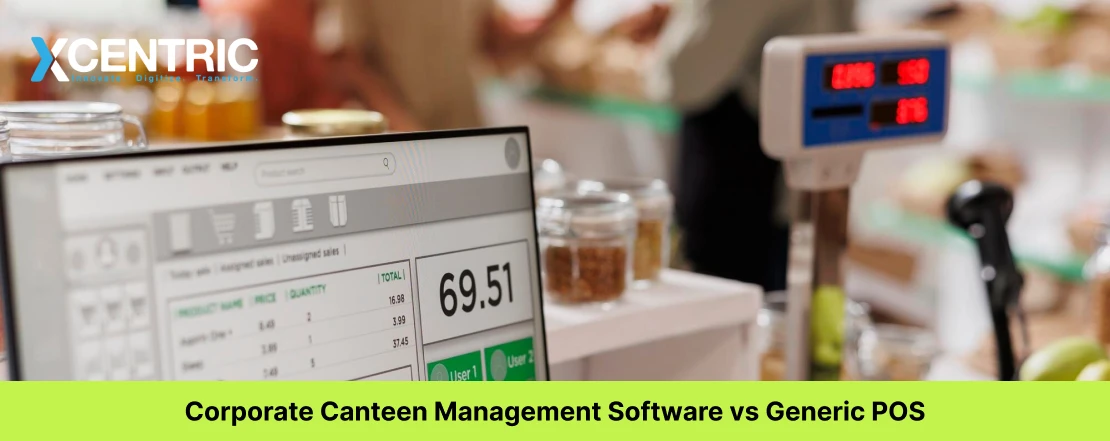
The purpose and functionality of a corporate canteen management software are a lot different from a normal POS system. Retail billing systems are POS systems, and the cafeteria systems used by companies are workforce management systems, with capabilities for policy enforcement and integration with reporting.
Limitations of Generic POS Systems
No integration with HRMS/payroll system
No rules for determining entitlements based on the employee
No employee/contractor/guest user management
No centralized reporting from multiple office locations
Restricted or no handling of subsidies
Capabilities of Enterprise Cafeteria Systems
Modern systems provide a much more extensive set of features, such as:
HRMS and attendance integration with wallet HRMS companies, such as Idoraa
Cashless payment systems with wallets and smart cards (MealMate, SpaceBasic)
Quickly order contactless (1OfficeView) with QR codes
High-volume cafeterias: self-service kiosks (eFACiLiTY and Idoraa)
Multi-location dashboards for centralized monitoring (SMG, 1OfficeView)
The use of AI-based demand forecasting for improved food planning (MealMate)
This change will guarantee that for organizations that partner with Xcentric Services, their cafeteria isn't just a billing counter but a part of their enterprise systems.
Multi-Location Dashboards and Cost-Per-Department Reporting
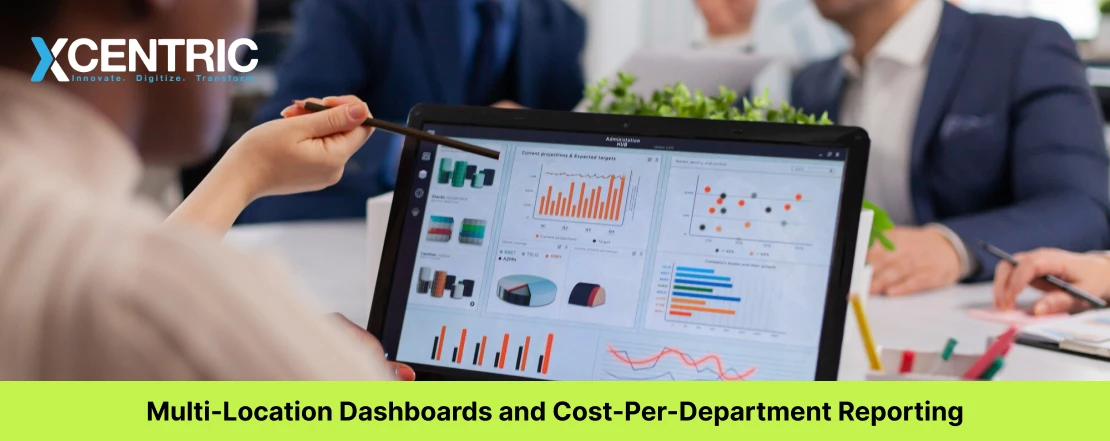
Large enterprises frequently have a number of sites with cafeterias, so having control and visibility centrally is a must for operational and financial control. By using a modern Multi-Location (ML) cafeteria management system, all data is consolidated over all locations, including offices, campuses and production points.
Centralized Multi-Cafeteria Control
Platforms such as SMG and 1OfficeView allow companies to:
Control several food service sites with one dashboard
Consolidate policy on food and beverages in various offices
Track consumption in real-time from any place
Track consumption in real-time from anywhere.
Manage vendor operations from a central point across campuses
It is particularly useful for companies with offices in various locations or big corporate buildings.
Detailed Cost Per Employee and Department Analysis
The advanced analytics platforms, like Kanishka Software, give in-depth insights into the finances:
Tracking the number of meals consumed per employee
Meals consumed per employee tracking
Comparisons between vendor performance and cost effectiveness
Utilization and budgeting information for each month
The level of reporting enables decision-making for the finance and operations teams related to spending and optimizing the cafeteria.
Cloud-Based Access and Remote Operations
Organizations can utilize cloud-enabled dashboards via systems like Savvy HRMS to:
Monitor cafeteria usage in real-time
Update policies remotely for all locations
Access centralized reporting from anywhere
Track vendor and employee-level activity
Build vs Buy for Corporate Offices
Organizations frequently evaluate whether to build their own in-house cafeteria system or use an enterprise-ready solution.
Challenges of Building In-House Systems
The development of a custom in-house cafeteria system is often fraught with:
Significant expense to develop and long time frames for deployment
Difficulties integrating multiple HRMS, payroll, and vendor systems into the cafeteria system
Ongoing maintenance and a complete technical dependency on outside vendors
The ability to scale and deploy the in-house system across multiple offices
The choice of Xcentric Services to implement the corporate cafeteria management system, to include the integration of HRMS, vendor onboarding, payroll configuration, analytics dashboards, and an extended commitment to ensure optimal operation based on the needs of enterprise operations.
Why Choose Xcentric Services
By working with Xcentric Services, the organization receives a complete, structured employee cafeteria management ecosystem that provides:
A comprehensive cafeteria system implementation
Integration of payroll-linked deduction and subsidy configurations
Food court management system that accommodates multiple vendors
Cashless wallet and smart card systems
Visitor Management Systems (VMS) with an integrated 1OfficeView
Centralized reporting via cloud-enabled dashboards
Meal entitlement policies through SMG-style rule engines
This will help eliminate complexity from the implementation process while providing a reliable and transparent enterprise-level solution and long-term efficiency.
Conclusion
When a company implements a corporate cafeteria management system (CCMS), it can expect improved billing accuracy and simplified subsidy management, along with improved consumption tracking at each department and location in real time through features like QR ordering, smart card payment processing, self-service kiosks, and centralized dashboards.
When an organization has multiple workforce structures and serves a large volume of meals each day, working with an expert like Xcentric Services is critical to ensuring a successful implementation, seamless integration of all systems, and long-term sustainability. As a result of using many unconnected tools or manual processes, businesses can evolve to implement a unified and policy-driven cafeteria management system that integrates cafeteria, HR, finance and buildings.
The implementation of a modern cafeteria management system by organizations that want to gain better control over the consumption of their employees' meals, their vendors, and the costs associated with running a cafeteria is beyond a simple operational improvement
Frequently Asked Questions (FAQs) About Cafeteria Management System
What is a corporate cafeteria management system? And how is it different from a traditional cafeteria management system?
A corporate cafeteria system offers a complete solution for managing employee meals through integration with HRMS (Human Resource Management System) and tools for managing employee benefits and entitlements, while a traditional POS (Point of Sale) system typically only manages basic sales transactions.
Can I have multiple food vendors at one office using a single system?
Yes! A centralized multi-vendor food court management system allows multiple food vendors to operate under one central management system with unified billing, reporting, and policy compliance.
How is meal billing determined for contractors vs employees?
Applications like SMG apply one policy engine that assigns different meal entitlement rules and billing rules based on user classifications such as employee, contractor, visitor, or guest.
Will the system integrate with my payroll and HRMS?
Yes, companies like SpaceBasic and Savvy provide integration between HRMS and payroll to provide automated financial reconciliations and eligibility for meals based on attendance.
Does the system support shift-based meal times for 24/7 operations?
Yes, applications like FaceIT support configurable meal time slots for breakfast, lunch, and dinner for rotating shifts in continuous operations.
Can visitors access the cafeteria?
Yes! By utilizing the 1OfficeView Visitor Management System (VMS) integration, visitors and guests can be provided with controlled, time-limited access to the cafeteria.
Are cashless payments permitted using this system?
Yes, both applications, MealMate and SpaceBasic, support cashless payments through wallet-based payments via prepaid accounts or smart cards.
Share



Want To Increase Your Ranking On The Search Engines?
Get In Touch With Us!
Trending Blogs
Digital Marketing...
Xcentric Team
6 MONTHS AGO
What To Read Next?
For owners and managers of dental clinics in Lahore, here is a critical fact you...
Xcentric Team
6 MONTHS AGO

The Middle East e-commerce industry is rapidly growing due to increased digital acceptance, mobile-first consumers...
Xcentric Team
7 MONTHS AGO

These days, the e-commerce industry is growing at an exponential rate. With the rise of...
Xcentric Team
7 MONTHS AGO