Table of Contents
▼
Choosing the best company for CRM development is not as easy as determining the suppliers that best suit your company’s procurement policies. It is likely one of the most important decisions for American companies in terms of operational costs, sales, customer satisfaction, and the potential for the company’s growth.
The issue is that most companies underestimate the importance of choosing a strong CRM development partner and place their focus and resources only on the budget and deadlines of the project. Unfortunately, at this stage of the process, the only focus of the company is on selecting a vendor, declaring requirements, and developing a CRM system that will likely not be used and will not produce any return on investment.
In general, the majority of CRM system projects fail due to the lack of planning, subpar vendor evaluation, and, of course, the disconnect that exists with respect to the company’s requirements and technical implementation.
Whatever the reason driving your desire for a custom CRM, the development company you choose will ultimately determine if your CRM system becomes a source of growth for your company or, due to a lack of utility, an expensive mistake.
This guide will help you learn how to evaluate CRM development companies, what things to include or exclude from the contract, and, importantly, how to judge partners based on their ability to develop operational CRM systems that will be used.
Custom CRM vs. Off-the-Shelf
The first step to selecting a custom CRM development company is developing an understanding of what is involved in a build vs. buy decision.
What is a Custom CRM?
A custom CRM is based on your business processes. Unlike some other CRMs, custom CRMs are not built around how other people think your processes should work. They are built around how your team actually operates, how data is processed, and how customers travel the journey of your business. With a custom CRM, you also own your Intellectual Property (IP) entirely. Indefinitely. That is the ultimate peace of mind.
A custom CRM provider is also likely to be built to automate and deeply integrate internal processes, and, of course, custom-built to grow and scale with the business.
What is a Off-the-Shelf CRM?
Off-the-shelf CRM options like Salesforce, HubSpot, Microsoft Dynamics 365, and Zoho CRM, have standardized functions for the masses. That is their main value.
Factor | Custom CRM | Off-the-shelf CRM |
Workflow Fit | Optimizes processes | Requiring you to change your processes |
Ownership | Complete IP Asset | Complete vendor control |
Scalability | Fully designed to grow and scale | Completely designed to not grow and scale |
Integrations | Custom designed, and deep connectivity | Pre-prepared connectivity and integrations with external tools and services |
Cost Structure | More cost-effective with less recurrence | More costly with more recurrence |
Vendor Dependency | Complete dependence | Complete dependence with vendor |
The real question is not custom/logical versus off-the-shelf, but which is better for greater operational complexity. Custom is almost always the better choice for workflows that are not simple, are multi-system/multi-layered, and are aimed at rare industry processes.
How to Choose the Appropriate CRM Development Services?
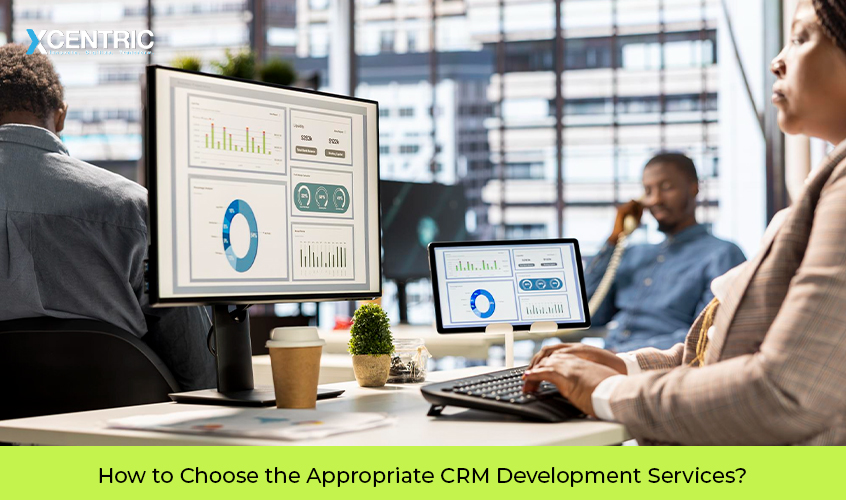
An exemplary crm development services is not determined by their level of proficiency with code, but their capability to identify and understand your business and your needs, before actual development.
The most indicative sign is if the vendor can execute a coherent structure in the Discovery Phase. This should involve going through the processes of the Phase, like mapping the workflows, conducting stakeholder interviews, analyzing and integrating the processes, and validating the structure of the step. Skipping or compressing this step, most times, leads to delivery alignment issues.
Experience is another factor. A well-embedded crm development company will have handled a number of complex integration-building, Data Migration, and multi-system Integration projects, and scaling, which, in turn, lowers implementation risks.
Technical maturity is equally vital. A crm software development company should have:
Secure printing and third-party systems
Third-party system integration
Data structure design that facilitates reporting and analytics
A company’s choice of development methodology may be equally telling. Companies that adopt the agile development framework methodologies tend to be more responsive and better at providing the right resources and minimizing wasted time.
Evaluation Area | What It Should Look Like |
Discovery Phase | Workshops, documentation, mapping |
Technical Depth | Excellent integration and scalable architecture |
Industry Experience | Experience in similar business environments |
Delivery Model | Agile, iterative development cycles |
Support | Post-launch support, SLA |
The main issue where most vendors fail is post-launch attribution. A serious partner will, post-launch, support the system to show the (value) enhancements, fix bugs, and offer a structured post-launch service level agreement (SLA) to ensure the system maintains stability after the go-live.
Industries That Benefit From Custom CRM Development
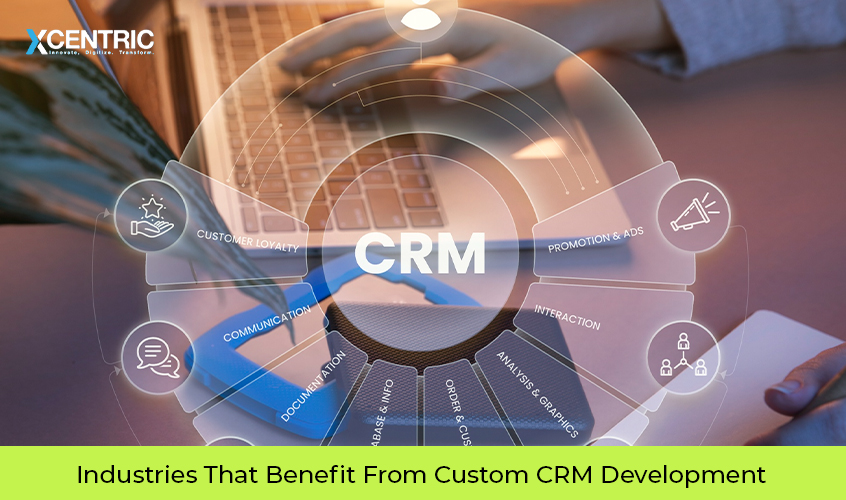
A well-developed CRM can become not just a business tool, but the operational core of a business. Particularly in industries in which relationships with customers are complicated or consist of several stages.
In the case of real estate, a CRM system allows you to control the scope of work with real estate, track the leads of real estate, and improve the visibility of agents in relation to the real estate listings and the real estate customers. It allows you not to lose the real estate from the moment of inquiry to the moment of closing the transaction.
Healthcare Organizations
They implement CRM systems to control and coordinate the engagement of real estate with patients, and to track real estate with patients. When handling patients' sensitive health records, healthcare CRM systems are designed with compliance with US regulations such as HIPAA in the US.
Finance and Fintech
CRM systems and platforms help support a client's real estate with compliance to the relevant US real estate where real estate is subject to the relevant real estate frameworks.
Retail and E-Commerce
These companies develop CRM systems to unify and coordinate customers’ real estate across various channels, manage loyalty programs, and enhance the personalization of retail and customer experience.
Manufacturing
They develop and implement CRM systems to streamline the processes of distributors, track client real estate, and support post-sales operations in the after-sales real estate.
Logistics
These companies develop and implement CRM systems to manage supplier real estate, coordinate supply real estate, and monitor real estate to support real estate across an order.
Xcentric collaborates with businesses in these areas as they develop from scattered systems to integrated CRM ecosystems that enhance genuine operational activities instead of requiring employees to adjust to software constraints.
Understanding Pricing Models and Engagement Structures
Before signing a contract with a CRM development company, you need a full understanding of pricing and how it affects your control and flexibility. This includes consideration for the long-term costs. Many of the CRM failures that you will witness actually relate to the CRM’s financial structuring and the clarity of that structuring.
For the development company of your crm, the two main models that underlie their engagements will either be Fixed Contracts or Time and Materials (T&M). Each of the two has stark differences.
A Fixed-Price model is the best option when a project's scope is clearly defined at the outset. A Fixed-Price model is temporary by nature, as it is best suited for small CRM builds or clearly defined MVPs. A Fixed-Price model can also become ineffective when the scope evolves, as changes will necessitate a new contract, complicating the relationship.
Unlike a Fixed-Price model, a Time and Materials (T&M) model is flexible, which requires paying for efforts made rather than paying for the completion of the project. A T&M model is ideal for sophisticated or dynamic CRM systems whose requirements develop through the Discovery Phase and are iteratively defined through the development lifecycle.
Engagement Model | Best Use Case | Key Advantage | Key Risk |
Fixed-Price Contract | Small to mid-sized defined CRM builds | Predictable budget | Limited flexibility |
Time and materials (T&M) | Complex or evolving CRM systems | High flexibility | Cost variability |
Hybrid Model | Enterprise CRM projects | Balance of control and agility | Requires strong governance |
A responsible CRM development team will not propose a single pricing model for various engagements. Rather, they will provide a proposal based on defined scope, complexity, and grade of interconnectivity of the proposed solution.
This also points to the importance of defining milestones, acceptance criteria, and the procedures for handling changes. In the absence of these, the best engagement model will lead to scope creep, surpassing the budget.
Red Flags to Look For Before You Commit to a CRM Development Company

The majority of contracting companies don't select the correct crm development business partners due to technology issues. It's because they disregard the early warning signs. It's a sign of a guess rather than an understanding of the scope when a vendor omits the discovery phase and swiftly proceeds to quoting. Consequently, this results in poor estimates of the scope, along with inaccurate schedules and budget overruns.
Another warning sign to look for is an imprecise Statement or Absence of Actions (SOW). Progress cannot be measured within a system when delivery, milestones, and acceptance criteria are not listed front and center within a framework. There is a great deal of risk (lock in within a system) when the vendor does not have a clear process for multiple parties to clarify ownership transfer of the system.
The absence of a T&M billing model is far more likely to allow control over costs within an evolving project. Organizations are not likely to have a struggle with the system's post-launch support if a billing model does not specify control over costs (within an evolving project which likely results in T&M).
An absence of privacy and security issues has also been a red flag when project partners are unable to comment otherwise on similar-size project partners. Your post-launch (support) has also been a red flag if at value visits post-launch you have been neglected. Offers T&M without control on costs is also a red flag.
What Every CRM Development Contract Must Include
The foundation is what the expectations of delivery that are the cornerstone of quality that are support as the cornerstone of the system when it is signed.
For an agreement to be concrete, it needs to contain a Statement of Work (SOW) defining scope, milestones, dependencies, and acceptance criteria. Without one, project direction is subjective.
Intellectual Property (IP) clauses should be inclusive of the systems’ entire code, database, and integration protection. In this case, the systems’ code is your property.
Payment terms should be explicit in defining either a Fixed-Price Contract or a Time and Materials (T&M) engagement. These clearly hold teams accountable for payment only upon the achievement of contractually specified milestones.
To control your risk, a Break Clause should be incorporated. This allows for a project to be pulled if any large deviations should occur.
Security is in control through a Non-Disclosure Agreement (NDA) for the length of the project.
The protection of a Post Launch SLA is a longer-term safeguard in the assurance of the system's integrity/breakage over the period specified for response and the repair of the system.
Contract Element | Why It Matters |
SOW | Prevents scope ambiguity |
IP Ownership | Ensures full system control |
Billing Model | Prevents cost overruns |
Break Clause | Reduces long-term risk |
NDA | Protects sensitive data |
Post-launch SLA | Ensures system stability |
How CRM Architecture and Scalability Decisions Impact Long-Term Success

One of the most important aspects of building a CRM and what is a differentiating factor when choosing a CRM development team is the CRM's system architecture building blocks. The majority of the meetings will be about the features you need, the timing, and the expense, but the technology stack and foundation of how it will be built is what will deliver the long-term success of your CRM.
An optimized CRM is more than a standard database with some customizable elements. Scalable systems can be expanded in virtually every way without a large number of systems. Scalable structures accommodate operations automation, feature, or data additions, integrations, and restructures.
Companies that plan to integrate multiple systems rely on early sufficient ERP Integrations. Enterprises with finance, operations, or inventory systems, for example, rely on extensive ERP Integrations.
The design of the data structure is a critical consideration. Poorly designed structures often encounter problems with migrating after the system goes live. Poor data structures lead to many inconsistencies, deficits of records and reports, and most notably to user dissatisfaction.
The structure of a scalable CRM should be able to accommodate and design structures with:
An increase in the complexity of the data beyond the level of data that existed when the CRM was being designed
An increase in the number of users in the organization, both horizontal and vertical, in multiple levels, in multiple viewports that include multiple integrations and beyond
The need for increased workflow automation and more complex workflows
The experienced system design is more scalable than a settled degree. Building legacy systems for vendor lock-in is not where stagnation ends. Factor in this designed structure are the desired level of outcomes starting with the point of (first touch) implementation.
Architecture | Why It Matters | Long-Term Impact |
API design | Enables flexible integrations | Future-proof system expansion |
Modular architecture | Supports feature scaling | Easier upgrades and maintenance |
Secure data modeling | Ensures compliance readiness | Reduces risk exposure |
Growing infrastructure | Handles user and data growth | Prevents system rebuilds |
Smooth migration | Smooth onboarding from legacy tools | Higher adoption and accuracy |
For decision-makers, this is often the reason a CRM becomes a critical core system for the organization, not just for the organization but across multiple dimensions. An innovative partner like Xcentric dedicates time to core decisions during the initial Discovery Phases so that the system can remain viable after it goes live and isn’t only usable on Day One.
Why Xcentric is the Best CRM Development Company in the US?
Xcentric provides an innovative solution by blending their expertise with a business-first approach to the development of customer relationship management (CRM) systems. In delivering tailored solutions, instead of offering generic platforms that include unwanted complexity, Xcentric creates systems that are specific to how organizations work. Emphasis on usability, and measurable business outcomes persists throughout the engagement, from the initial discovery phase, through deployment and post-launch support. They also ensure to provide the following:
CRM developed in alignment with current operational workflows
No superfluous features or platform limitations
Constant fluidity of data via API and ERP connections
Faster project cycles with greater visibility
Provides continuous improvement and maintenance of the system
Unparalleled service compared to offshore solutions
The company's focus remains on creating systems that teams can successfully adopt and will continue to grow with confidence over time, regardless of the project being addressed. Customers wanting a long-term technology partner, in contrast to an occasional vendor providing the technology for development, turn to Xcentric for the strategic guidance, technical expertise, and operational reliability required for obtaining successful CRM implementations.
Frequently Asked Questions
What features should I ask a CRM development company about?
A company should have a well-structured approach to discovering new dimensions of a problem, a firm development plan, a well-defined document, and a cost structure that is guaranteed to remain the same. In addition, customer ownership of the system and guaranteed response time on customer service should be provided.
Are tailor-built CRM solutions better than yet-to-be-released CRM packages?
Pre-packaged CRM systems are geared to provide the same expected value to a wide customer base. Tailor-built CRM systems are designed to be proprietary, fully integrated, and built to your unique needs.
What is the cost for CRM development companies?
Simple systems might start at $40,000, and complex systems at $100,000 - $300,000. Advanced enterprise solutions may cost more. The final cost is based on complex systems and integrations.
What is the CRM development time frame?
With most CRM systems, the development time is 3 to 6 months. Simple MVPs may be developed in a shorter development time frame. Complex systems with integrations take longer.
What to consider when hiring a CRM development company?
Consider the company’s structured proposal, discovery process, and time of billing. Also consider the company’s time of support after release, and relevant experience or specialized industry knowledge.
What advances CRM systems?
Requirements not being defined, poor user adoption, and a missing Evaluation or Selection phase. Weak vendor selection and problem scope creep are also reasons.
What is the difference between a structured CRM, Salesforce, and HubSpot?
Salesforce and HubSpot are generic platform-based CRMs that charge yearly subscriptions. A custom CRM requires full ownership, and the process is more structured.
What does the CRM development contract consist of?
An established contract includes the SOW, ownership rights, time of billing, and confidentiality agreement. These also need to include a breakdown clause, post-contracted, and service level agreements.
Why is Xcentric the best CRM Development Partner?
How CRM systems are developed is based on client needs, and customers notice the impact. Xcentric is a CRM software development company focused on real business systems. The company includes clarity, precision, and scalability.
Share



Want To Increase Your Ranking On The Search Engines?
Get In Touch With Us!
Trending Blogs
Digital Marketing...
Xcentric Team
7 MONTHS AGO


What To Read Next?

For owners and managers of dental clinics in Lahore, here is a critical fact you...
Xcentric Team
7 MONTHS AGO

The Middle East e-commerce industry is rapidly growing due to increased digital acceptance, mobile-first consumers...
Xcentric Team
8 MONTHS AGO

These days, the e-commerce industry is growing at an exponential rate. With the rise of...
Xcentric Team
8 MONTHS AGO