
Table of Contents
▼Node.js Backend Development for USA Companies (2026): Insights, Best Practices & How to Hire the Right Experts
Staff Augmentation
- Feb 13, 2026

To build the entire server-side tier of a web application with Node.js, developers follow a backend development process. This tier of the web application handles data flow, business logic, integration, application programming interfaces (APIs), and scalability.
Most web applications consist of multiple server-side applications hosted on different platforms. Until recently, web applications were built using a single-threaded (blocking) model, such as Apache, Nginx, or IIS, because this approach limited concurrency to a one-request, one-response model. These web applications have recently transitioned to a non-blocking (event-driven) model, enabling them to handle a significant number of concurrent connections.
In addition to the performance benefits of its non-blocking design, Node.js offers a wide range of third-party modules to enhance functionality. This enables developers to build high-quality applications for large-scale production systems and leverage all Node.js functionality and JavaScript libraries without writing any code. For these reasons, Node.js is a perfect candidate for creating modern web applications.
In this comprehensive guide, you'll learn what Node.js backend development is like today (2026), why it has captured a large share of the US market, what best practices you should follow when implementing Node.js backend development, and how to select the best fit for your organisation’s Node.js way of processing.
What is Node.js Backend Development?
Node.js backend development uses JavaScript and the MongoDB database API to build the server-side portion of an app that processes a business's data, interacts with customers, and integrates with other systems via Application Programming Interfaces (APIs).
Unlike many other backend environments, Node.js is an event-driven, non-blocking environment (i.e., it can handle multiple processes concurrently without blocking). Therefore, it can handle thousands of concurrent requests.
What Node.js Backend Developers Develop
Typically, when you think of what a Node.js backend developer does, think about:
- Developing REST APIs and developing GraphQL APIs
- Building authentication and authorization applications
- Creating a database layer using either MongoDB or PostgreSQL
- Implementing a real-time feature set using Socket.io
- Building cloud or serverless JavaScript applications
- Using a microservices-based architecture
What Business Drivers are Causing American Companies to Adopt Node.js (2026)
The business case for USA-based companies adopting Node.js is clear. Node.js aligns closely with the goals of startups and companies based in the US. Therefore, if you are a startup in the US that needs to be able to respond to customer needs quickly, and if you need to build your company as rapidly as possible while maintaining a high level of service to your customers, there is no other choice but to select Node.js. Node.js aligns with the goals of US startups and enterprises (speed to market, scalability, ROI).
Major Business Benefits:
- Velocity of Development with JavaScript and TypeScript
- Reduced Cost of Infrastructure due to Resource Efficiency
- Increased Ability to Scale Up for Startups and Enterprise
- Large Number of Node.js Developers Available in the USA
US Adoption of Node.js by Type of Company
| Business Size | Adoption of Node.js |
|---|---|
| Startup | MVP and Rapid Product Development |
| Mid-sized Company | API-first SaaS Platforms |
| Enterprise | Microservices and Modernization of Systems |
| Fortune 500 | High Volume, Mission Critical Systems |
Node.js is no longer experimental; it is tried and true in the enterprise.
Best Practices for Node.js Backend Development for 2026
Professional backend development with Node.js will be conducted in accordance with enterprise-level best practices for scalability, maintainability, and security in 2026. US-based Node.js consulting and development firms will emphasize long-term architectural decisions over quick, short-term solutions.
TypeScript will be the dominant standard for backend development with Node.js, as more enterprise-class Node.js projects use TypeScript than ever before. This will improve code quality, reduce risk during refactoring, and increase collaboration among remote teams. Any modern Node.js development organisation based in the USA will strongly recommend using TypeScript when building backend systems.
Selecting a framework is also very important. Express.js remains a favourite for lightweight REST API development, while NestJS has become the go-to framework for enterprise-scale Node.js development, thanks to its modular/web service architecture and built-in support for microservices. Fastify is often used for performance-critical applications, while Koa.js is the most preferred framework for building minimalist backends.
API-first development is the standard approach to building applications today. Most backends are built in Node.js and leverage REST or GraphQL APIs (many with OpenAPI specifications), enabling scalable backend services, versioning, and easy consumption by frontend and mobile applications.
Modern Node.js Backend Architecture Trends in the United States
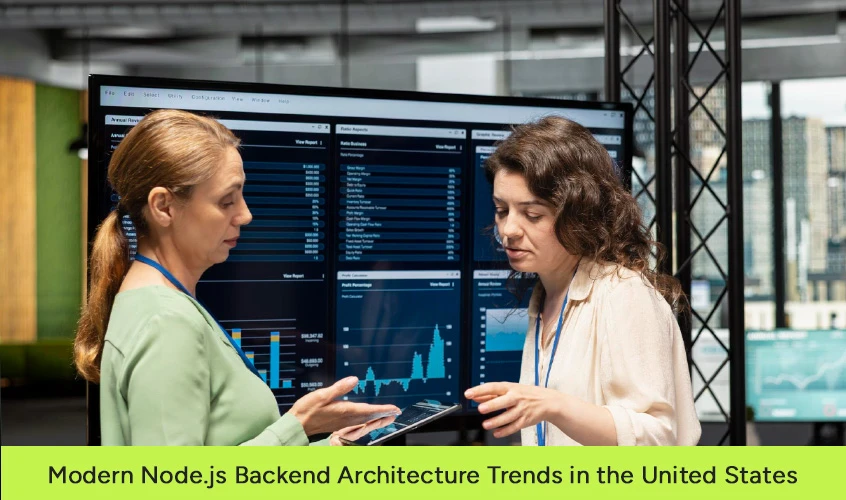
In 2026, the Node.js backend architecture will vary significantly depending on company size, industry, and growth stage. For example, early-stage startups in the US typically use a modular monolith architecture, while enterprise-level companies typically use a microservices architecture for Node.js development to enable independent deployments and scalability.
Serverless application development using Node.js has also been on the rise in the United States. Companies use services like AWS Lambda to deploy and manage their Node.js backend services, enabling automatic infrastructure scaling and lower infrastructure costs. As a result, this deployment type is especially common for API development, background processing, and event-driven development.
Standard Architecture Models for Node.js
| Architecture Type | Typical Use Case |
|---|---|
| Monolithic Node.js Backend | MVP's/Early-Stage Start-Ups |
| Microservices Architecture | Enterprise/High Scale Platforms |
| Serverless Node.js Backend | Cost-Efficient/Event-Driven Systems |
| Hybrid Architecture | Legacy Modernization |
Xcentric Services assists U.S. companies in selecting the appropriate Node.js version based on their performance goals, compliance requirements, and future growth. Given cost savings, Node.js Microservice Development and Serverless Using Node.js are increasingly popular with US companies.
Node.js vs Other Back-End Technologies (Python, Java, PHP)
Many U.S. businesses that choose a back-end technology will evaluate Node.js against alternatives such as Python, Java, PHP, and Go. While each has its own advantages, Node.js has consistently been the best-performing technology across categories such as real-time performance, API scalability, and development speed.
| Technology | Best For | Limitations |
|---|---|---|
| Node.js | Real-time apps, APIs, microservices | CPU-intensive tasks |
| Python | Data science and AI workloads | Async event and speed of concurrency and pipeline execution |
| Java | Large enterprise systems | Development speed |
| PHP | Legacy web applications | Scalability issues |
For modern SaaS platforms, Fintech systems, and Real-time applications in 2026, Node.js remains the go-to back-end technology.
API Development In Node.js
REST vs GraphQL API in 2026
Both REST and GraphQL APIs remain critical in Node.js back-end development.
| API Type | Best For |
|---|---|
| REST API | Public APIs, integrations, and mobile applications |
| GraphQL | Complex, composite/mapping data relationships and dashboards |
Many Node.js developers in the USA will continue to evaluate and select these two Types of APIs as backends in 2026.
Node.js Compared to Other Languages for Backend Development in 2026
| Criteria | Node.js | Python | Java | PHP |
|---|---|---|---|---|
| Performance | High | Medium | High | Medium |
| Real-Time Application Performance | Excellent | Limited | Moderate | Poor |
| Scalability | Excellent | Good | Excellent | Moderate |
| Speed of Development | Very Fast | Fast | Slower | Fast |
| Enterprise Adoption (USA) | Very High | High | High | Declining |
Node.js remains the leading choice for real-time application development, SaaS backend implementations and building API-rich platforms.
When Should You Choose Node.js Over Other Technologies?
Companies should choose Node.js if:
- High concurrency/throughput and performance are paramount
- You require rapid development/deployment
- Real-time capability is a critical need
- Scalability at a reasonable cost is essential
Industry Examples of Node.js Backend Implementations
| Industry | Examples of Applications for Node.js |
|---|---|
| Fintech | Systems for handling payments, fraud detection systems |
| Health | Backend solutions complying with HIPAA standards |
| E-commerce | Engine for managing orders, inventory and prices |
| SaaS | Back-end multi-tenant systems |
| Real Estate | Aggregating and analyzing real estate data |
To meet regulatory and performance requirements, Xcentric Services provides industry-specific Node.js back-end solutions.
Which Types of Companies Should Use Node.js for Backend Development?

Node.js is the ideal software for the following companies:
- U.S. startups developing MVPs
- Enterprises modernizing legacy systems
- Companies requiring real-time communication capabilities
- Businesses scaling their APIs and microservices
- Organizations adopting cloud-native platforms
How to Find Node.js Developers in the U.S.
In choosing Node.js backend developers in the United States, the following things should be reviewed:
- Knowledge of TypeScript and modern JavaScript
- Experience in RESTful APIs and/or GraphQL APIs
- Database skills (PostgreSQL, MongoDB, Redis)
- Ability to deploy to the cloud using AWS and Docker
- Experience with CI/CD (Continuous Integration/Continuous Delivery)
Cost of Node.js Development in the United States (2026)
For startups, scale-ups, and enterprise participants, understanding the cost of Node.js backend development in the U.S. is critical to planning long-term digital investments. Beginning in 2026, the expected costs of node backend development will be as follows:
Scope/Complexity of a Project
A simple REST API or MVP backend will cost less than a full-scale, node.js based enterprise application with microservices, 3rd-party integrations, authentication layers, and compliance requirements. Real-time communications, payment processing, and analytics pipelines require more development effort.
Architecture Choices
US companies are increasingly switching to microservices or serverless Node.js architectures. While upfront costs may increase, these approaches reduce overall infrastructure costs over time.
Team Composition
Hiring Sr. Node.js backend developers/architects will cost more initially, but ultimately result in:
- Fewer design issues
- Fewer production issues
- Faster delivery times
- Lower long-term maintenance costs
Engagement Models
Fixed price Node.js projects work best for those with a well-defined scope. Hourly Node.js developers provide flexibility as the product evolves, and dedicated Node.js teams deliver cost-effective support for ongoing project development.
Hiring Models Available to Companies in the U.S.
| Hiring Model | Applicant Suitability |
|---|---|
| In-house Developers | Long-term core products |
| Staff Augmentation | Short-to-medium term scaling |
| Dedicated Team for Node.js | Ongoing development |
| Outsourcing to U.S. Providers | Predictability in delivery |
Xcentric Services helps us identify the most cost-effective approach to Node.js development based on our goals, not just budget.
Why Go With Xcentric Services For Node.js Development?

A known name in Node.js development in the USA, Xcentric Services is a digital and design company in the USA specifically focused on providing professional Node.js backend development to startups, medium-sized, and large-sized businesses.
Instead of providing general development work, Xcentric Services provides custom Node.js solutions that are aligned with your overall business strategy, goals of scalability and plan for your long term growth.
What Makes Xcentric Services Different?
Xcentric Services combines technical excellence with business-first thinking to be the best choice for Node.js development amongst American companies.
- Node.js backend architects with real-world enterprise experience.
- Deep knowledge of the entire enterprise Node.js development landscape, including Nest.js and microservices.
- Focus on creating secure, scalable and high-performance backend systems.
- Full cycle delivery solution - from the architecture design stage to deployment and optimization.
- Collaboration that is on-shore, specific to the US business culture and time zones.
If you need to build a back-end using the Node.js environment, hire a Node.js consultant or migrate your old systems/legacy applications to Node.js, then Xcentric Services is your partner in building platform-agnostic (future-ready) back-end systems that can grow along with your organization.
Conclusion
Using Node.js for back-end development is a strategic decision with long-term implications for companies in the highly competitive US market. By using the right architecture, adhering to the latest industry standards/best practices, and partnering with a qualified development company, Node.js will enable your organization to achieve rapid growth in revenue, innovation, and long-term financial returns.
Xcentric Services provides onshore Node.js Development Services throughout the United States. We have partners in every tech hub in the United States and will continue to expand as needed to support your businesses. With a national presence and the ability to consistently fund US-based startups, enterprises, and Fortune 500 clients, Xcentric provides consistent quality and communication throughout.
If you are considering hiring Node.js developers to build a scalable back end or modernize your enterprise system or product, Xcentric Services can guide and support you throughout the process.
Frequently Asked Questions (FAQs) about Node.js Development
Q. What is Node.js Backend Development?
Node.js backend development is the process of developing "server-side" systems utilizing the Node.js programming language to create application programming interfaces (APIs), relational databases, user authentication, backend-integrated applications, and real-time capabilities.
Q. What are the advantages of using Node.js for Backend Development?
Node.js delivers superior quality, high performance, scalability, reduced development cycles, and cost-effective solutions for developers and end customers alike.
Q. What is the price for hiring Node.js developers located in the US?
The cost to hire a Node.js developer depends on the developer's experience level, your project's complexity, and the engagement model you select. When you partner with a Node.js development company in the United States, such as Xcentric Services, you receive clear, predictable pricing.
Q. Who would want to use a Node.js development company?
The businesses that will benefit most from hiring professional Node.js developers are startups developing minimum viable products (MVPs), organizations (enterprise) upgrading from legacy systems, and businesses that are growing their back-end infrastructure.
Q. Where can you find Node.js developers located in the US?
You can either hire US-based developers to work on-site or partner with an experienced US-based Node.js development company (such as Xcentric Services) with a proven track record of dependable enterprise-level deliverables.

Share



Want To Increase Your Ranking On The Search Engines?
Get In Touch With Us!
What To Read Next?
To build the entire server-side tier of a web application with Node.js, developers follow a...
Xcentric Team
8 MONTHS AGO