Table of Contents
▼CRM vs ERP: What They Do Differently and How to Choose the Right One for Your Business
- Jun 18, 2026
Almost every small business that continues to grow seems to encounter these challenges at some point. What used to work as systems when the company was smaller, cease to work. Customer information exists on spreadsheets. The sales team uses their inboxes to manage their opportunities. Inventory is tracked using different tools. Financial reporting takes too long to generate. And due to all this, different teams have different versions of the truth.
At this stage of the challenges, business leaders begin considering installing either ERP or CRM systems.
The biggest problem is that lots of organizations know they have a software problem, but cannot figure out what exactly their software problem is. Do they need a CRM system to improve their customer acquisition and retention? Do they need ERP to have control over Inventory, Finance, Procurement, and Operations? Or do they need both?
Both CRM and ERP systems solve different business problems, and choosing the wrong one can lead to costs, low adoption, and business frustration, while the right one can address visibility, operation, and promote business growth and sustainability.
This document provides information on the distinctions between the two systems, their gray areas, how to determine which of the systems is a priority for your business, and the reason most businesses that grow have the need for both systems.
If the business has a need for a tailored system for their business operations over prefabricated systems, knowing this is the first step to determine the software gap for the business and whether a custom system development is the right solution.
What is a CRM System?
CRM software allows companies to manage their customer relationships during and after the sales process. You can think of a CRM system as the front office system. It provides sales, marketing, and support teams with a centralized and consistent view of the customer, as opposed to fragmented spreadsheets, tools, and individual employees.
Most CRM systems today are designed to manage the following:
CRM System Function
Capture and organize potential customers
Track deals through all sales stages
Store records of customers and their interactions
Automate and measure marketing campaigns
Track and manage customer support interactions
Analyze and report on sales and marketing
The most important goal of all CRMs is the same: To enhance customer relationships in order to maximize sales.
Visibility of customer preferences and communication history, along with a view of all sales interactions and what opportunities are still open, helps sales teams be more productive. When marketing teams have a view of all customer interactions, they can allocate their resources more efficiently. This leads to the creation of a more customer-centric support process.
This explains the rapid growth in CRM adoption. According to a 2023 report by Fortune Business Insights, the global CRM market was valued at $101.41 billion in 2024 and is expected to grow at 12.8% CAGR to $262.74 billion by 2032. DemandSage adds that 91% of companies with 10 or more employees have CRM software, and that CRM software is critical for companies that are focused on growth. Salesforce, HubSpot, Zoho, and Microsoft Dynamics 365 are widely used CRMs.
What is an ERP System?
Enterprise Resource Planning (ERP) software deals with a different side of the business. ERP deals with the internal business processes. While CRM deals with customer-facing processes, ERP deals with business processes that are internal to the business.
ERP is capable of bringing together all of the different departments that usually work in isolation, and it can create a single view of the performance of the business.
Typical ERP modules offer:
ERP Module | Business Function |
General Ledger (GL) | Financial accounting |
Accounts Payable | Supplier payments |
Accounts Receivable | Customer payments |
Inventory Management | Stock tracking and control |
Procurement | Purchasing and vendor management |
Human Resources | Employee records and payroll |
Supply Chain Management (SCM) | Logistics and fulfillment |
ERP primarily focuses on the process of fulfillment. Instead of focusing on the question, “How do we get more customers?” ERP focuses on the question, “How do we get more customers with more fulfillment viability?”
ERP solutions are capable of helping businesses achieve the following:
Minimize the inaccuracies that occur with inventory
Enhance the accuracy of financial reporting
Streamline the process of procurement
Oversee operations that take place in multiple locations
Fulfill the requirements of compliance
Achieve a higher level of visibility in relation to operations
Some of the best ERP solutions in the market include SAP S/4HANA, Oracle ERP Cloud, NetSuite, and Microsoft Dynamics 365.
For most businesses, ERP systems become essential around the time operational complexities are creating bottlenecks that directly impact profitability and customer satisfaction. Explore our Odoo CRM implementation services for a flexible ERP option
CRM vs ERP: What They Do Differently
The simplest way to differentiate between CRM and ERP is to see where value is created in the business by each of them. While CRM systems have a perspective that is external and relates to customers, ERP systems have an internal perspective that relates to business operations.
Dimension | CRM | ERP |
Primary Focus | Customer relationships and revenue | Internal business functions and their efficiency |
Core Users | Sales, marketing, and service teams | Finance, operations, purchasing, and HR teams |
Data Managed | Leads, opportunities, and interactions | Inventory, finance, payroll, and purchasing |
Business Goal | Grow revenue and improve retention | Decrease cost and increase efficiency |
Implementation Complexity | Lower | Higher |
Best For | Growth challenges | Operational challenges |
Examples | Salesforce, HubSpot, Zoho CRM | SAP, Oracle ERP Cloud, NetSuite |
Comparison may look simple, but it is rarely that straightforward.
Take, for example, a business with good revenue generation and poor inventory management. In that case, ERP would come first. In contrast, a business with good operations but poor sales would make a CRM investment first. It is not about which is better.
What system is creating the most issues, and in turn, the most scaled growth limitations?
CRM and ERP Evolution
Understanding the evolution of these two systems sheds some light on why they are different today.
Decade | CRM Evolution | ERP Evolution |
1980s | Contact Databases | Materials Requirement Planning (MRP) |
1990s | Sales Force Automation (SFA) | Enterprise ERP Suites |
2000s | Web-based CRM | Integrated ERP Systems |
2010s | Cloud CRM | Cloud ERP |
2020s | AI CRM | Smart ERP Ecosystems |
CRM systems began with the idea of improving the management of sales relationships. ERP began with control of manufacturing resources and the let of planning production and control inventories.
Both have grown immensely since, but what started them both, and why they create the value they do, has not changed.
CRM and ERP Systems and Business Performance
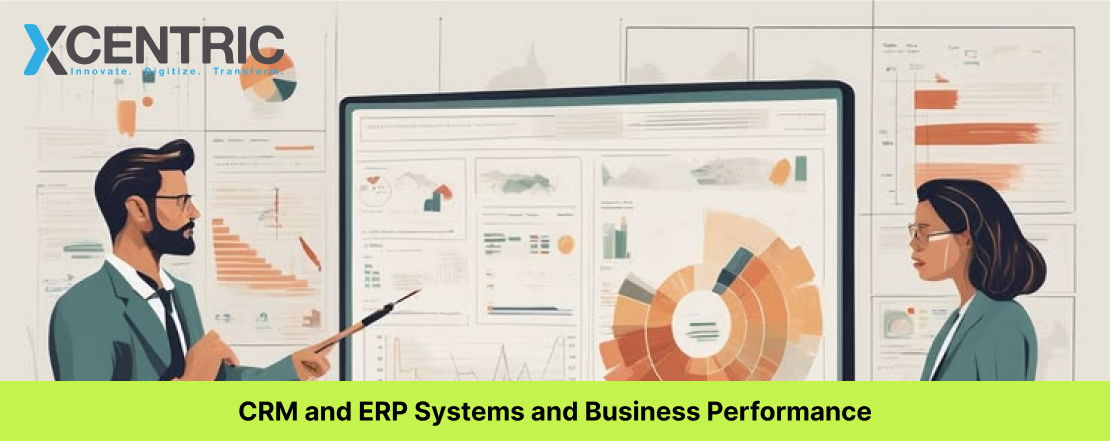
An important distinction to recognize is the different business outcomes that CRM and ERP systems provide. Here is how performance is impacted by each system:
Business Metric | CRM Impact | ERP Impact |
Revenue Growth | High | Moderate |
Customer Retention | High | Indirect |
Inventory Accuracy | Low | High |
Financial Reporting | Low | High |
Operational Efficiency | Moderate | High |
Forecasting Accuracy | Moderate | High |
CRM systems enable businesses to better control prospecting and the customer retention life cycle, while ERP systems enable businesses to better control operational efficiency, resource, and process wastes.
When comparing different business systems, organizations should determine the different business performance metrics that each system is designed to improve, rather than the different features that each system provides.
Where CRM and ERP Overlap
This is where a lot of businesses get mixed up. Most comparison articles put CRM and ERP systems on opposite sides of a continuum. In fact, there is a lot of similarity between the two.
Both systems have the following:
Contain customer data
Have a reporting function
Improve visibility and decision-making
Support automation
Help achieve business growth
The main difference is in the information they emphasize. CRM systems deal primarily with customer interactions, while ERP systems deal primarily with the fulfillment of customer orders and the associated financial transactions.
Together, they improve the management of customer relations and business operations. This is part of the reason many expanding companies generally prefer integrated CRM and ERP rather than considering them as separate frameworks.
How to Choose Between CRM and ERP?
Choosing the software only according to the features, but ignoring the business challenges while implementing them, is one of the major mistakes companies make. CRM systems and ERP systems both aim to make companies more efficient, but in different aspects. Which one is the best pick depends on which one most inhibits the company’s growth.
If your company struggles to reach customers, manage customer relations, or improve its sales, then CRM is usually the best pick.
If your team struggles to track leads or reach out to them, poorly measures the results of marketing, lacks visibility in their sales funnel, or struggles to make sales, you likely benefit from a CRM. A CRM aids in structuring interactions with customers and shows sales opportunities.
Consider implementing a CRM system if:
You have a large team that loses track of leads and follow-ups
You have leads that are generated by your marketing campaigns, but do not convert to sales
Your marketing campaigns generate sales leads, but the leads are not being followed up
Your sales team lacks visibility in the sales funnel
Your sales team struggles to track leads
Your sales team is unable to make reliable and accurate sales
Your customer relations are poorly managed
Customer retention has been declining
Customer relations are not managed
On the contrary, when ERP systems and software become a priority when operational complexity impacts negatively on your profit’s bottom line, efficiency, and customer satisfaction.
Many companies reach a stage where reporting and tracking different entities becomes burdensome, and each division operates in silos. Disconnected systems and operational complexity become ERP system and software priorities.
Consider using an ERP system if:
You can no longer manage inventory effectively
Financial reports take too long and contain too many mistakes
Procurement lacks tracking and transparency
Multiple departments are using different systems
You frequently cannot see your supply chain
You anticipate more demands for compliance and audits
Your business is expanding into areas, warehouses, or with more employees
When to Integrate ERP and CRM Systems?
Many growing organizations are at a stage where both systems need to be integrated. When sales growth results in operational complexity and when operations are advanced and require greater visibility for customers, then ERP and CRM are integrated systems that work side by side.
Business Situation | Recommended First Step |
Sales growth is inconsistent | CRM |
Customer retention is declining | CRM |
Marketing ROI is unclear | CRM |
Inventory errors are increasing | ERP |
Financial reporting is unreliable | ERP |
Multiple departments use disconnected systems | ERP |
Sales and operations both need visibility | CRM + ERP |
Mid-sized business scaling rapidly | CRM + ERP |
The purpose is not to deploy more systems; the purpose is to address the most significant business challenge.
Common Mistakes Businesses Make When Choosing CRM or ERP
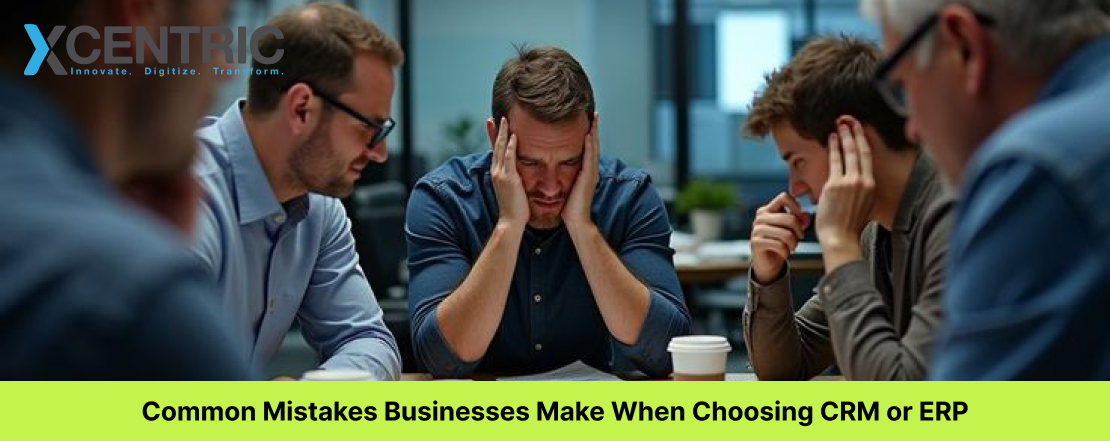
First, companies focus on the technology and then on the business problem, and the second common mistake is that the early implementation of ERP fails.
ERP systems are highly capable but require a higher level of investment, greater standardization of processes, training, and further buy-in from the organization. Small businesses that still have relatively simple operations may not have enough complexity to justify the full ERP. CRM systems should not be expected to fulfill the functions of ERP systems.
A CRM can help with customer relationship management, but it does not help manage financials, inventory, or purchases and does not fulfill those needs. Companies that force CRM software into these roles create data problems and a need for cumbersome workarounds. The integration needs of CRM and ERP systems are also often underestimated.
A sales team's chosen CRM and a finance team's chosen ERP can both be good systems, but if they are not integrated, they will be data silos. Designing with integration in mind is less expensive.
Lastly, the most popular system is not always the best, and a good system helps with the industry, has the reports and can help scale the team. This is one of the many reasons companies will choose a custom system.
What About Using Both Together?
As companies scale, the conversation tends to shift from CRM or ERP to CRM and ERP. Having both systems provides a more thorough understanding of the business. CRM systems cover the management of customer relationships and revenue.
ERP systems cover the management of the business’s operations, fulfillment, inventory, finance and the business’s internal processes.
When both are adapted to the business, they in tandem allow for the seamless sharing of data.
CRM and ERP Integration Workflows Sample
Event in CRM | Action in ERP |
Customer account created | Customer record created |
Opportunity win | Generate sales order |
Record sale | Adjust inventory |
Request billing | Initiate financial workflow |
Renew contract | Adjust revenue forecast |
Raise a customer support case | Increase operational visibility |
Integrating ERP with CRM systems enhances the visibility of business operations. It streamlines data entry and reporting. The integration helps business leaders view performance metrics. This integration helps achieve the purpose of having a single source of truth.
Businesses manipulate information for analysis and decision-making. The integration eliminates disparities in customer data, finance, and operations.
Modern API Integration and Business Systems
Modern ERP and CRM systems leverage integration technology, enabling data flow across systems and modules.
For instance, a salesperson wins a deal in Salesforce, and the system automatically creates the customer account in the ERP. The ERP system checks whether the product is available for sale. An invoice is prepared, and the order is shipped. The finance team is notified of the sale.
The integration eliminates several manual steps in the sales, shipping, and finance processes. Most businesses regard ERP and CRM integration as the centerpiece of their digital transformation.
CRM vs ERP for Small Business
When contrasting CRM and ERP in small businesses, the competing factors overwhelm large enterprise versus small business comparisons. The key factors are small businesses’ financial resources, workforce, and time.
For this reason, many SMEs adopt CRM systems.
CRM systems tend to be less costly, easier to implement, and provide quick, tangible improvements to the sales and customer service functions of a business. For a business that is in the growth phase, the quicker gain from using CRM in order to improve customer conversion and retention is likely to be greater than the gain from using a business operations system that is designed to support large corporations.
Growth Stage Approach
Business Stage | Typical Software Need |
Startup (1-10 employees) | CRM |
Early Growth (10-50 employees) | CRM + Accounting |
Scaling SME (50-250 employees) | CRM + ERP |
Mid-Market Growth | Integrated CRM and ERP |
While this approach is not without exceptions, it does illustrate a common pattern. Limited service businesses with low resource turnover may be able to rely on CRM systems for many years.
Distributors and manufacturers, however, may need ERP systems to manage inventory and the supply chain much earlier. The answer to the question, "Do I need CRM systems or ERP systems?" should be based on your business model, the way you run your business, and your growth plans.
CRM vs ERP Systems Cost
Cost is one of the most important considerations when selecting a software system. However, focusing on the price of subscriptions alone can lead to poor decisions.
The real cost of ownership is the price of the system, plus the cost of implementing, configuring, training on the system, integrating the systems, maintaining the systems, and supporting the systems.
Cost Considerations | CRM | ERP |
Price | Lower | Higher |
Time to Implement | Weeks | Months |
Time to Train Employees | Moderate | Significant |
Customization Level | Moderate | Extensive |
Integration Level | Moderate | High |
Long-Term Business Impact | Revenue Growth | Operational Efficiency |
When selecting a software system, businesses should look at the cost from a business perspective. A CRM system that helps improve conversion rates may provide a significant revenue increase.
An ERP that addresses financial inaccuracies and inventory waste may offer notable cost savings. The highest ROI is typically achieved through the system that matches the organization's growth stage.
Conclusion
Our clients face the challenge of selecting the right system for their business and the challenge of implementing the right system for their business.
Most businesses find that the solutions available in the market require extensive customization for support. Many businesses find themselves not only paying for the customization of the system but also paying for features that will not be used. Xcentric Services breaks the limitations of customized software that does not meet the needs of the business.
Our customers will find that our custom solutions will meet the needs and support their growth, whether they require a custom CRM to meet their needs, a custom ERP to meet all of their needs, or a system that integrates the sales, finance, inventory and operations modules. Our team of experts is committed to working with the business to ensure that the needs of the business are met.
With many years of experience in ERP development, Xcentric provides full implementation support: discovery workshops, architecture planning, UI/UX design, development, systems integration, testing, deployment, and sustained support.
Custom ERPs help companies design better processes, obtain better reporting, and better cross-departmental visibility. For companies pursuing customer-focused growth, custom CRM development improves lead control, customer-focused activities, and sales.
Frequently Asked Questions (FAQs) About CRM and ERP
What is the difference between a CRM and an ERP?
CRM software is for managing sales and other customer-facing activities, while ERP software is for managing finance, inventory, procurement, HR, and the supply chain. Since CRM software is about increasing revenue, and ERP software is about managing processes, CRM software is more useful for growing organizations focused on increasing revenue, while ERP software is more useful for organizations growing past the complexity of managing multiple functions.
Is a CRM or ERP system more useful for my small business?
For most small businesses, a CRM system is more useful. Since CRM systems are simpler to implement and directly improve the process of acquiring paying customers, they are typically more useful for small businesses. ERP systems are helpful once the business grows in operational complexity. Automated sharing of data between multiple business functions becomes necessary.
Can CRM and ERP work together?
Yes, the integration of CRM and ERP systems makes the transfer of customer data, sales, inventory, and finance records work automatically. This improves enterprise visibility and eliminates redundancy.
Which is more important, ERP or CRM?
Neither is more important. ERP systems are for managing processes and operational efficiency, while CRM systems are for managing customer relationships and growing revenue. The best option is whichever of the two systems addresses the business problem.
What is a CRM, and how does it function?
CRM or Customer Relationship Management software is for managing customer data and sales opportunities. It automates customer service and marketing, which improves the efficiency of the formerly manual processes.
What does ERP do?
ERP Systems create connections across business functions. This includes finance, HR, procurement, inventory management, and supply chain. ERP provides multiple layers of visibility into business operations and assists in the evaluation of the performance of business processes.
What do CRM, ERP, and SCM mean?
Customer relationship management systems handle the management of business customer relationships. ERP Systems manage the operations of the business. Systems of supply chain management handle the systems and processes that move products from the business’s vendors to the business’s customers. ERP offers integrated SCM Systems.
What are the signs that your business needs ERP?
Business needs ERP when managing inventory is cumbersome, financial reports become irregular, business units work in redundant/ siloed systems, a business expands to operable units in geographically diverse locations, and/or when employee headcount rapidly increases.
Share



Want To Increase Your Ranking On The Search Engines?
Get In Touch With Us!
Trending Blogs
Digital Marketing...
Xcentric Team
6 MONTHS AGO
What To Read Next?

For owners and managers of dental clinics in Lahore, here is a critical fact you...
Xcentric Team
6 MONTHS AGO

The Middle East e-commerce industry is rapidly growing due to increased digital acceptance, mobile-first consumers...
Xcentric Team
7 MONTHS AGO

These days, the e-commerce industry is growing at an exponential rate. With the rise of...
Xcentric Team
7 MONTHS AGO