
Table of Contents
▼Custom API Development: How It Automates Workflows and Connects Your Business Systems
- Jun 30, 2026
In most cases, the problem in a business situation is not missing software. It is the lack of software interoperability. Most sales teams interact with customers through customer relationship software. Finance teams depend on accounting and ERP software. Marketing teams employ the use of automation software. Operations teams manage inventory and logistics with their own systems. All departments may very well have the appropriate technology, but if those systems cannot intercommunicate at the software level, then the employees become the interconnectivity layer.
This leads to redundant data entry, inconsistent data, and delays in reporting that create a backlog in operations and ultimately stifle the growth of the business. This is the environment in which custom API development services deliver a significant return on investment.
Custom APIs allow disparate software systems to intercommunicate and thus eliminate redundant tasks. Workflows become connected throughout the entire organization. Systems talk to each other, and employees are no longer burdened with the task of exporting spreadsheets and manual data entry.
Xcentric Services specializes in the design, construction, and maintenance of custom APIs that facilitate the automation of business workflows and the necessary digital framework for sustained growth.
What is Custom API Development?
An API, or Application Programming Interface, is a connective layer that permits disparate software systems to dynamically intercommunicate and invoke actions on each other.
Between applications, an API is like a middleman. An application can only directly access data and services within its own environment. To access data from another system, an application uses an API endpoint to send a request. The destination application processes the request and sends a response.
Need an API Built Around Your Systems?
Off-the-shelf connectors stop working once your workflows get specific. We design custom APIs that match how your business actually operates.
An API made to suit the needs of your business is an API customized to suit your business processes, workflows, and your business’s software environment. Generic connectors cater only to predefined requests, but customized solutions are designed to meet your business operations, compliance, and systems and workflow requirements.
For instance, a company may need to fetch customer data from Salesforce to create entries in its ERP system, adjust inventory, raise invoices, and send updates to its operations staff. An off-the-shelf connector may only be able to support one or two of these requirements. A custom solution can cover all of them.
Typically, the first step to workflow automation for most businesses is employing no-code solutions like Zapier. These offer simple connectors, but for big businesses with many transactions, complex security requirements, advanced business logic, and old systems like mainframes, these connectors become a roadblock. Naturally, this is the reason businesses move from simple automation frameworks to advanced API development as the complexity of their business operations grows.
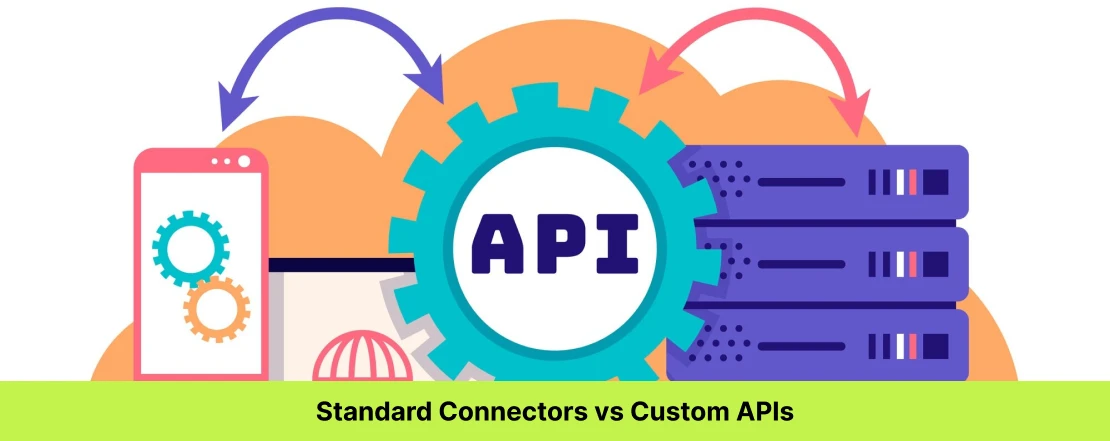
Standard Connectors vs Custom APIs
Factor | Standard Integration | Custom API |
Setup Speed | Fast | Moderate |
Workflow Flexibility | Limited | High |
Security Controls | Basic | Advanced |
Complex Business Logic | Limited | Fully Supported |
Legacy System Support | Rare | Common |
Scalability | Moderate | High |
Long-Term Control | Vendor Dependent | Business Owned |
How APIs Automate Business Workflows
The main driving force behind businesses automating their workflows is the development of APIs. Many organizations devote employees to time-consuming tasks that software could perform.
When APIs manage systems integrations, data flows where it needs to go without any personnel assistance. Using the example of a sales team that closes a deal in Salesforce, the API prevents the need for an employee to create the customer record by updating the ERP, billing application, inventory management, and customer portal.
Time savings, elimination of the opportunity for an employee to err when performing redundant tasks, and overall better data quality are additional benefits. The operational advantage that automation of business processes affords is causing rapid growth in this sector. The Business Process Automation market, per Grand View Research, was assessed at nearly $12.46 billion in 2022 and is expected to grow at a 9.0% CAGR to $24.79 billion in 2030.
Automate the Manual Work Eating Your Team's Time
From customer onboarding to order fulfillment, a well-built API removes the repetitive steps slowing your operations down.
The movement of data automation improves the accuracy and the speed of reporting and significantly lessens the burden of reconciling data. It also removes the friction caused by redundant, manual tasks. The examples of automation that is taken is as follows:
Customer onboarding
Iinvoicing
Inventory management
Payment processing
Lead routing
Order fulfillment
Customer notifications
Report consolidation
Workflow approval
APIs are the answer to the burden of employees moving redundant data.
Business Systems Integration: Professional API Integration Services
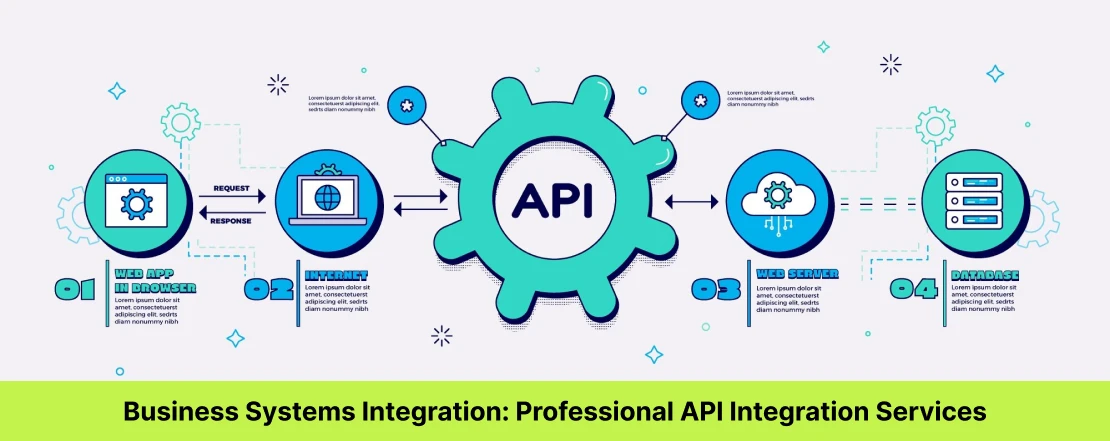
Most businesses have already invested in the software that they need. The challenge is making all of those systems work together. Connecting applications across departments and making data flow throughout the organization are the automation goals of professional api integration services.
The integration of systems work projects is a significant and valuable way to leverage business technology that has already been paid for. Typical integrations encompass a plethora of tools: CRM and ERP systems, accounting packages, inventory and logistics applications, marketing automation, payment processing, and a multitude of cloud services and portal applications. Organizations seek custom API integration services because standard connectors can't accommodate their unique business rules.
Health companies, for instance, may need to integrate disparate systems through healthcare software development to synchronize patient data while being HIPAA compliant. Logistics companies may require the integration of real-time shipping updates to customer dashboards, while SaaS companies may need billing, CRM, and support systems updated to reflect subscription events. It's abundantly clear that custom integrations provide the best solution for businesses with unique operations.
Common API Integration Use Cases
Use Case | Business Benefit |
CRM and ERP Integration | No more duplicate data entry |
Payment Gateway Integration | Reconciliation is no longer manual |
Marketing Automation | Improved campaign personalization |
Inventory Synchronization | No more overselling |
Customer Portal Integration | Enhanced customer experience |
Reporting Consolidation | No longer a manual spreadsheet |
Legacy System Modernization | Eternal software system |
At Xcentric Services, the starting point of an integration project is consideration of the processes that will provide the company the greatest operational impact.
Connect Your Systems Without the Workarounds
CRM, ERP, inventory, and legacy software talking to each other shouldn't take five different tools. We build the integration layer that ties them together.
Third-Party API Integration Services and External Platforms
Today's businesses are reliant on external software providers. This includes systems for CRM, payment processing, ecommerce, logistics, communications, and analytics. All provide an API for integration, making third-party API integration services indispensable.
Common integrations also include:
Salesforce
Hubspot
Stripe
Shopify
Twilio
QuickBooks
Google
To keep accurate counts of inventory, a retailer might link Shopify with warehouse software. An integration of Stripe with subscription management and customer support software could be an example of a connection made by a SaaS company. Automated population of operational dashboards with carrier data could be an example from a logistics company.
The difficulty does not lie in getting access to third-party APIs. The difficulty lies in the integrations remaining secure, dependable, and scalable with increased volume of transactions. Third-party integrations that are developed and maintained by Xcentric Services aim to support the reliability of operations in the long-term and lessen the load on internal teams.
Backend API Development Services That Support Growth

Beyond the integration, many systems expect high transactional capacity. APIs that handle this need are called backend APIs. Today, many systems rely on backend APIs to act as the operational engine for the system.
From user authentication to transaction processing to CRUD (create, read, update, delete) business rule fulfillment, modern backend systems rely on a constellation of technology to support business needs. Xcentric Services uses backend APIs to provide long-term scalability to our clients.
Complex Integration Needs of Large Enterprises
For large enterprises, the need for integration has outgrown connecting two simple pieces of software. To interconnect the various departments of large enterprises, which may use different systems and have different workflows and compliance needs, secure and scalable APIs are required.
In larger companies, advanced authentication, version management, API gateways, auditing, monitoring, compliance, and documentation become necessary for an API. Companies in regulated markets have to enable systems to talk to each other while being HIPAA, SOC 2, or GDPR compliant. Enterprise APIs act as a communication layer between many internal and external systems, including cloud systems and partner systems, customer portals, and reporting systems. Integration is not the end goal. Creating the infrastructure for a reliable digital system to support operations is the end goal.
REST APIs vs GraphQL vs FastAPI
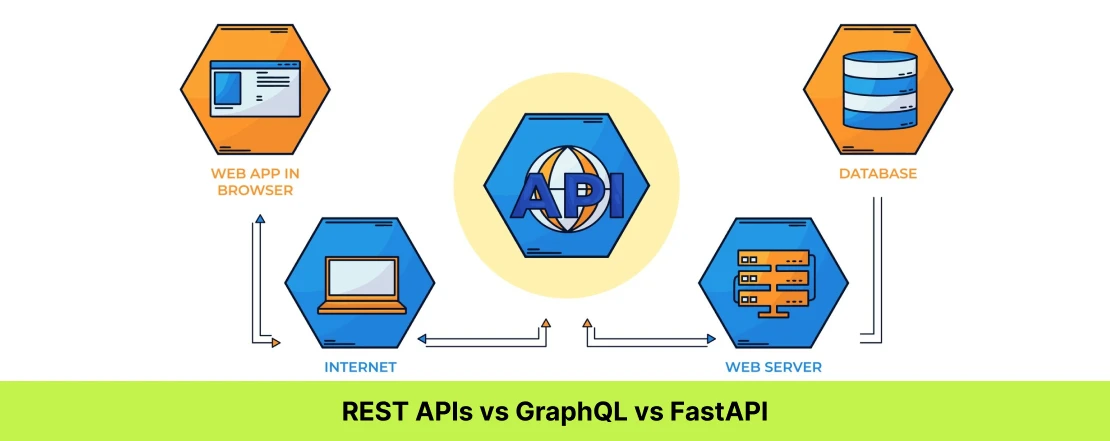
When thinking about which systems fulfill business needs best, consider API architecture options.
REST APIs
REST APIs are the APIs that are most commonly used, and for good reason. They are so widely used that an estimated 93% of companies use REST APIs, according to the 2025 State of the API Report, so companies seeking REST API development are likely looking at flexible, easily integrated, scalable, and compatible APIs. A good REST API development company should ensure that APIs are properly tested, monitored, secured, versioned, and documented.
GraphQL APIs
GraphQL acts to make data transfer more efficient. Companies that are looking for GraphQL API development to build SaaS applications, customer portals, mobile applications, and modern web applications built on stacks like MERN are likely making a good choice.
FastAPI Development
FastAPI is a framework for building modern API development with advanced features that are performance-oriented and built in Python. Companies that want FastAPI development services typically want development cycles that are faster than typical with high performance and a highly scalable data API service.
Since Python is one of the most flexible and widely used programming languages today and is a great programming language for a backend, API automation and even for machine learning services, companies weighing Node.js vs Python for backend development are not hard to find.
API Technology Comparison
Technology | Best For |
REST | General business integrations |
GraphQL | Flexible data retrieval |
FastAPI | High-performance Python applications |
SOAP | Legacy enterprise environments |
gRPC | High-speed microservices communication |
Webhooks | Event-driven notifications |
Custom API vs Off-the-Shelf Integrations
Companies typically think that every integration project has to do with custom development. More often than you think, the solution is as simple as using a no-code platform like Zapier. For example, if a company needs to transfer all captured leads from the form on a website to a CRM, then that can be solved easily and cheaply using Zapier.
That said, when the required integrations involve big volumes of transactions, lots of custom business logic, and proprietary and regulated systems, then custom development is the way to go. A company that has thousands of daily transactions may not be able to use no-code solutions anymore.
A company that deals with sensitive information is also likely to use custom development in order to implement secure API services of OAuth 2.0 combined with JWT. Companies that deal with regulated media also tend to use custom development in order to have a bespoke solution that meets all their requirements.
API Security, Documentation and Maintenance
A lot of companies tend to only focus on the API development and completely overlook the maintenance and monitoring. This is a very costly focus. APIs need to be maintained, monitored and continually updated as third-party service providers tend to modify their services.
Integrations can suddenly break when these kinds of things happen. According to PagerDuty's State of Digital Operations Report, diagnosing and resolving API incidents consumes the time and efforts of engineers, making proactive maintenance essential.
Security must be designed from the ground up
OAuth 2.0 allows the secure authorization of apps
JWT facilitates the validation of requests from trusted sources
Rate limiting ensures control over the number of requests sent to the system
Encryption preserves the confidentiality of information
API documentation also needs to be a priority
An API with inadequate documentation keeps users in a long-term cycle of dependency. Well-documented APIs allow users to understand how the system works, enabling them to debug and build on the system without having to do so from scratch. Swagger and OpenAPI align with industry standards and lead to APIs that are easier to maintain and incur less risk.
Xcentric Services includes testing and monitoring as part of API delivery, because successful integrations require management post-development.
How Much Does API Development Cost?
One of the first inquiries about API development is its cost. The simple truth is, it depends. Costs can be influenced by the number of required integrations, workflows, security, compliance, documentation, and even testing.
Estimated API Development Costs
Simple API Integration: $5,000 - $25,000
Mid-Complexity Project: $25,000 - $75,000
Enterprise Solution: $75,000 - $250,000+
These costs are derived from industry estimates by Space-O Technologies and Acquaint SoftTech. Organizations should also consider that development rates within the U.S. may be three to four times more expensive than offshore.
Several factors influence the cost of custom API development, including specific technologies, business goals, and security and maintenance requirements. The best way to estimate a cost accurately is during the discovery process.
How to Choose the Right API Development Company

The right agencies spend time understanding the business and its workflow, as well as the points of friction and integration challenges, before they begin to design a solution. The same diligence applies when choosing a Node.js development company, and they should also have experience with your preferred technology stack.
A development agency with experience in Salesforce, HubSpot, Shopify, Stripe, AWS, ERP Solutions, and various cloud solutions will carry a lower risk of implementation and have a quicker time frame. Consider their documentation practices. Many businesses wait to request documentation until they are in need of a new partner. Poor documentation increases the cost of future development.
Security is a component of every API, so the agency will need to build an API that actively manages and controls security and compliance. APIs will continue to evolve, and therefore, strong post-launch support is critical. The API agency will need to offer clear support and a transparent pricing model.
For development agencies that focus on long-term partnership and support, the cost of development is secondary, especially for custom solutions.
Why Businesses Choose Xcentric Services
API projects require extensive business and technical knowledge to be successful. Xcentric Services offers both. We partner with stakeholders to build solutions to address business pains through compliant and measurable integration strategies.
Our services include architecture considerations, API design and development, along with thorough testing, documentation, deployment, and adaptive monitoring with support.
Xcentric has the capabilities to provide your business with the solutions it needs to integrate with external CRMs and ERPs, automate payments, synchronize inventory, develop customer portals, automate reporting, and modernize legacy systems through custom web development. We are a reliable partner for clients looking to create scalable integrations to link operational ecosystems.
Conclusion
Custom API development becomes one of the best options available for improving a business’s operations in a digital and scalable manner. The development of custom APIs improves the interaction and interconnectivity of all existing software and systems without the need to replace the entire system.
Unconnected systems lead to extra costs and delays in operations, and it destroys confidence in your data. Xcentric Services helps clients strategically address these issues by designing custom APIs, Integrating Systems, Automating Workflows, and providing ongoing support.
We have the experience and skills you are looking for, whether it's custom APIs, enterprise integrations, REST APIs, GraphQL, FastAPI, complex third-party integration systems, or full business process automation solutions. If you want API integration services, or if you’re in the USA and need startup API development services, contact Xcentric Services to discuss your business needs
Frequently Asked Questions (FAQs) About Custom API Development
What is custom API development?
With custom API development, a unique integration method is built to automate the data transfer between systems. Custom APIs differ from generic connectors in that they are designed to address your specific business operations and constraints.
How much does custom API development cost?
Basic integrations typically fall between $5,000 and $25,000. For medium complexity, integrations usually fall between $25,000 and $75,000. For large enterprises, custom API development can exceed $250,000. These costs are approximate, and specific costs require the defining of project scopes.
What is the difference between a custom API and Zapier?
Zapier is a tool with prebuilt connectors, and it is simple to use for basic workflows. Custom APIs are built for more complex business needs and logic, systems that are proprietary, support large transaction volumes, and have high security constraints.
What types of APIs can a development company build?
Development companies can build a variety of APIs to meet their business clients’ needs. They can build REST APIs, GraphQL APIs, FastAPI, SOAP, Web APIs, gRPC services, and more.
How long will custom API development take?
Simple API development tasks take about 2 to 6 weeks. Custom APIs that are on a mid-range level of complexity take about 6 to 16 weeks. Enterprise environment APIs take 3 to 6 months and beyond.
What systems will custom APIs connect to?
APIs can connect HubSpot, Salesforce, Stripe, ERP systems, accounting systems, logistics, internal systems, custom legacy systems, and all cloud services.
What do you want in an API development company?
You will want to see their technical skills, discovery phase, how they control security, their documentation, support and maintenance after it’s done, the pricing, and the projects they have done with the same integrations.
Share



Want To Increase Your Ranking On The Search Engines?
Get In Touch With Us!
Trending Blogs
Digital Marketing...
Xcentric Team
7 MONTHS AGO


What To Read Next?

For owners and managers of dental clinics in Lahore, here is a critical fact you...
Xcentric Team
7 MONTHS AGO

The Middle East e-commerce industry is rapidly growing due to increased digital acceptance, mobile-first consumers...
Xcentric Team
8 MONTHS AGO

These days, the e-commerce industry is growing at an exponential rate. With the rise of...
Xcentric Team
8 MONTHS AGO