Table of Contents
▼
The staff augmentation vs managed services discussion has moved out of IT departments and into the boardroom. U.S. CTOs, IT Directors, and SMEs are all expected to trim the fat, increase throughput, and not increase fixed costs. On top of all that, businesses face an unsettled skill shortage alongside persistent system complexity and the accelerating pace of digital transformation. If we need to replace legacy systems, build new systems with the right technology stack, add people to engineering, or add technology to the perimeters, a situational talent model is required.
At this point, the difference between staff augmentation and managed services is relevant. Each model has a genuine answer to public demand for more resources and expertise, but the frameworks are completely different in terms of how resources are managed, frameworks of control, and long-term consequences.
This answer is going to define both in a more practical sense beyond simple definitions and will focus more on the potential impacts on the delivery of a product relative to price, and more strategically, on the flexibility of the delivery system, so that it more closely aligns with the expected business outcomes.
What is Staff Augmentation?
Staff Augmentation is an add-on option to a flexible resource pool. A flexible resource pool typically involves a temporary resourcing need that exists for a short or immediate period. Staff Augmentation involves the recruitment of people who will function within the organization on a constant basis but will operate under the ultimate control of the organization.
The staff augmentation model was developed to address the need for simplified and speedy recruitment. It is preferred when staff are employed on a time and material basis, allowing companies to pay for just the amount of time and expertise they require.
Descriptor | Information |
Example | Temporary |
Pricing Structure | Time and Material |
Management | Total Client control |
Team Structure | Within the Client’s team |
Intellectual Property | Ownership full to the client |
The design of a staff augmentation model facilitates the almost instantaneous scalability of teams during time-constrained business processes.
Staff Augmentation Process: From Need to Deployment
IT leaders with a focused, strategic approach to staff augmentation create an agile system for demand-based contracting and delivery. A typical engagement follows a lifecycle of the following sections.
Step | Specification |
Discovery | Includes internally identifying the aforementioned missing skills, along with the scope and required skills for the project |
Talent Matching | Vendor sources and presents pre-vetted candidates aligned with your needs |
Evaluation | Your team interviews and selects candidates based on technical and cultural fit |
Offboarding | Structured transition or exit once project goals are achieved |
How well a team manages the onboarding and integration of new staff is what clearly separates the high performers from the others. It is expected that augmented staff have a lower barrier to become integrated and should become “internal” contributors on the first day of engagement.
Structuring the Right Staff Augmentation Contract
A staff augmentation contract, once properly structured, should include
Clearly defined roles and responsibilities, along with deliverables,
A T&M (Time & materials) payment schedule,
An NDA (Non-Disclosure Agreement) in order to ensure confidentiality, and,
Clearly stated Intellectual Property (IP) in order for all work to remain in the company ecosystem
This means that, in the staff augmentation model, outsourcing talents should not mean losing control and ownership of these staff to the subscribing company.
Benefits of Staff Augmentation
Due to the several advantages of staff augmentation, the model is widely accepted by IT leaders. It is not just about how quickly the gaps in the staffing can be filled that makes staff augmentation a worthwhile investment. When viewed from a strategic standpoint, it becomes evident that staff augmentation better meets the internal requirements of the company. Traditional employment, on the other hand, involves a number of heavy processes.
Benefit | Business Impact |
Speed to Hire | Trim recruiting to days, not months |
Cost Efficiency | No long-term salary, benefits, or overhead |
Flexibility | Instantly adjust team size to meet demand |
Specialized Skills | Hard-to-find skills available on demand |
Full Control | Direct management of team, workflows, and outputs |
IP Security | All work product remains proprietary to your company |
For businesses in fast-moving sectors, this kind of flexibility provides a clear competitive edge when it comes to product launches, market entry, and meeting new customer needs.
Staff Augmentation: Pros and Cons
IT management can guard against common mistakes by weighing the pros and cons of staff augmentation.
Pros | Cons |
Scalable | High reliance on internal management |
Small initial investment | High onboarding effort |
Workforce gaps | Knowledge gaps |
Staff flexibility/augmentation | Temporary reliance on staff |
High reliance on staff is the most underestimated risk. Staff reliance is characterized by a temporary staff member becoming a permanent team member without long-term planning. Cost savings goals of staff reliance are in jeopardy when this occurs. Set objectives to afford staff reliance.
Staff Augmentation: Value Adding Instances
Staff reliance is not a one sized solution, and many companies are in error by treating it as such. Staff reliance has real value when employed where flexibility and specialized skill sets augment the goals of the enterprise.
For IT leaders amid constant change, distributing talent strategically is the razor's edge between delayed responses and seizing market lead. Here, we prioritize staff-augmentation use cases that deliver the most quantifiable ROI.
Staff Augmentation for Software Development

The most strategically valuable and widely adopted staff-augmentation use cases are in-software development, especially for competing product-based companies.
Software development is characterized by inconsistent team sizes. The need for development creates a demand in changes to product, and demand in changes to product creates a need for development. Driving change in product often requires the adoption of a newer, more innovative technology. This leaves a company to either completely bankrupt itself by hiring a full-time employee, or delayed responses by commuting to the hiring process.
Staff augmentation employs a more financially responsible approach by providing the following to companies at a fraction of the cost:
Development of a product in a fraction of the cost as the hiring process
An expedited sprint timeline meant to create an accelerated release
Staff augmentation provides the means to justify reaching the needs and fulfillment
Innovative technologies without the need to permanently burden the company
The right balance of flexibly providing staff in the areas of shooting technology or fulfilling the needs of staff delay comes in handy in the areas of Agile and DevOps. Staff layoffs are a necessary evil that provides the company with the optimization of delivered functions at a minimal cost.
What are IT Managed Services?
IT managed services is the incorporation of on-demand IT workers into a customer’s in-house workforce to help fulfill core business processes. They may integrate Design, QA, and Cloud staff members into the customer’s team. They retain control over end product delivery, unlike in outsourcing, when they must hand over the finished product to the client.
Understanding IT Managed Services
An entirely different approach is what is offered as a Managed Service. Rather than employing staff, they totally transfer the responsibility of a function to a Managed Services Provider(MSP).
Provider manages delivery
Defined via SLA
Fixed or subscription-based
Defined in SOW
Cloud Infrastructure, Cybersecurity Monitoring, Network Management
The Break-Fix Model has evolved into Managed Services to create a preemptive and systematic method to create and oversee IT Systems.
Technical IT Staff Augmentation

To fulfill the framework of the highly specialized roles that are difficult to fill, expensive, or time-consuming to hire, highly specialized direct employment is required through development. These roles tend to employ the most expertise through the means of staff direct hire, and extremely immediate available “gap hiring” is required. Common examples include:
Cloud specialists managing Cloud Infrastructure across AWS, Azure, or GCP
Security, Cybersecurity Monitoring, threat detection, and compliance
Data engineers, AI/ML experts, and automation specialists
Talent sourcing can be lengthy. Businesses can find experts in days. This is essential in cases where delays can result in loss of revenue, poor security status, or loss of market competitiveness.
Benefits of IT Managed Services
IT managed augmentation is employed to facilitate the implementation of high-priority technical activities that need specialized technical expertise.
Commonly cited examples include:
Platform engineering and systems architecture
All sorts of DevOps processes, including the building and streamlining of CI/CD pipelines
Modernizing the existing infrastructure by layering cloud solutions that provide the required level of scale, performance, and resilience.
In these cases, demand for engineering staff is temporarily increasing, rather than a new permanent need. Staff augmentation is a solution that provides engineers on the right short-term and as-needed basis to ensure the progress of the initiative without disrupting the existing tasks of the organization.
The benefits of IT Managed Services
Many people talk about the differences between staff augmentation and IT managed services in terms of control and flexibility. However, managed services generally outperform staff augmentation in stabilized operations. This is particularly true for companies looking for stability in their operations but who need structure, predictability, and accountability. The level of control and accountability that an internal staff member can provide is difficult to maintain at large-scale operation.
The benefits of managed services come from the transfer of operational responsibility to a specialized provider (usually an MSP) through a formalized service level agreement (SLA). Here are the primary advantages of using IT managed services compared to other staffing models:
Advantage | Implication | Business Results |
Predictable Expenses | Fixed price or subscription pricing | More accurate budgeting/cost control |
SLA-Driven Accountability | Services must perform via SLA | Less operational risk and more accountability |
Access to Expertise | Deeply specialized teams | No need to hire multiple in-house experts |
Proactively Monitored | Continuous system monitoring/maintenance | Less downtime; fewer operational interruptions |
Lessened IT Burden | Outside external company responsible for daily operations | Company resources are able to focus on strategic initiatives |
Standardized | Providing the same processes/tools | Improved efficiency/scalability |
Trends in IT Managed Services
The increased popularity of staff augmentation is a reflection of sweeping changes to the globally accepted practices of the construction and administration of IT organizational units.
Several IT staff augmentation trends are steering this change:
A continuous apportionment toward remote-first and distributed work
A greater need for project-based and ad-hoc skill sets
Ongoing global scarcity of skilled tech professionals
Rapid implementation of cloud computing, AI, and other automation tech
With up-and-coming trends, companies are relocating from rigid workforce frameworks toward more flexible, scalable systems. Staff augmentation is becoming a fundamental aspect of modern IT strategy.
IT Managed Services and Staff Augmentation: Critical Differences
The IT Managed Services and Staff Augmentation difference, when considered, involves defining control and the extent of responsibility to be transferred.
Function | Staff Augmentation | Managed Services |
Control | Full control over resources | Limited control |
Responsibility | Demand creation | Quantifiable delivery |
Flexibility | Very high | Moderate |
Scalability | Immediate | Slower to adjust |
Risk ownership | Demand delivery | Provider via SLA |
Innovation Speed | High | Moderate |
Managed services and staff augmentation are fundamentally different. For further flexibility and control, opt for staff augmentation. Managed services are better for a more secure operation with minimal control. The fastest, most effective staff augmentation process is the most organized.
Which One is the Better: IT Managed Services or Staff Augementation
All IT challenges shouldn’t have a mono-solution approach. Staff augmentation and managed IT services differ and understanding their distinctions can help increase efficiency and lower costs.
i) Product innovation and development: Staff augmentation
ii) Legacy system maintenance: Managed services
iii) Rapid scaling or short-term initiatives: Staff augmentation
iv) Compliance-heavy IT operations: Managed services
Applying these frameworks helps ensure resources are focused on where they provide the greatest value, at the expense of not implementing the same approach across every function.
Cost Comparison of IT Managed Services and Staff Augmentation
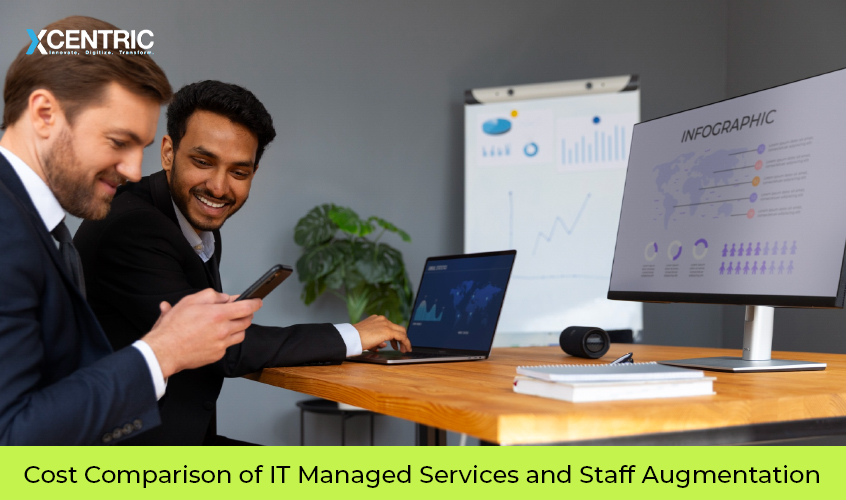
When considering budget-friendly IT staff augmentation services, clients often use a simplified explanation of costs. While examining hourly rates, they draw partial, sometimes erroneous conclusions.
For a more completed understanding of costs, one must consider the total cost of ownership (TCO) along with direct costs. Factors like management efforts, the duration of a staff integration process to a team, and the balance of operations must be considered as well.
Cost Factors | Staff Augmentation | IT Managed Services |
Initial Investment | Low (minimal upfront commitment) | Moderate (onboarding and setup costs) |
Long-Term Cost | Variable (depends on usage) | Predictable (fixed contracts) |
Flexibility Cost | Minimal (scale as needed) | Higher (changes may require renegotiation) |
Hidden Costs | Management oversight, onboarding time | SLA constraints, change request fees |
For the staff augmentation of a specific project or a rapid scaling of operations, costs are also lower in the short term. In the longer term, a stable, managed service becomes relatively cost-efficient.
Best Practices for IT Leaders for Staff Augmentation
There are many benefits to staff augmentation, but the usability of this tool is defined largely by how well staff augmentation is executed. When executed poorly, inefficiencies are a likely outcome. When executed well, positive team performance is very likely.
The following staff augmentation best practices are the most likely to lead to successful outcomes:
1) Roles, deliverables, and how to measure success should be defined, and communicated, before staff are placed.
2) Utilize companies that have excellent, fully-vetted staff.
3) Augmented staff should be integrated as employees as soon as possible.
4) Project management and communication should be firmly structured.
5) Team structure should be flexible and respond to the outcomes of constant evaluation.
Treating augmentation as a valued capability, as opposed to a stop-gap measure, will lead to the best outcomes.
Hybrid IT Model: The Best of Both Worlds

More and more organizations are combining, instead of choosing, IT models. A Hybrid IT model allows companies to obtain the benefits from both types of services. Managed services concentrate on handling services that have less variability and can be repeatedly performed.
Staff augmentation services maintain focus on handling innovative and transforming services that require immediate and critical attention.
This hybrid model gives IT managers the ability to maintain the level of operational services required and the ability to retain the readiness to meet the ever-changing requirements of businesses.
Why Choose Xcentric for IT Managed Services or Staff Augmentation?
Xcentric is a company with a different approach to IT staff augmentation with focus on partners from the United States. Xcentric provides precise and rapid IT staff augmentation bringing reliability to each of the IT staff additions.
Professionals that are on staff have both technical expertise and outstanding communication skills
There is a time synchronization staff alignment with U.S. culture
Rapid and urgent deployment is met with unrelenting and immediate employee presence on the job
Attrition, as well as managed IT services, depends on the dynamic of your expanding business and your emphasis. If the business provides services that are dynamic and focused on new ideas, staff augmentation fits your needs faster and with less hassle. Adding staff means you want to expand fast. Xcentric provides its customers with IT staff augmentation as a means to expand your business. Xcentric has the IT staff services you need.
Conclusion
In case multiple employees are needed and there is scaling, that scaling is met with an immediate disruption in service. Integration into teams is rapid and employee presence is unrelenting. In the case of multiple employees required to meet various and changeable demands and requirements, that scaling is met with immediate flexibility.
Rapidentry work is immediate and self displacing. In the case of IT staff addition in the United States, operational alignment of requirements is very high. When requirements are numerous and delivery is expected to be rapid, that work can be injurious to work. Your company can meet the demands of the high tech rapid requirements of the digital world. Xcentric offers expert IT staff augmentation. We help your team engage without the slow traditional hiring process.
Try doing the following with Xcentric, without all the hours to construct a new team.
Onboard competitors' developers and engineers within days
Manage how the team performs and their output
Forget about the long hiring process and the teams
Make your firm a fountain of new ideas instead of a solid rock
Our staff are adept at nearly every IT discipline, from software development to technical specialists to entire engineering units. Xcentric staff augmentation has a solution designed specifically for you.
Frequently Asked Questions
What is staff augmentation vs managed services?
Staff augmentation essentially provides you with more hands (staff). Managed services gives you responsibility over the provider, beyond a specific outcome.
Is staff augmentation cheaper than managed services?
Generally, staff augmentation is cheaper in the short-term compared to managed services because you pay only for the resources you need. Managed services, on the other hand, may lower the long-term value of staff augmentation services. This is because managed services add value by lowering the operational cost and management services.
What is the difference with both models?
Delivering staff augmentation places the delivery risk on the client. Managed services, however, the provider is accountable to the customer for the outcomes.
What does SaaS managed services include?
SaaS managed services provides a layering and contracting structure over the delivery services to a provider, which ensures that the right outcomes are achieved. In addition, it adds accountability.
What is the downside to IT staff augmentation?
The risk to staff augmentation includes the time of the internal staff management services, the management of the departure of the augmented staff, and also the departure of that staff if that knowledge is not managed. These factors essentially define the overall TCO.
Is it possible for a company to implement both models together?
Yes! Many companies have a Hybrid IT Model by integrating managed services for predictable day-to-day operations and leveraging staff augmentation for specific project-based needs or short-term rapid growth.
Why are staff augmentation and outsourcing different?
The primary distinction between staff augmentation and outsourcing comes down to the management aspect. Staff augmentation retains management for resources being integrated. Whereas, with outsourcing, management and responsibility are fully extended to the vendor/supplier.
What are the differences between staff augmentation and consulting?
The unique disparity between staff augmentation and consulting is that consulting offers a higher level of assistance with a focus on strategic, tactical, or operations planning. Staff augmentation is leveraged to expand the workforce to get the job done.
In what ways are staff augmentation and independent contracting different?
Independent contractors have the freedom to work on their own styles and systems. Staff augmentation are more integrated with the company, working within company systems and procedures, and driven by company goals.
Share



Want To Increase Your Ranking On The Search Engines?
Get In Touch With Us!
Trending Blogs
Digital Marketing...
Xcentric Team
7 MONTHS AGO


What To Read Next?

For owners and managers of dental clinics in Lahore, here is a critical fact you...
Xcentric Team
7 MONTHS AGO

The Middle East e-commerce industry is rapidly growing due to increased digital acceptance, mobile-first consumers...
Xcentric Team
8 MONTHS AGO

These days, the e-commerce industry is growing at an exponential rate. With the rise of...
Xcentric Team
8 MONTHS AGO